

In the past several years, inflation and essential expenditures have been top of mind for Canadians. In the 2025 election, the rising cost of living consistently polled as the top issue for voters. A recent poll by Abacus Data showed cost of living as a top concern for 57% of respondents, with even the economy a distant second place at only 37%.
On a national average basis, rents are becoming more affordable compared to both Consumer Price Index (CPI) inflation and wages, but there are significant regional variations in these trends, which reflect a very different rental landscape in different provincial markets. In the highest-cost markets, Ontario and BC, rents have become more affordable relative to incomes in recent years, while in Nova Scotia, rents have outpaced both inflation and wage increases, with Nova Scotia now overtaking BC as the least affordable province for the average renter.
To gain a more complete picture of rent affordability for Canadians, rents need to be understood in the context of inflation and real wage growth, including regional variations between provinces. The difference between overall inflation and price inflation for core household needs is also a key consideration.
Inflation – Average vs. Essentials
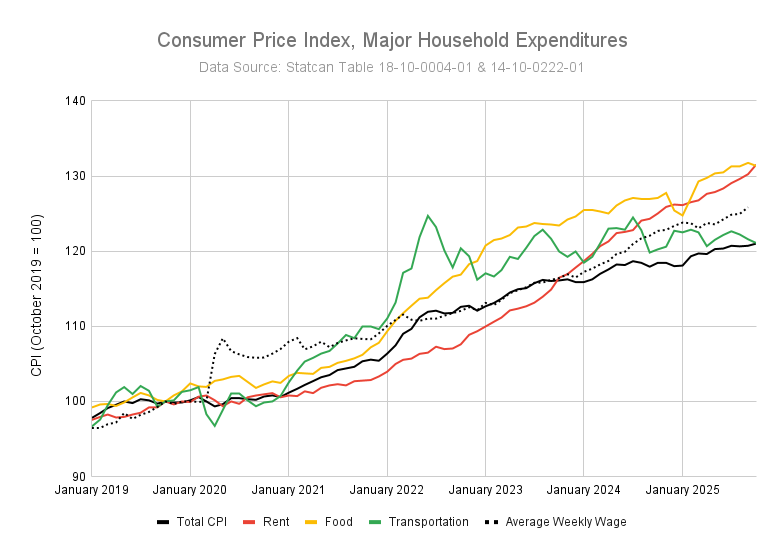
Although data from Statistics Canada has continued to show real wage growth compared to inflation, concerns about the cost of living are not unfounded. Of the top three household expenditure categories, only transportation has remained in line with the overall Consumer Price Index since the pre-pandemic period, with food and shelter outpacing both CPI inflation and wage growth. Inflation in these categories has resulted in additional financial strain for Canadians, particularly lower-income households, where essential expenditures make up a larger proportion of the household budget.
Asking Rents vs. Current Rents
While the CPI data from Statistics Canada measures current rents – the price of rent being paid by existing tenants – asking rents for units available to rent have shown a different trend. Current rents have shown a constant increase, due to the moderating effect of rent-controlled provinces. However, asking rents have been more volatile. During the pandemic, asking rents fell by approximately 10%, followed by a rapid three-year rise of approximately 30%, then a correction starting in mid-2024.
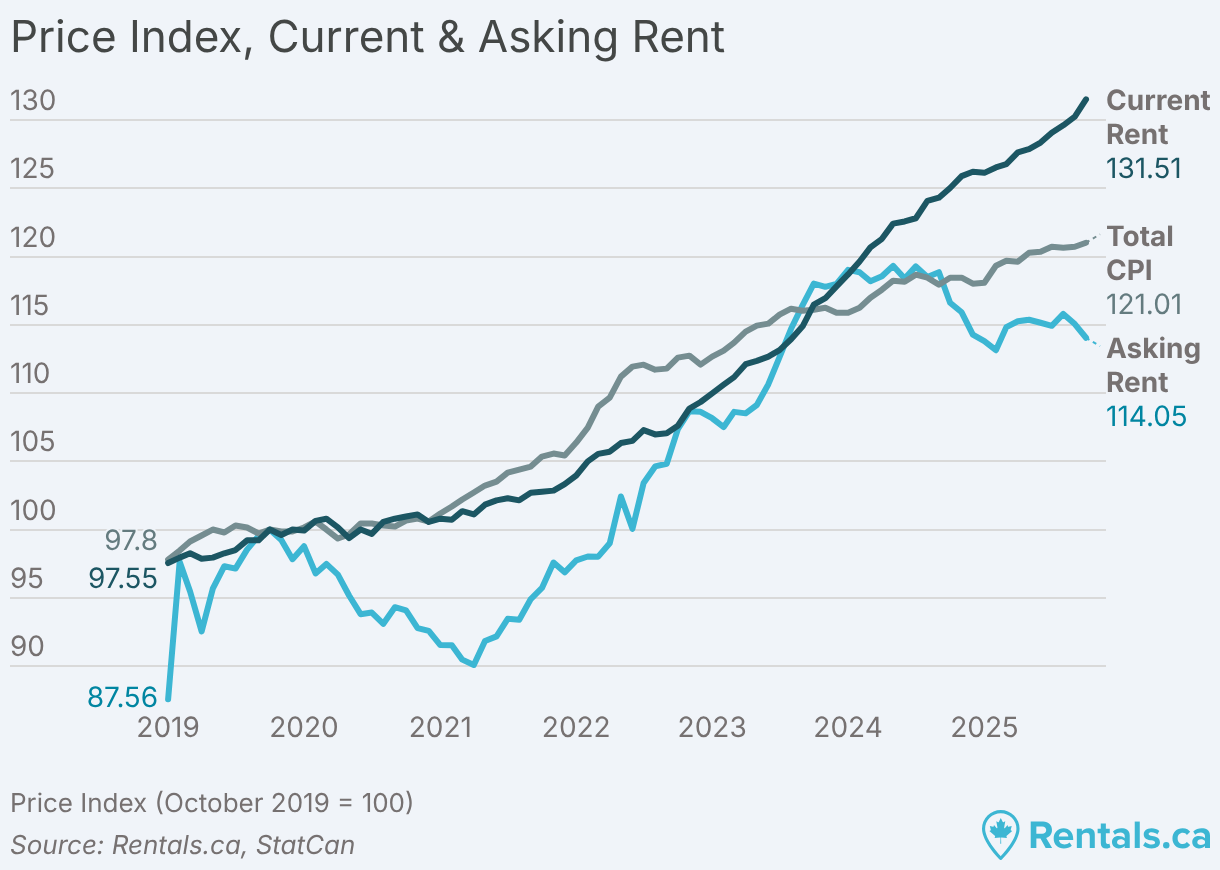
While average asking rents are affected by variables such as the composition of the available units (e.g. a large number of newly-completed units can push the average up), they are representative of the price for a new tenancy in a given market. Particularly in rent-controlled markets, current rents will often be significantly lower than asking rents, due to the baseline effect of existing long-term tenants, making asking rents more representative of the true cost of moving to (or within) a city. As a result, current rents tend to rise consistently every year, while asking rents are more volatile and respond quickly to changes in the balance of supply and demand.
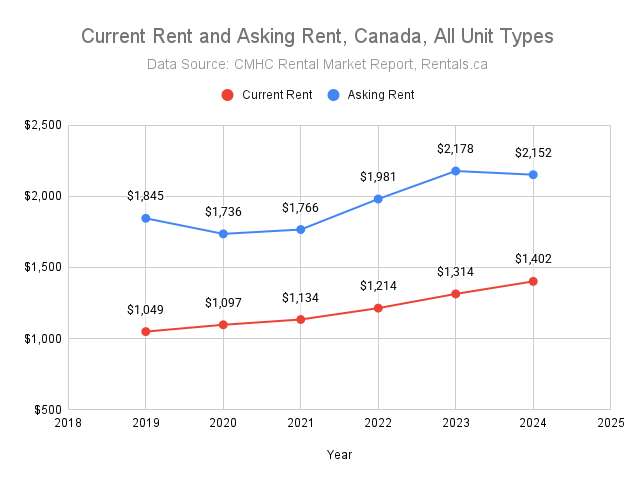
Note: Data reported in October of each year to align with CMHC’s annual Rental Market Report
With the spread between asking rents and current rents remaining relatively large, CMHC data also shows that turnover rent increases are also quite significant, particularly in rent-controlled markets. An average difference in current to market rent of $750 per month creates a significant financial disincentive for tenants to leave a rent-controlled lease for a new unit, leading to a suppression of turnover rates, as tenants opt to stay longer in their current rental.
Regional Variations – Asking Rents and CPI Inflation
While CPI inflation varies only slightly from province to province, the regional variation in asking rents is much larger:
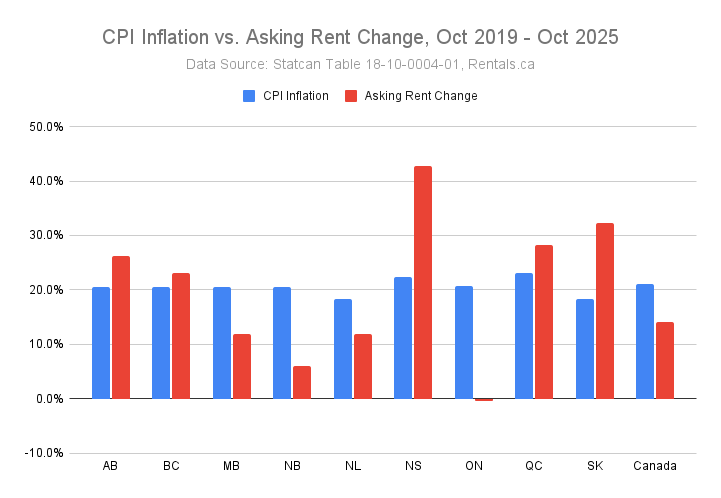
On a relative basis, average asking rents in Canada increased less than the overall Consumer Price Index over the past six years. However, this was largely driven by Ontario, with asking rents in Alberta, Saskatchewan, Quebec and BC slightly outpacing overall inflation. Surprisingly, asking rents in Ontario were nearly flat over a six-year period (-0.5%), owing to larger-than-average declines in asking rents during the pandemic and the 2024 correction, as well as high baseline rents in 2019. This trend may continue as more existing condo stock is pushed into the secondary rental market.
Regional Variations – Asking Rents and Average Wages
Similar to CPI inflation, there is more variation in asking rent growth compared to wage growth, but the spread in wage growth is also significant, ranging from 14.5% in Alberta to 30.3% in Quebec.
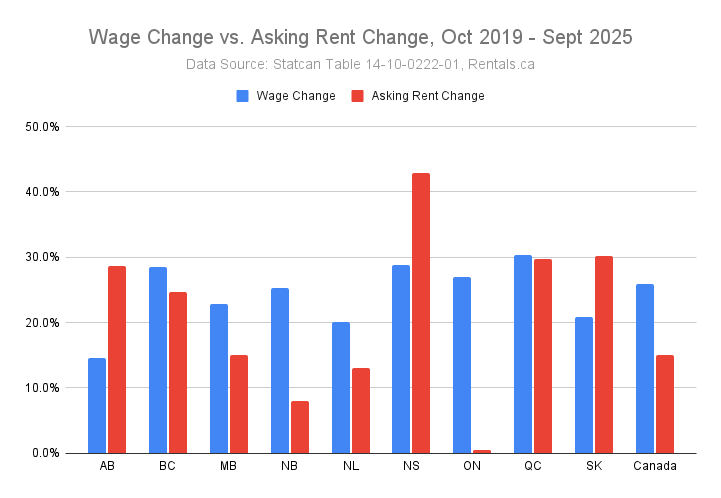
Alberta, Saskatchewan, and Nova Scotia saw asking rents outpace wage growth over the past six years, while all other provinces and the national average showed wages growing faster than asking rents. Alberta has seen the largest increase in rents relative to wages, due to slower-than-average wage growth. However, weekly wages in Alberta have been the highest of any province since at least 2019, so the relative cost of rent still remains significantly more affordable than the national average.
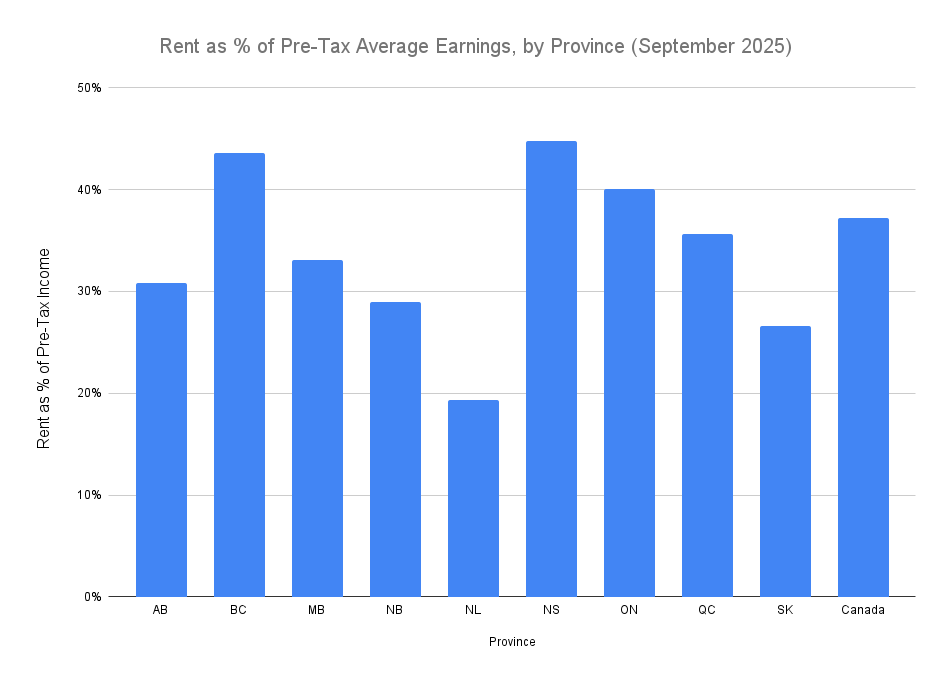
Nova Scotia Overtakes BC as Least Affordable Province to Rent
Although average asking rents in Nova Scotia still remain lower than those in British Columbia and Ontario, the sustained above-average increases in asking rents, combined with relatively average wage growth, have resulted in Nova Scotia overtaking BC as the most expensive province to rent in, as a percentage of average pre-tax earnings, since March 2025.
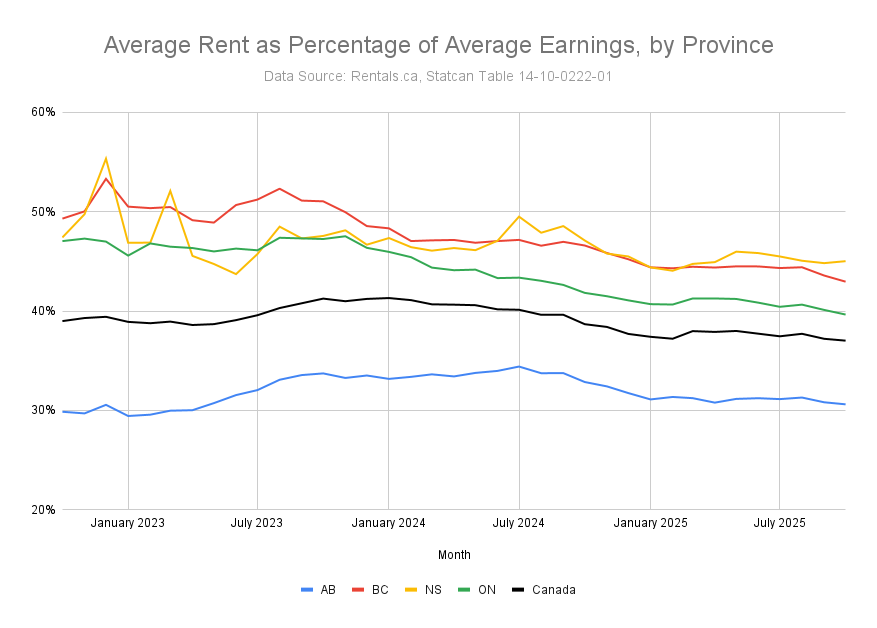
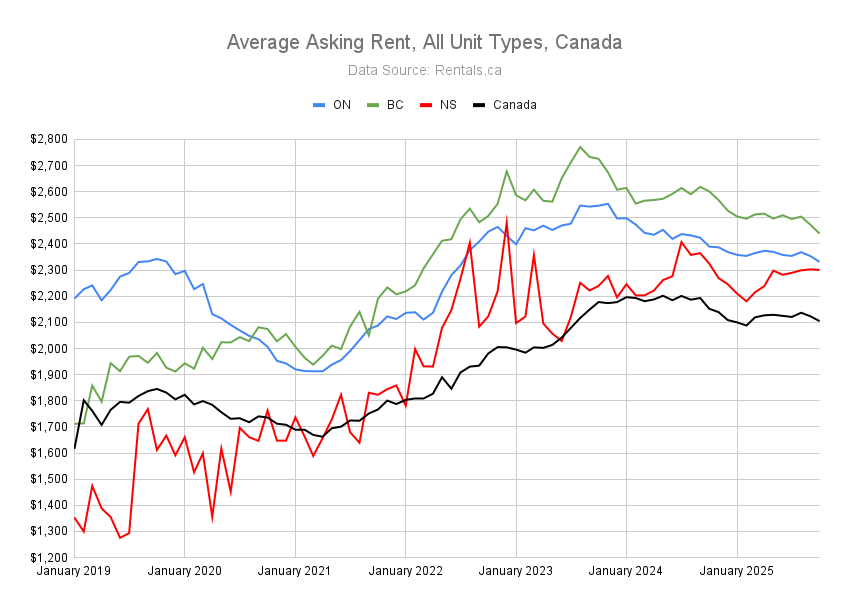
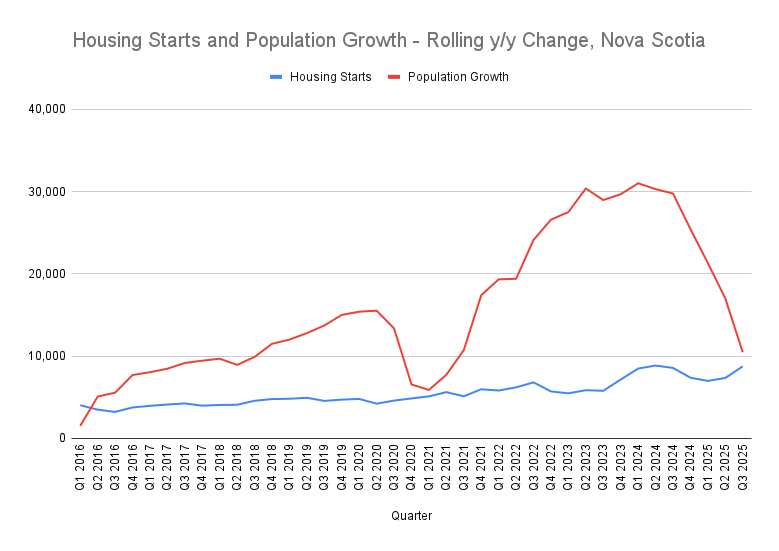
Nova Scotia’s rapid rise in housing costs corresponds to years of increasing population growth with a proportionally smaller increase in housing starts, particularly in the years after the pandemic, driven by both international and interprovincial migration. However, with recent changes to federal immigration rules, population growth has slowed rapidly while housing starts remain elevated, which should create some downward pressure on prices as new units enter the market. In the longer term, this demographic shift could disincentivize new construction, leading to another supply shortage in the future.
Relative Changes
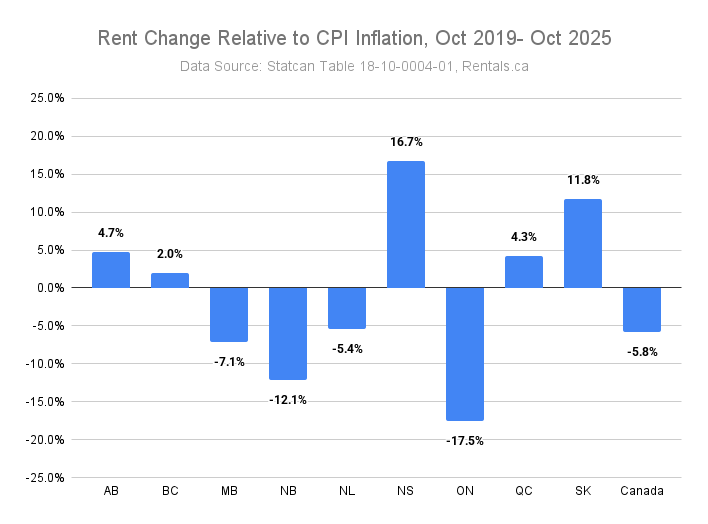
On a national level, asking rent change relative to CPI inflation has been negative (-5.8%), but this is primarily driven by negative real rent growth in Ontario (-17.5%). Asking rents outpaced CPI inflation in Alberta, BC, Nova Scotia, Quebec, and Saskatchewan. Nova Scotia saw the largest increase in real asking rents (+16.7%)
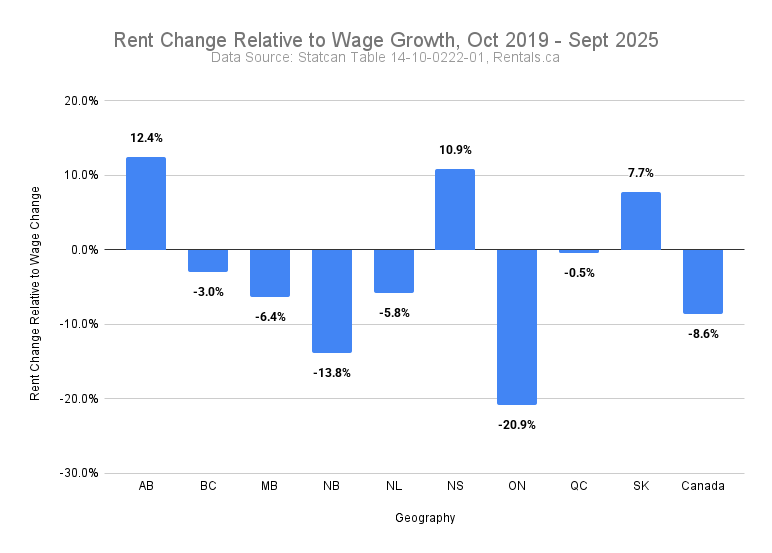
The relative change in asking rents compared to wage growth is similar – the national wage-adjusted rent declined (-8.6%), driven mainly by Ontario (-20.9%). Quebec, which saw positive rent growth compared to CPI inflation (+4.3%), also had the highest wage growth in the country, resulting in a slight decrease in wage-adjusted rents (-0.5%). Alberta, Nova Scotia, and Saskatchewan all saw rent growth outpace wage growth, with the largest wage-adjusted increase in Alberta (+12.4%), which also had the lowest wage growth in the country.
Conclusion
Despite current rents out-pacing overall CPI inflation, national average asking rents have fallen relative to both inflation and wages compared to the pre-pandemic period. However, the variation across provinces has been significant, with the decrease in the national average being largely driven by Ontario, while many other provinces, particularly Nova Scotia, have seen asking rents continue to rise relative to wages and overall inflation.
With housing being a top priority for governments across the country, the variation in regional trends highlights the need for strategies tailored to individual regions, requiring coordination between federal, provincial and municipal governments. Care must be taken to ensure that new construction remains viable on an ongoing basis, to avoid volatile “boom-and-bust” cycles, which create uncertainty for investors, developers, and tenants.

Rentals.ca is Canada’s premier online marketplace for renters and landlords, providing a comprehensive suite of tools and resources tailored to simplify the rental process. With an extensive selection of listings across the country, Rentals.ca offers user-friendly search functionality that helps renters find their perfect home efficiently. For landlords, Rentals.ca delivers effective advertising solutions to maximize visibility and fill vacancies faster. Committed to innovation and excellence, Rentals.ca aims to empower users with up-to-date market insights and expert guidance, making renting easier and more accessible for everyone.