
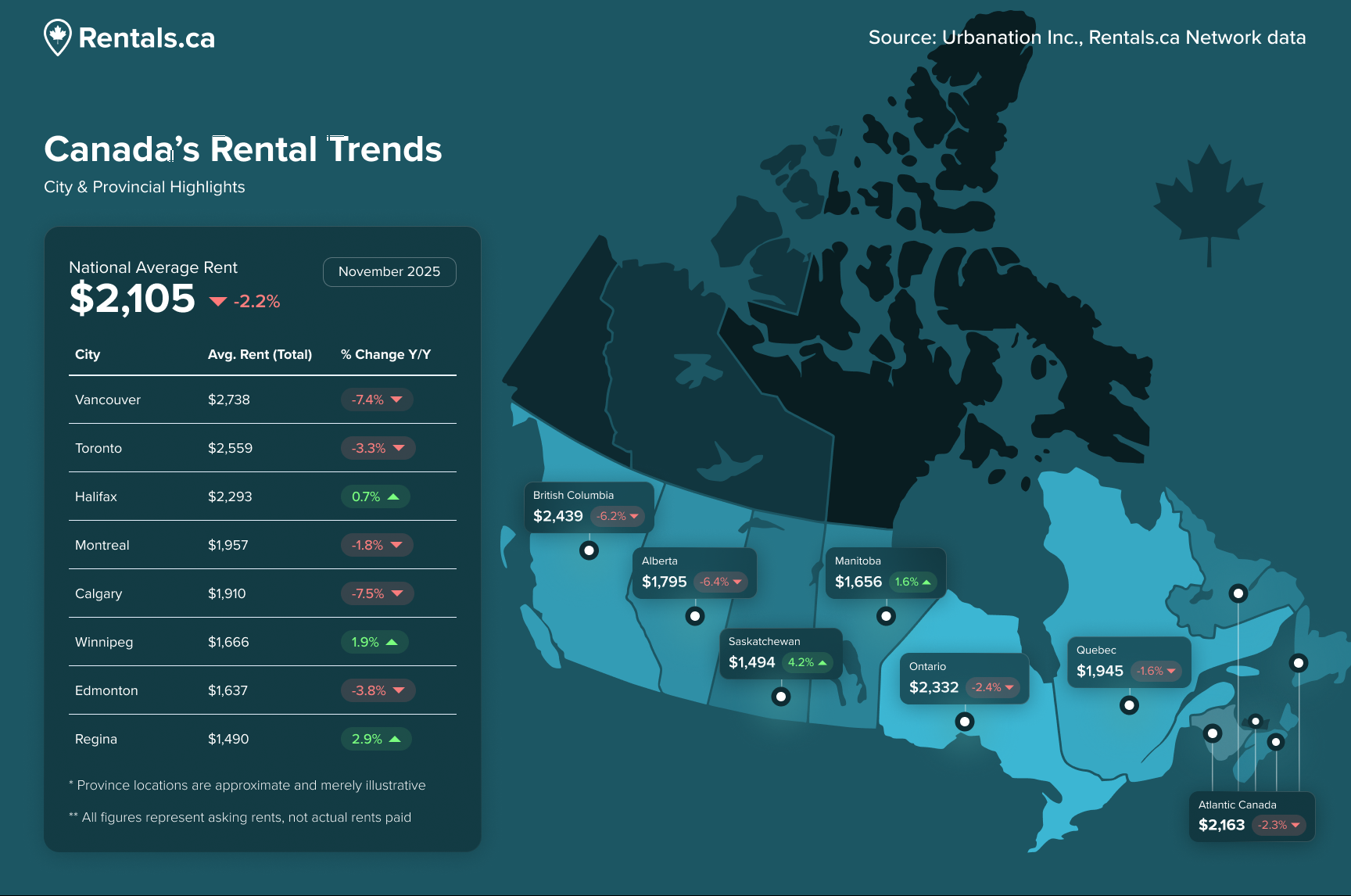
November 2025 Rent Report Highlights
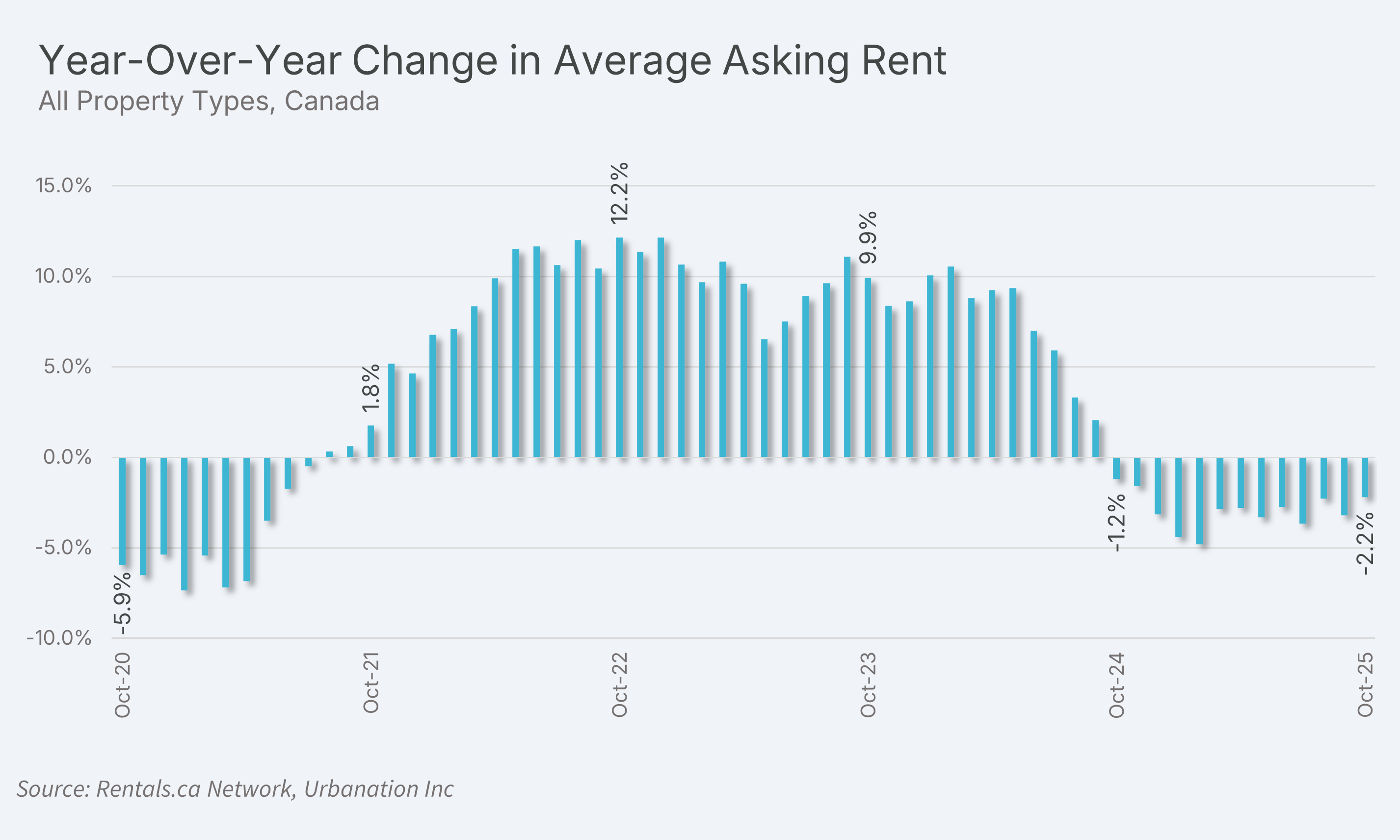
- Rents declined year-over-year for the 13th consecutive month, but the 2.2% annual drop in October was the smallest in nearly a year, suggesting a softening in declines.
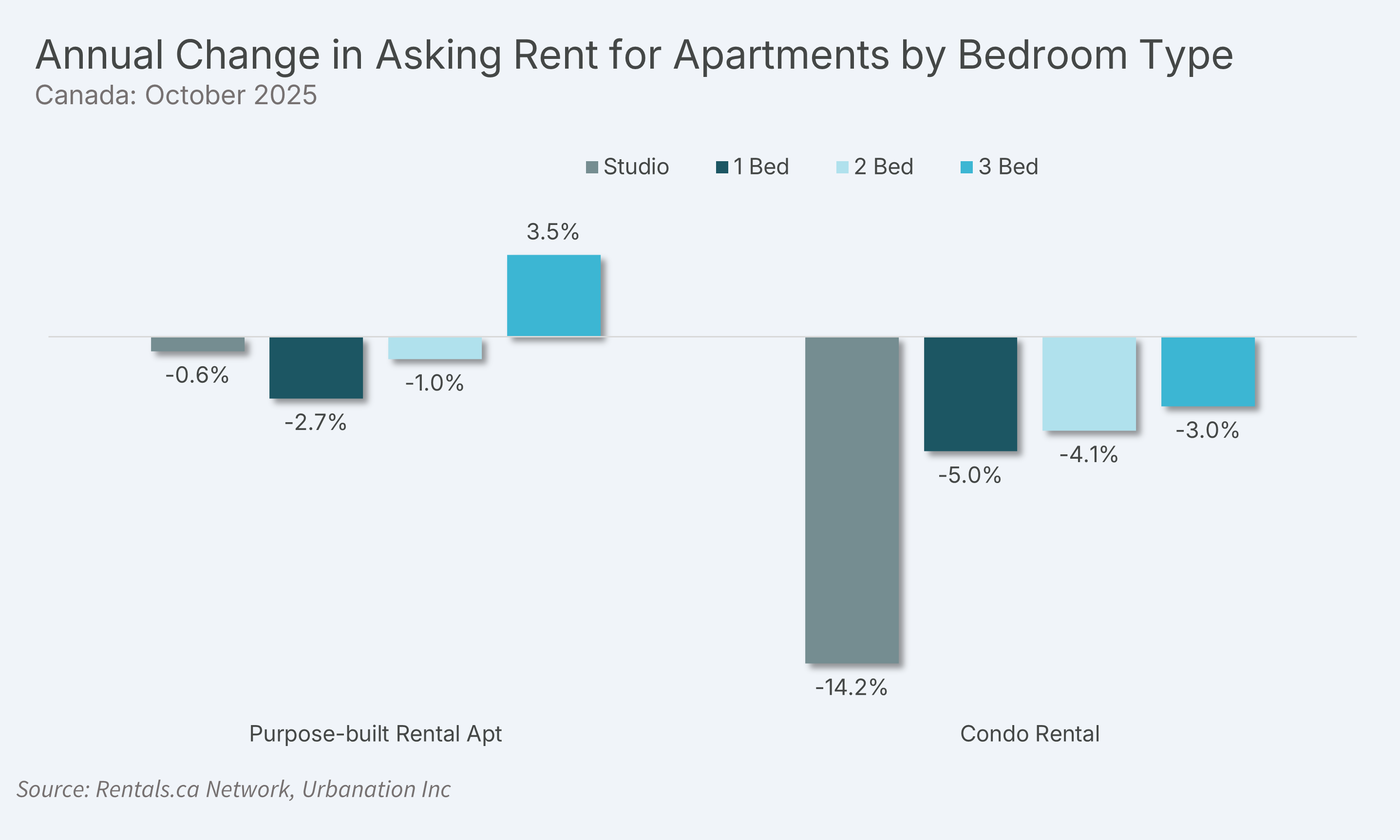
- Purpose-built rentals remained stable (-0.7% YoY), while studio condo rents fell sharply (-14.2%), and three-bedroom purpose-built units rose (+3.5%).
- Western provinces led the decline in rents, with B.C. (-5.8%) and Alberta (-5.3%) posting the steepest drops; Saskatchewan and Manitoba saw rents rise by 1.8%.
- Vancouver and Toronto rents hit multi-year lows, while shared accommodation rents fell to a 28-month low, led by double-digit declines in B.C. and Alberta.
National Overview
Rent Declines Soften in October
Asking rents in Canada averaged $2,105 in October, declining 2.2% from a year ago, and down 3.4% from two years ago. Rents remained 6.2% higher than three years earlier in October 2022. Compared to the pre-COVID average in October 2019, rents have risen 14.0%, or by $259 per month.
While rents declined on an annual basis for the 13th month in a row, the year-over-year decline in October was the smallest of the past 11 months.
Rental demand continued to decline in October, marking the third straight month of reduced renter activity. With levels tracking near historic lows and winter approaching, Canada is on pace to experience the slowest winter of rental demand in recent years.
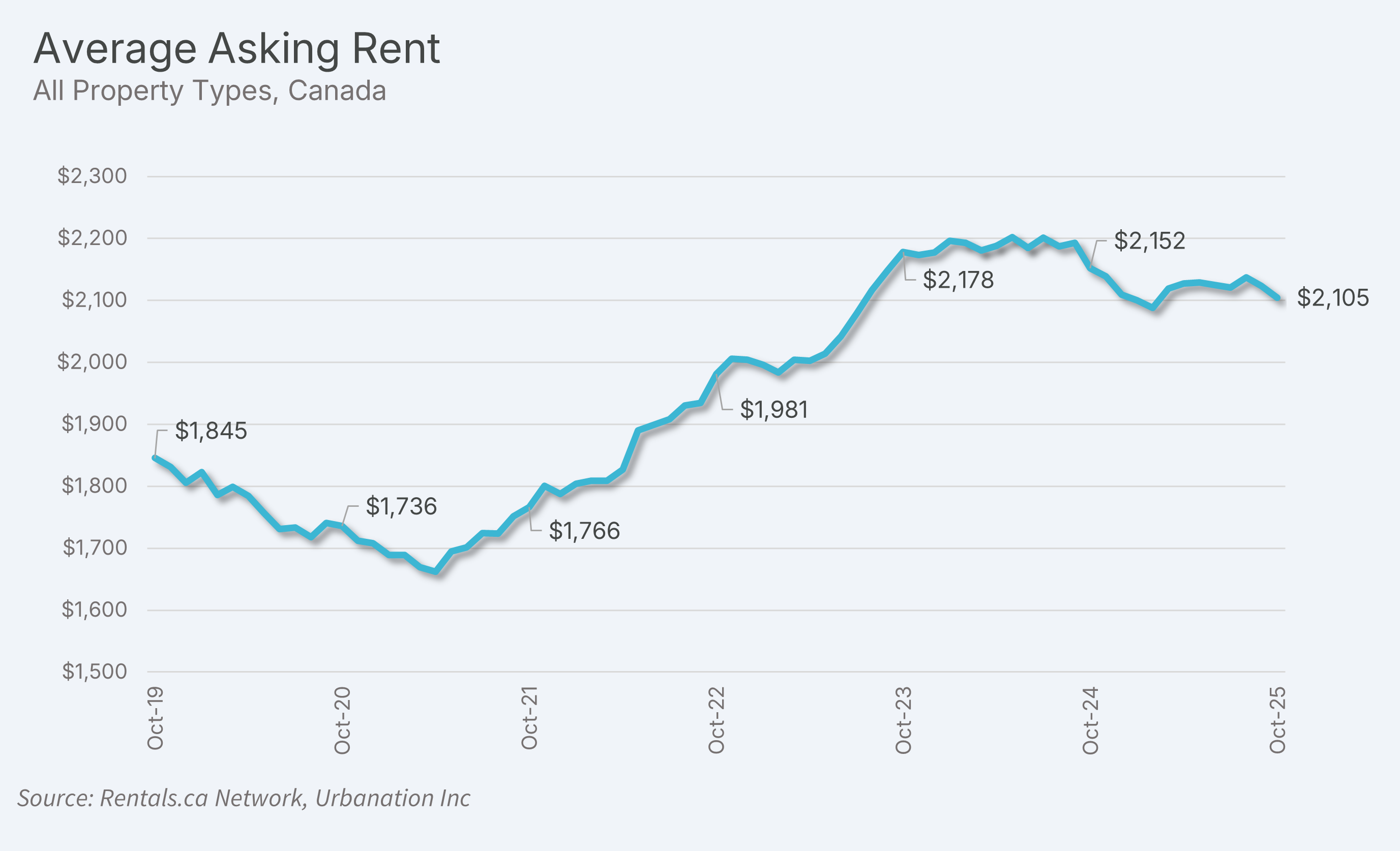
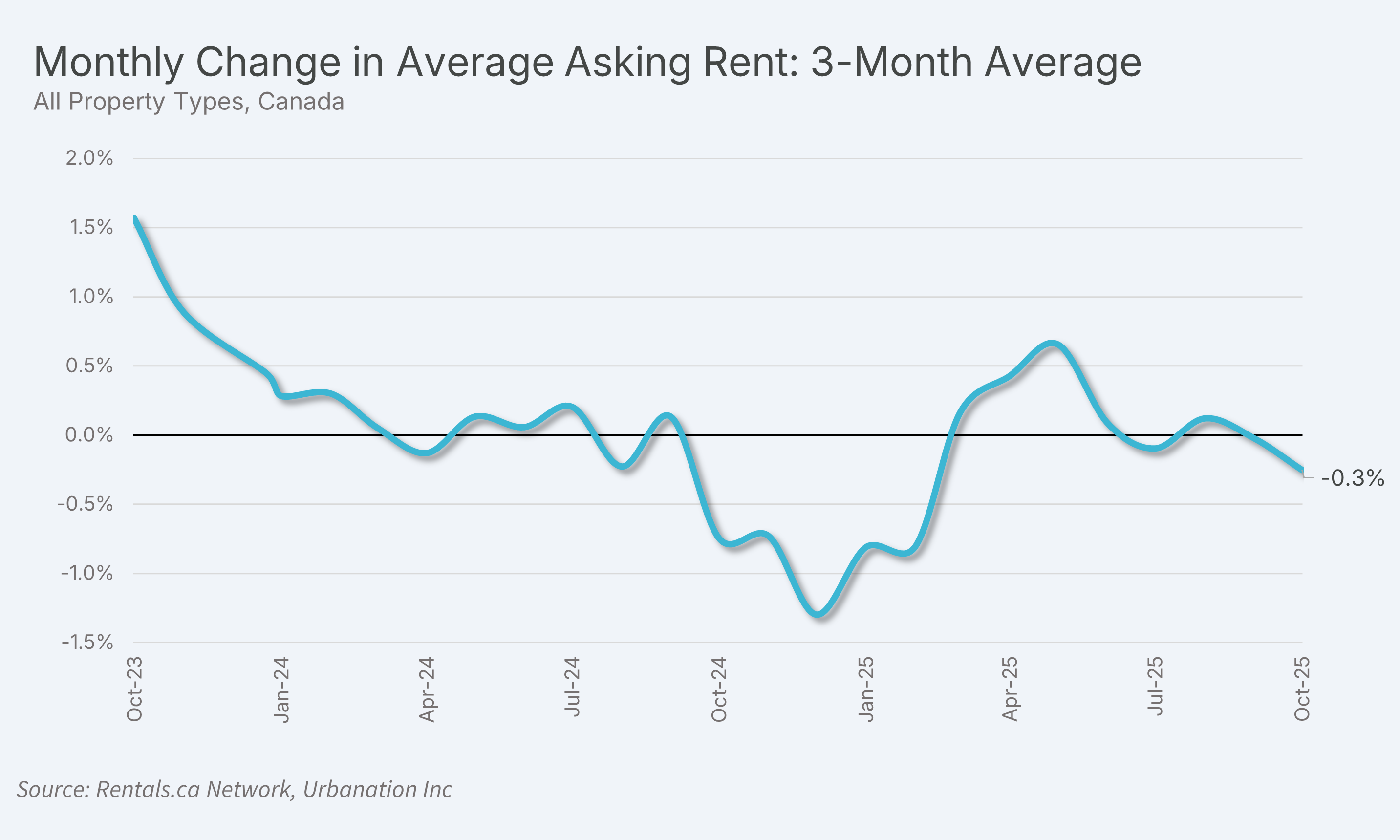
As the market entered its typical seasonal slowdown during the fall, asking rents decreased 0.9% month-over-month to reach an eight-month low. The latest three-month average change was down 0.3% from September.
Purpose-built Rents Down by Less than 1%
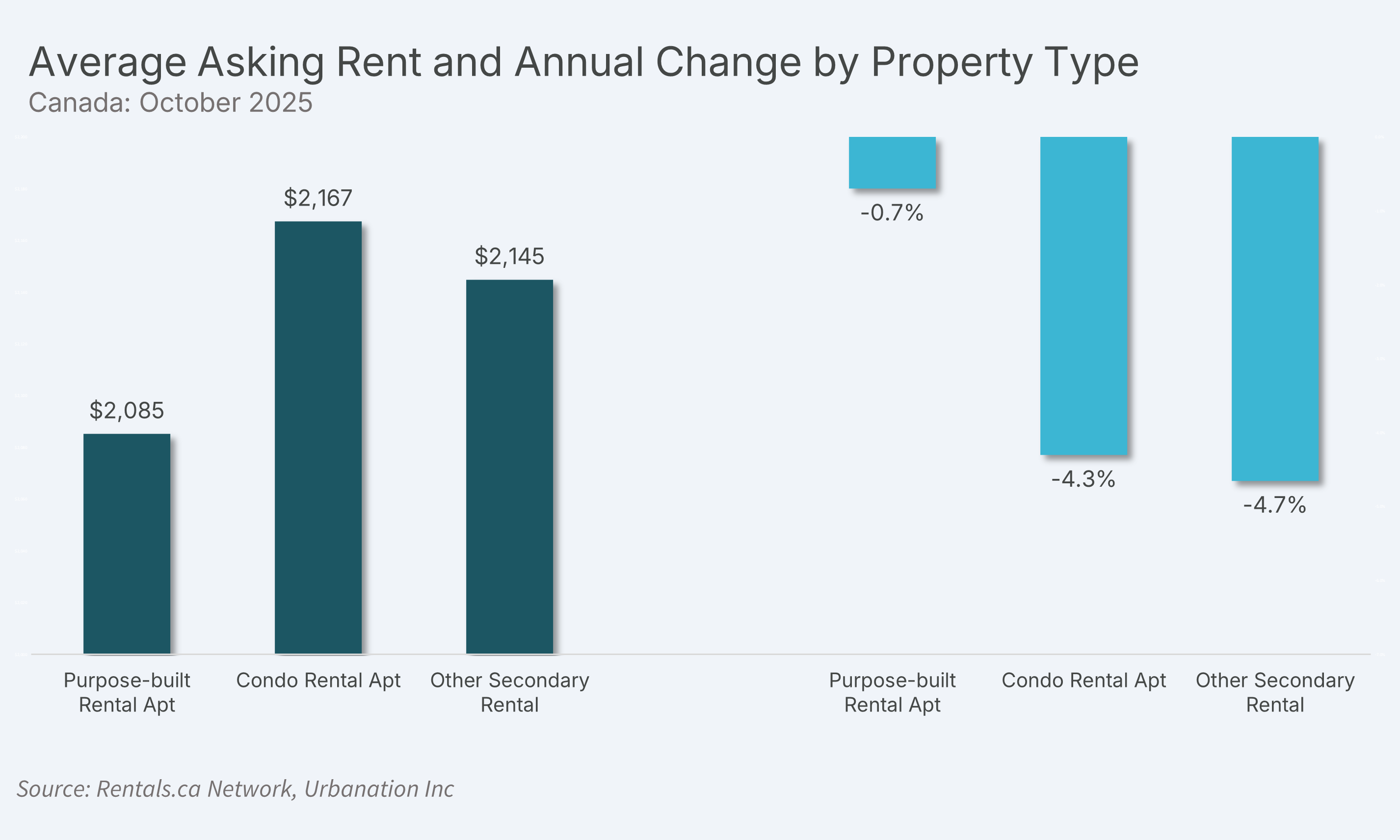
Asking rents for purpose-built rental apartments declined by only 0.7% from last year to an average of $2,085. Meanwhile, condo units and other secondary market rentals saw annual rent declines of 4.3% and 4.7%, respectively, but remained more expensive than apartments on average.
Three-Bedroom Rents Steadiest
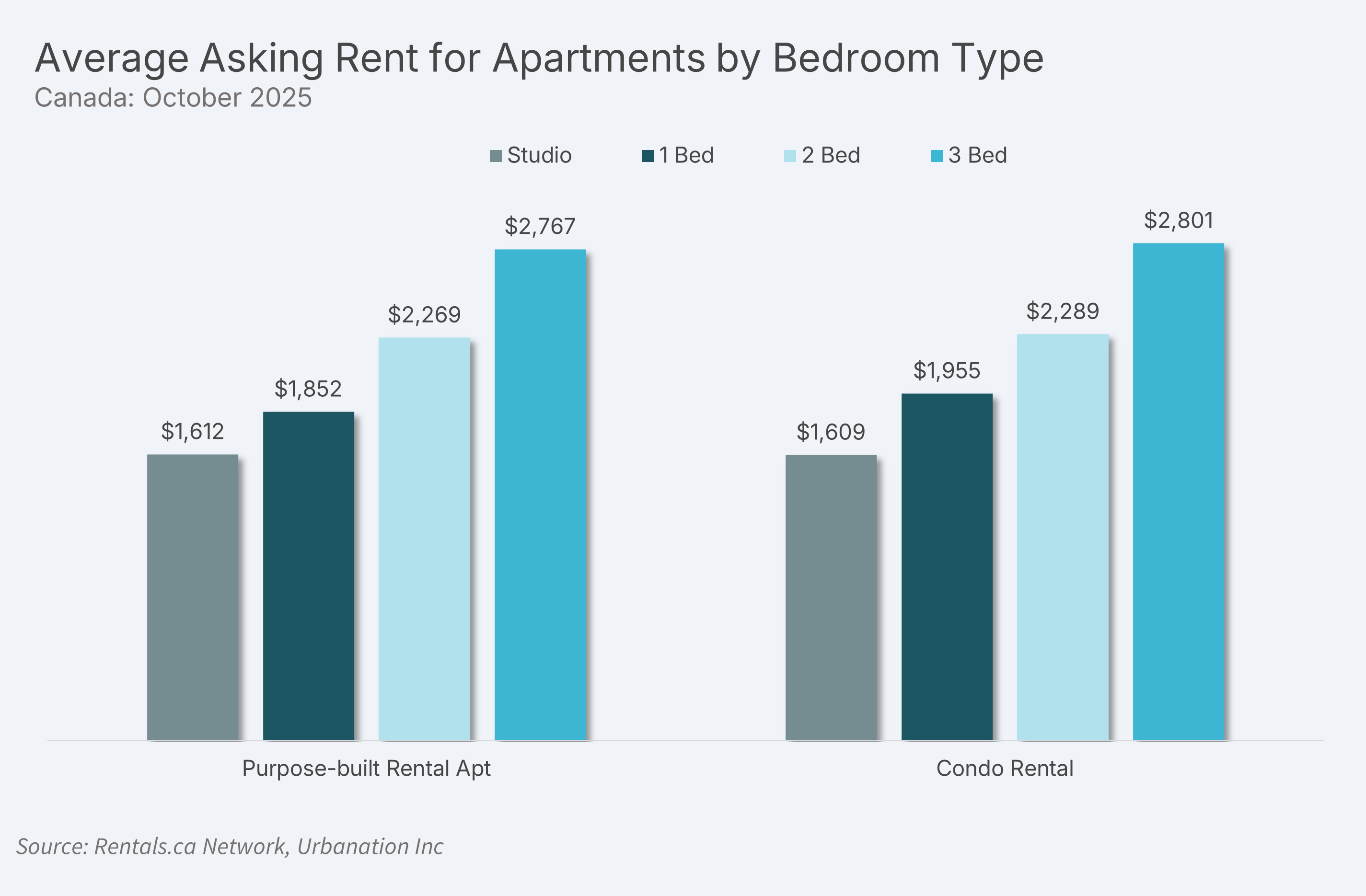
Across all property types, one-bedroom units recorded the largest annual rent decrease of 3.4% to an average of $1,822. Three-bedroom rents were the steadiest, decreasing by 0.2% from last year, to an average of $2,539. The largest and most expensive rentals were four-bedroom-plus units, which averaged $2,944, a 2.5% decline from a year ago. The smallest and least expensive rentals, studios, saw rents decline 1.5% annually to an average of $1,610. Two-bedroom rents averaged $2,200 — a 1.7% year-over-year decrease.
Studio Condo Rents Drop 14%
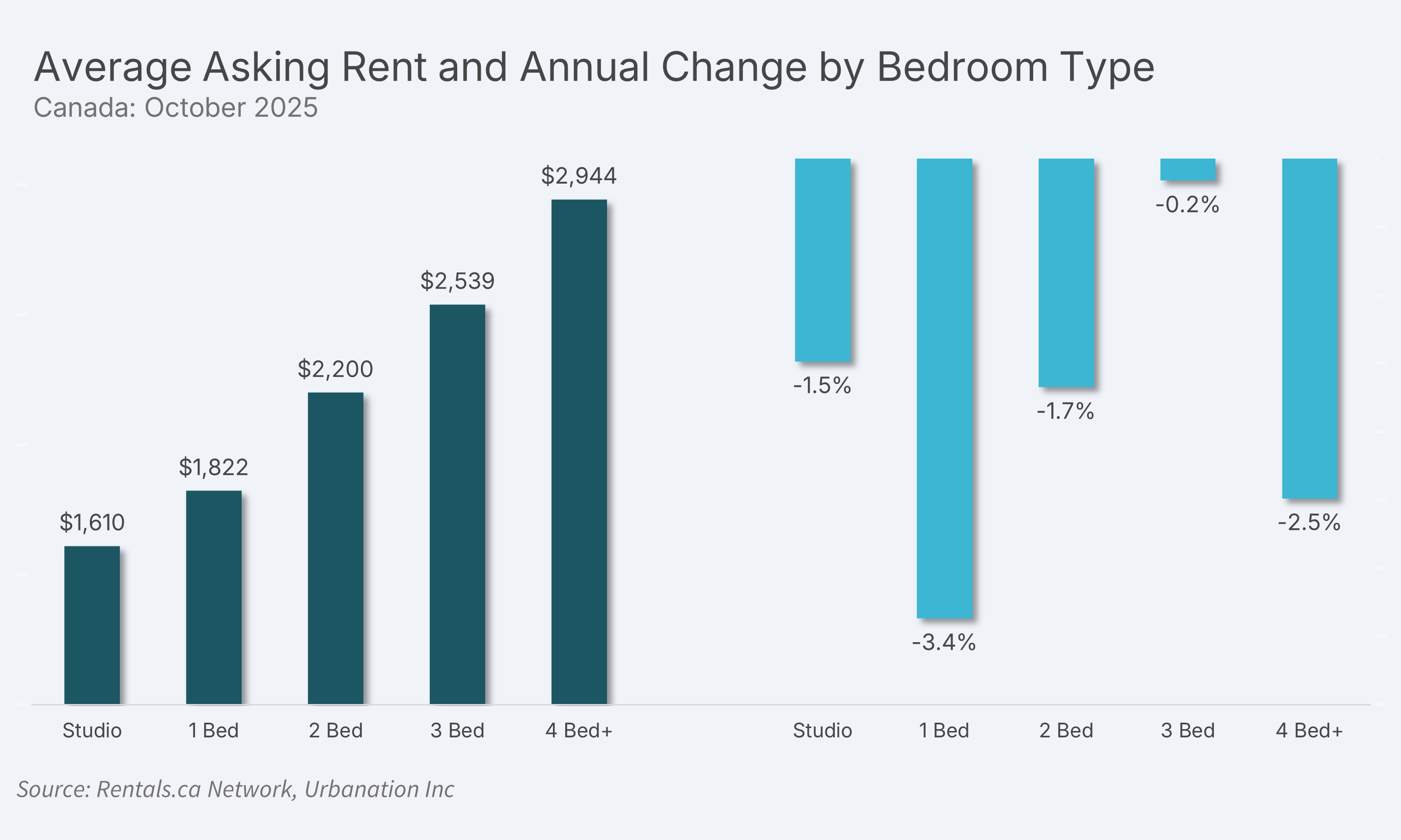
Average rents for three-bedroom purpose-built rentals increased 3.5% annually to $2,767. All other bedroom types for purpose-built and condo apartments recorded annual rent decreases, led by a 14.2% drop for studio condo units to an average of $1,609.
Rents Falling Fastest in Western Canada
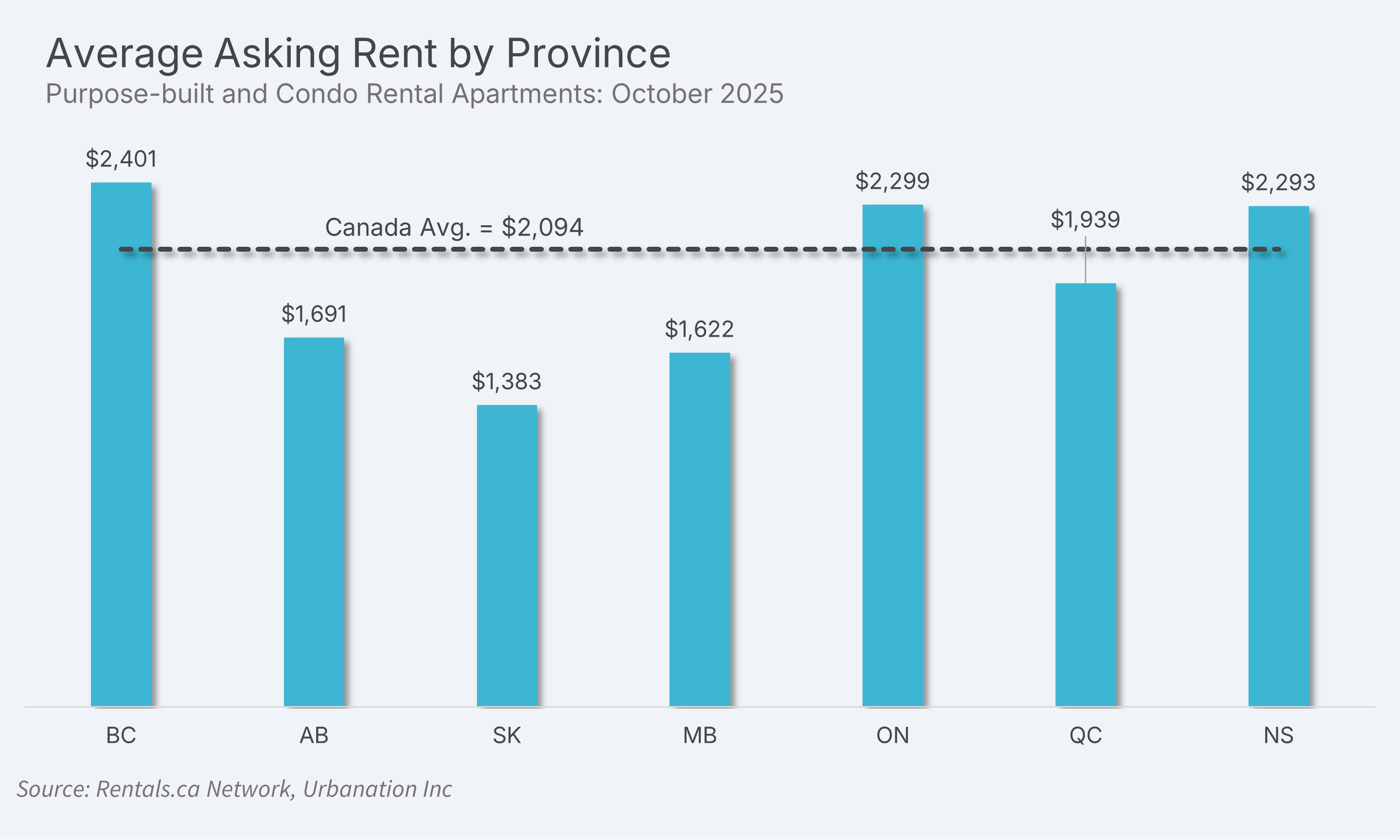
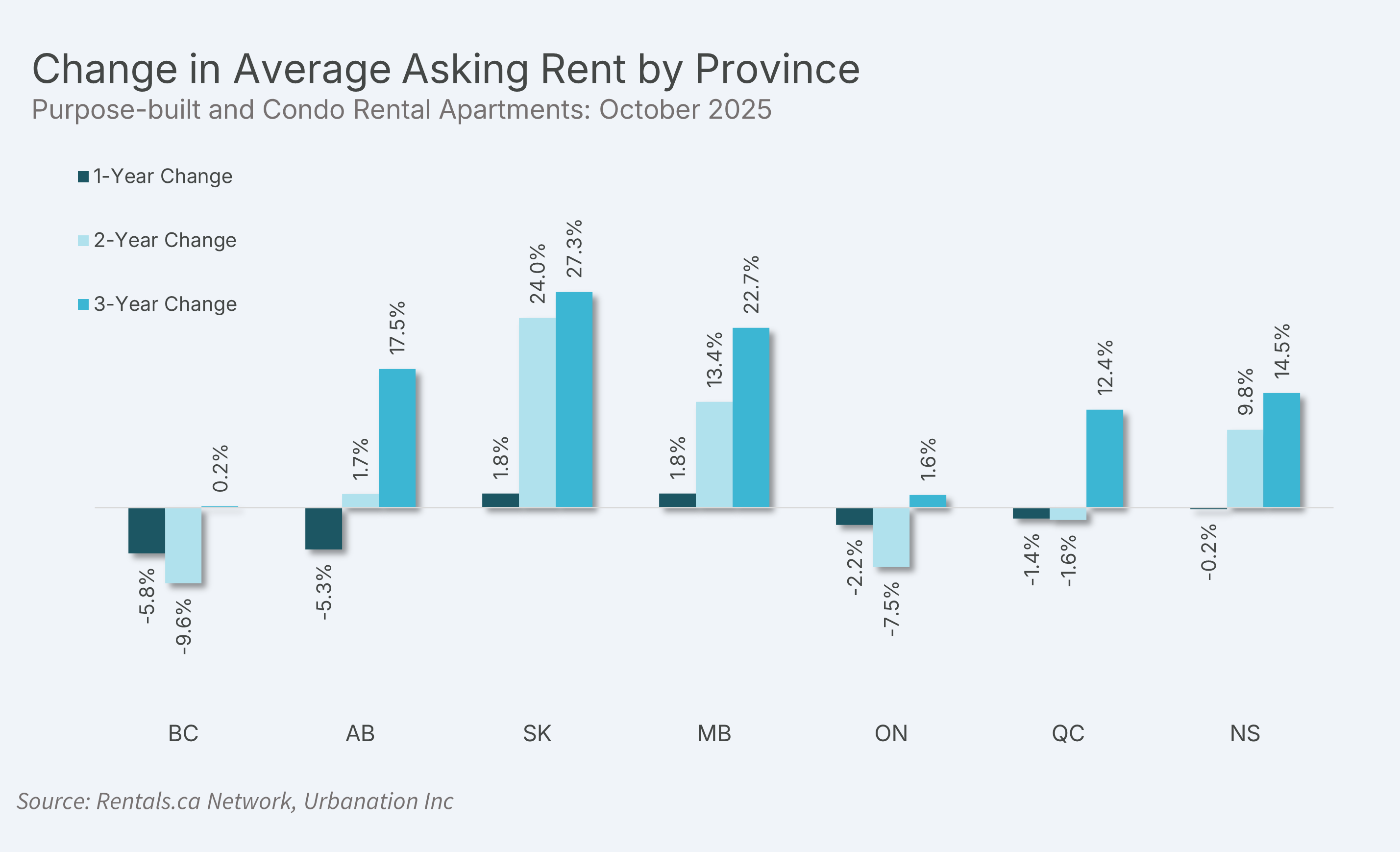
Combined asking rents for purpose-built and condo apartments averaged $2,094 in October, a 1.3% decrease from last year. Annual declines for average apartments were steepest in B.C (-5.8% to $2,401) and Alberta (-5.3% to $1,691), with milder decreases seen in Ontario (-2.2% to $2,299), Quebec (-1.4% to $1,939), and Nova Scotia (-0.2% to $2,293). Meanwhile, average apartment rents continued to rise in the lowest cost provinces of Saskatchewan (+1.8% to $1,383) and Manitoba (+1.8% to $1,622).
Compared to two years ago, average apartment rents were down 9.6% in B.C, 7.5% in Ontario, and 1.6% in Quebec. All other provinces saw rent increases from two years ago, led by a 24.0% rise in Saskatchewan.
Two-Bedroom Rents in B.C. Fall More than 6%
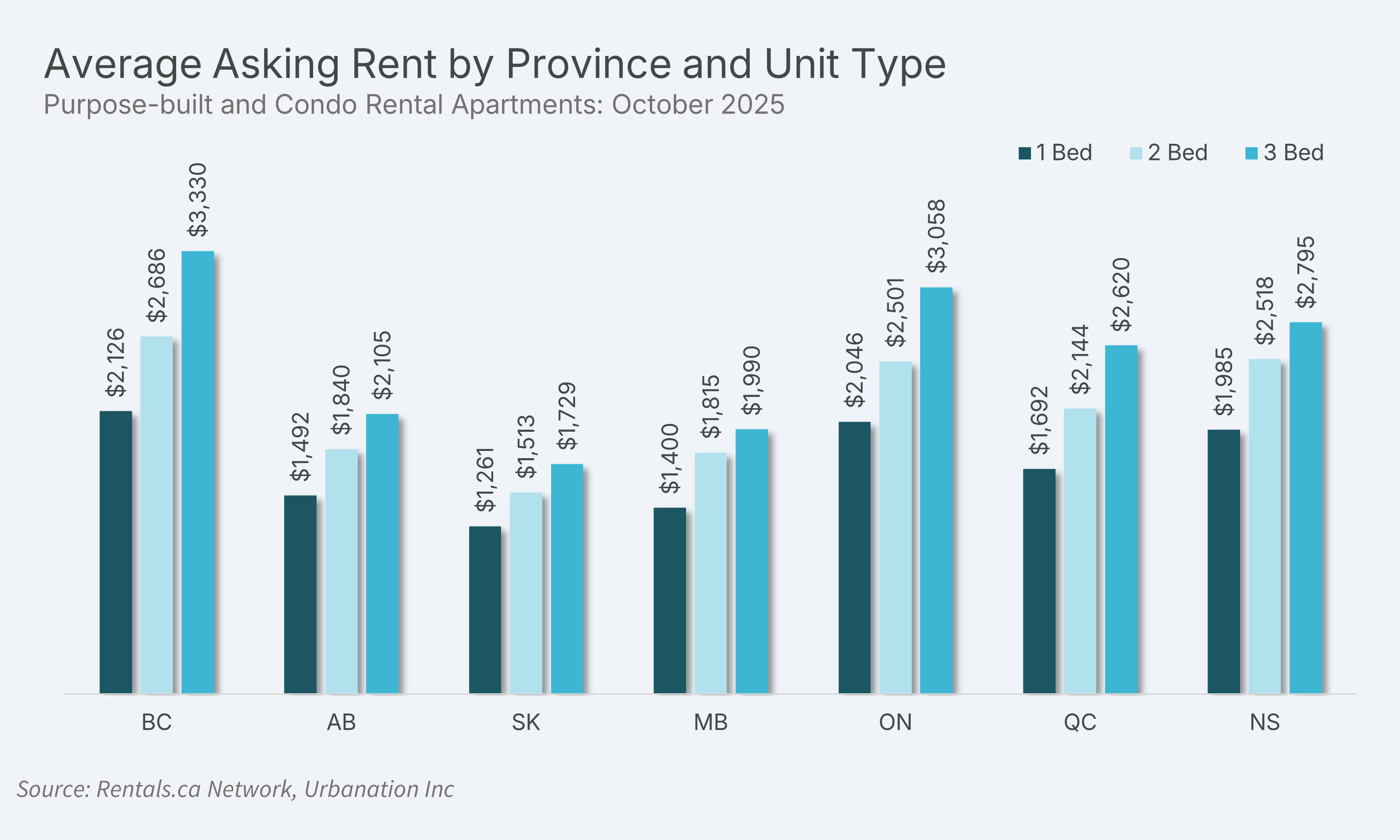
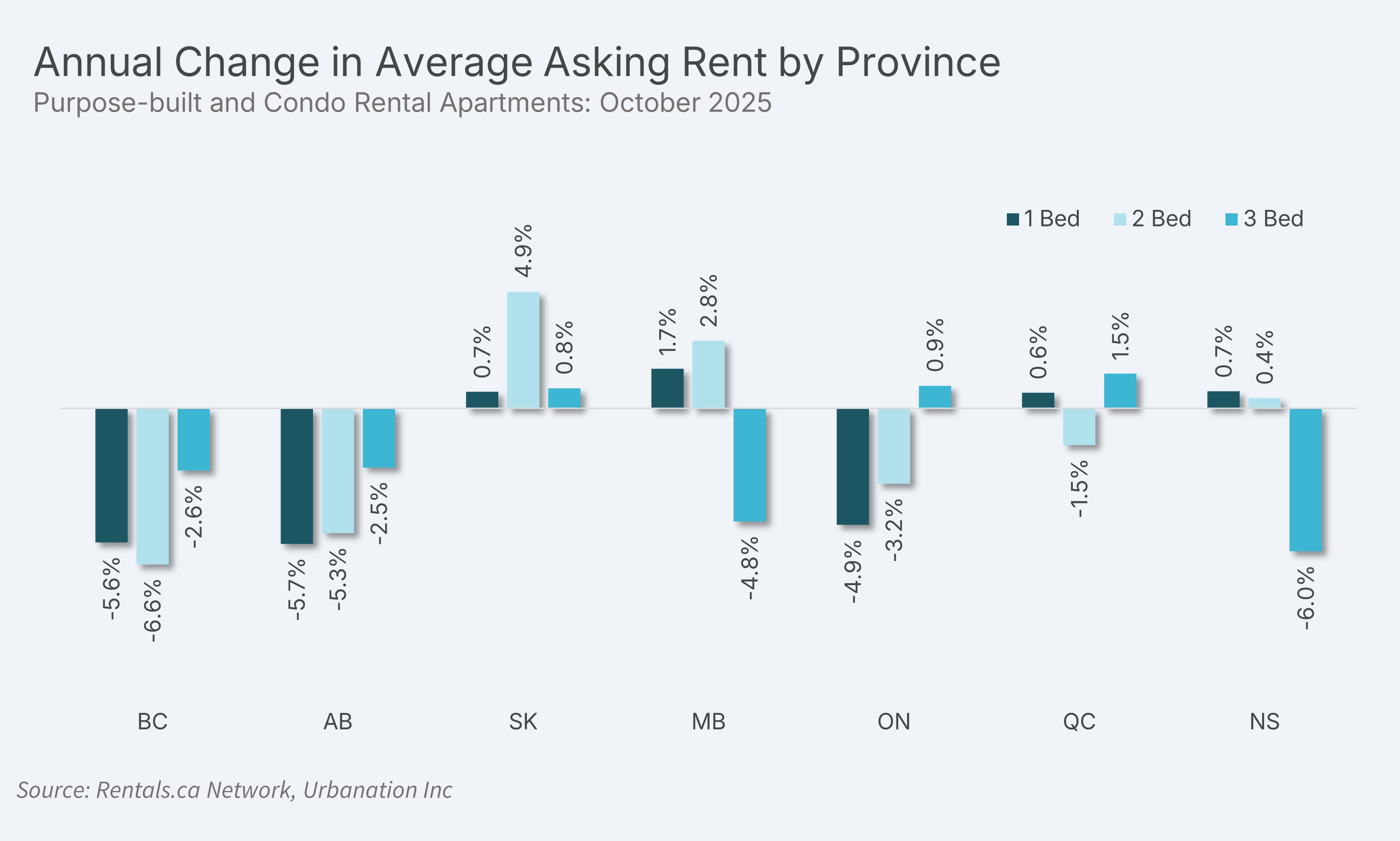
Average apartment rents declined the most over the past year for two-bedroom units in B.C (-6.6% to $2,686), three-bedroom units in Nova Scotia (-6.0% to $2,795), and one-bedroom units in Alberta (-5.7% to $1,492).
Vancouver and Calgary Lead Rent Declines Among Canada’s Largest Cities
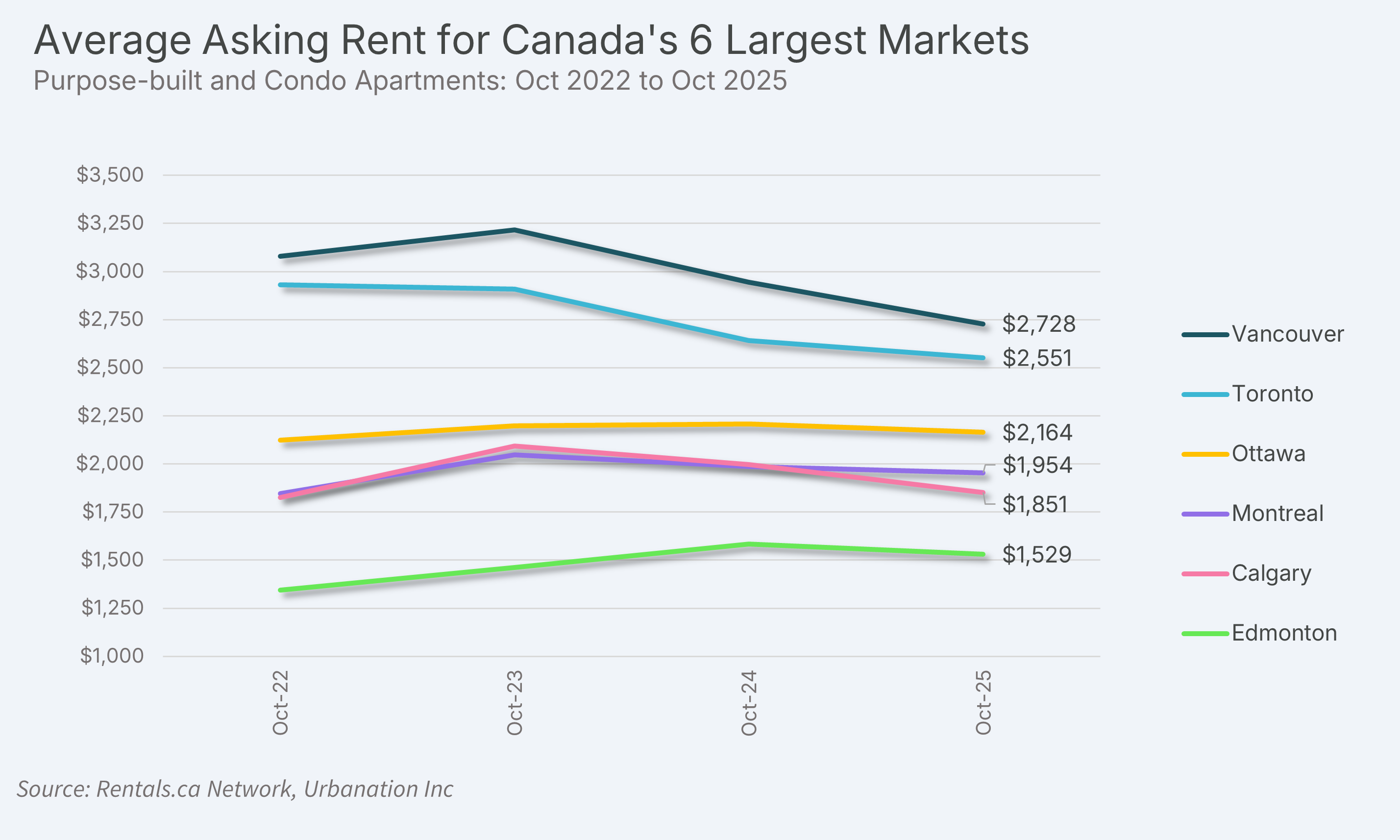
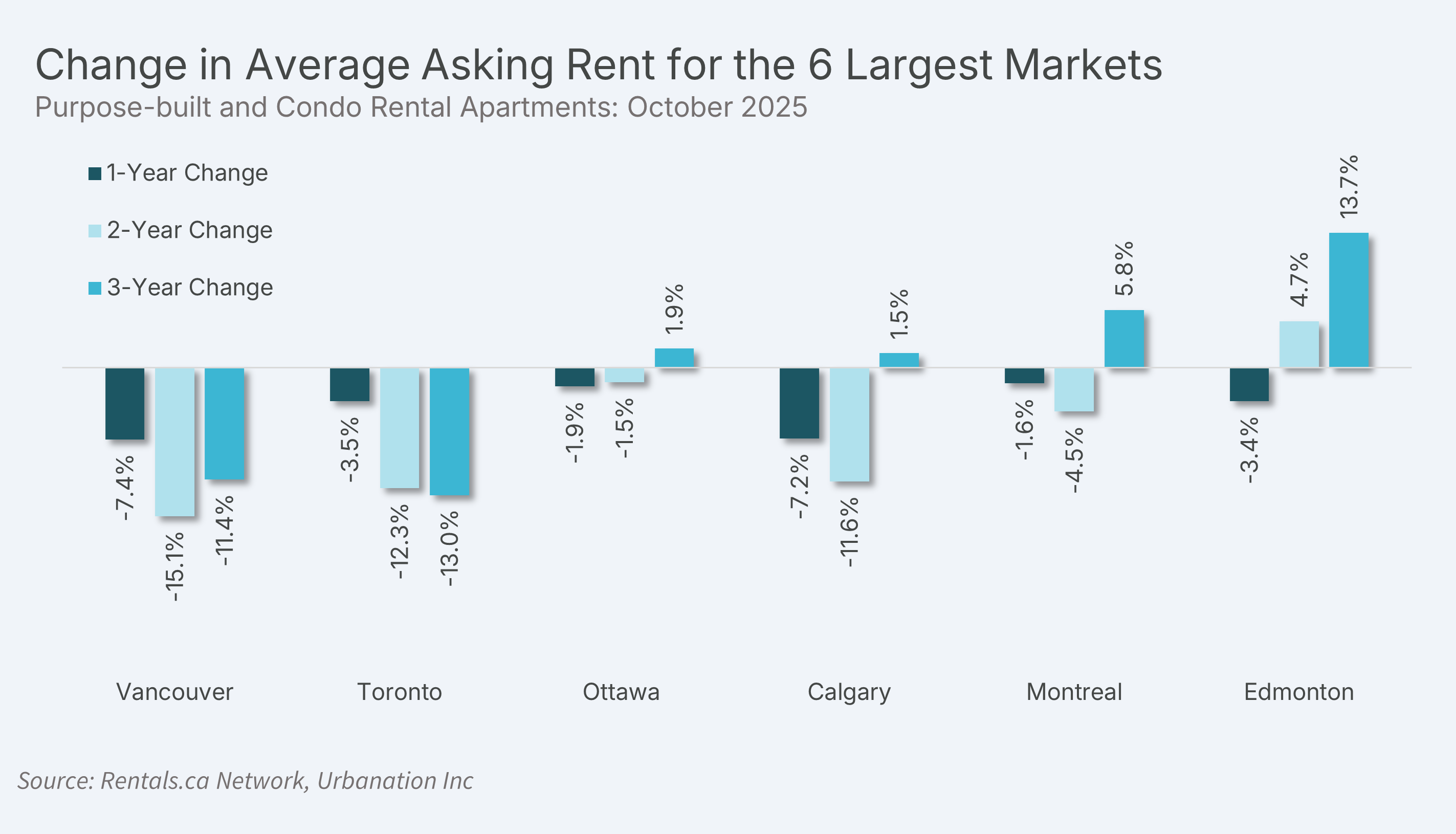
Canada’s six largest markets continued to post annual rent declines for apartments during October, led by a 7.4% decrease in Vancouver to an average of $2,728 and a 7.2% decrease in Calgary to an average of $1,851. Average apartment rents fell 3.3% annually in Toronto to $2,551 and by 3.4% in Edmonton to $1,529. Marginal year-over-year decreases in average apartment rents were seen in Ottawa (-1.9% to $2,164) and Montreal (-1.6% to $1,954).
Apartment rents in Vancouver reached a 43-month low in October, falling 11.4% over the past three years, and declined on an annual basis for the 23rd consecutive month. In Toronto, apartment rents were at a 40-month low, following 21 straight months of annual declines, with a three-year decrease of 13.0%.
Two-Bedroom Rents Fall More than 7% in Toronto
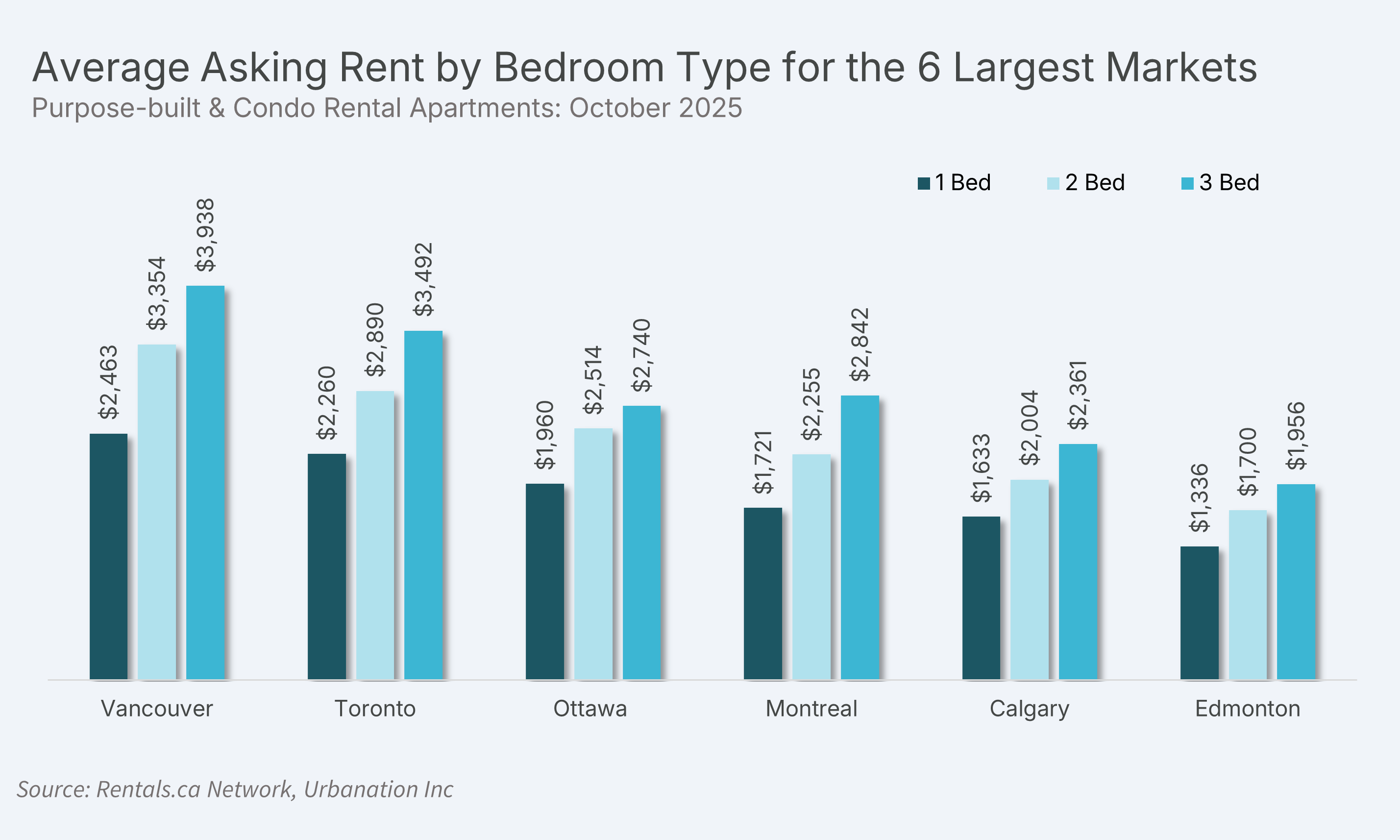
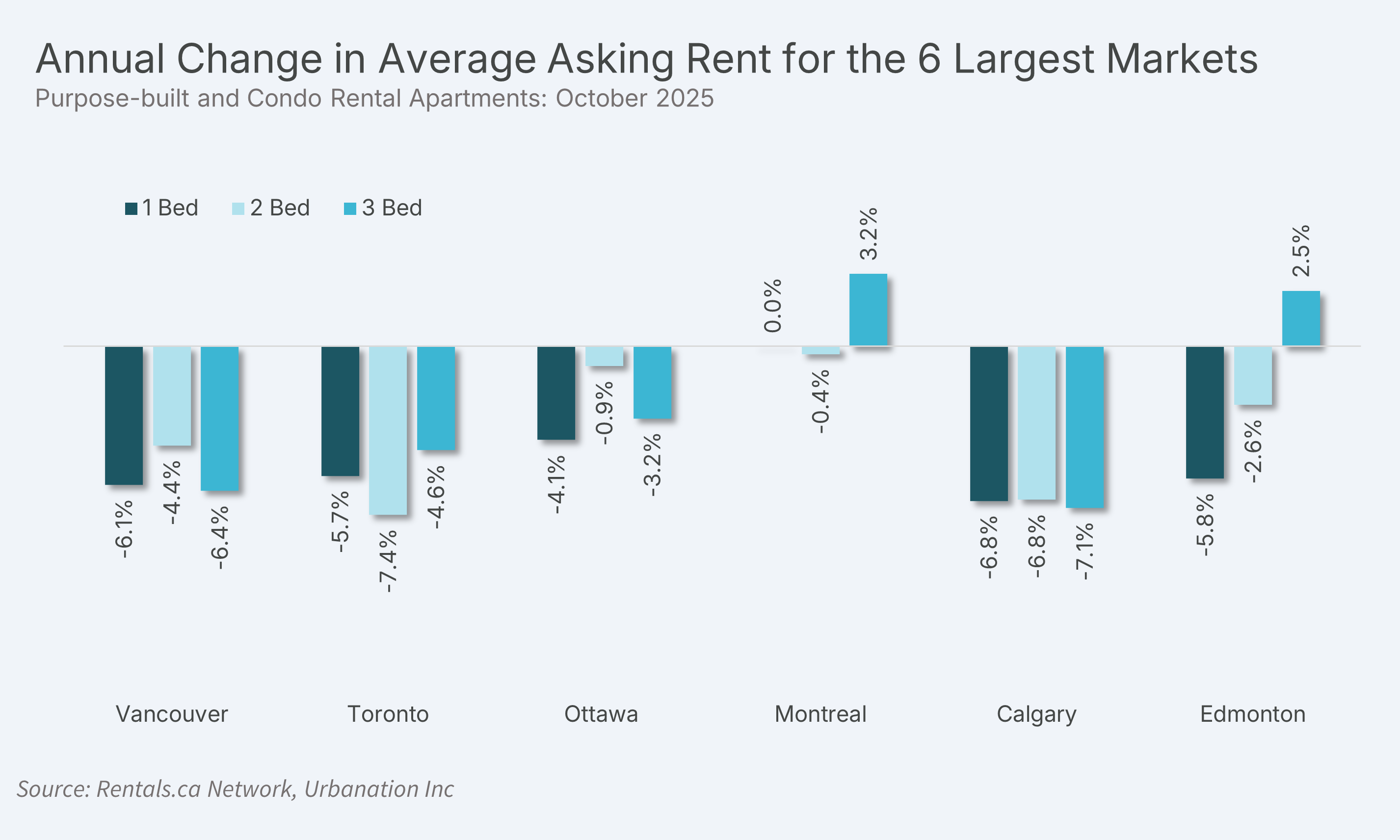
Among Canada’s largest cities, the biggest rent declines over the past year were for two-bedroom apartments in Toronto (-7.4% to $2,890) and three-bedroom apartments in Calgary (-7.1% to $2,361). Annual rent decreases were also steep in Calgary for one-bedroom apartments (-6.8% to $1,633) and two-bedroom apartments (-6.8% to $2,004).
North Vancouver Still Most Expensive with Rents Above $3,000
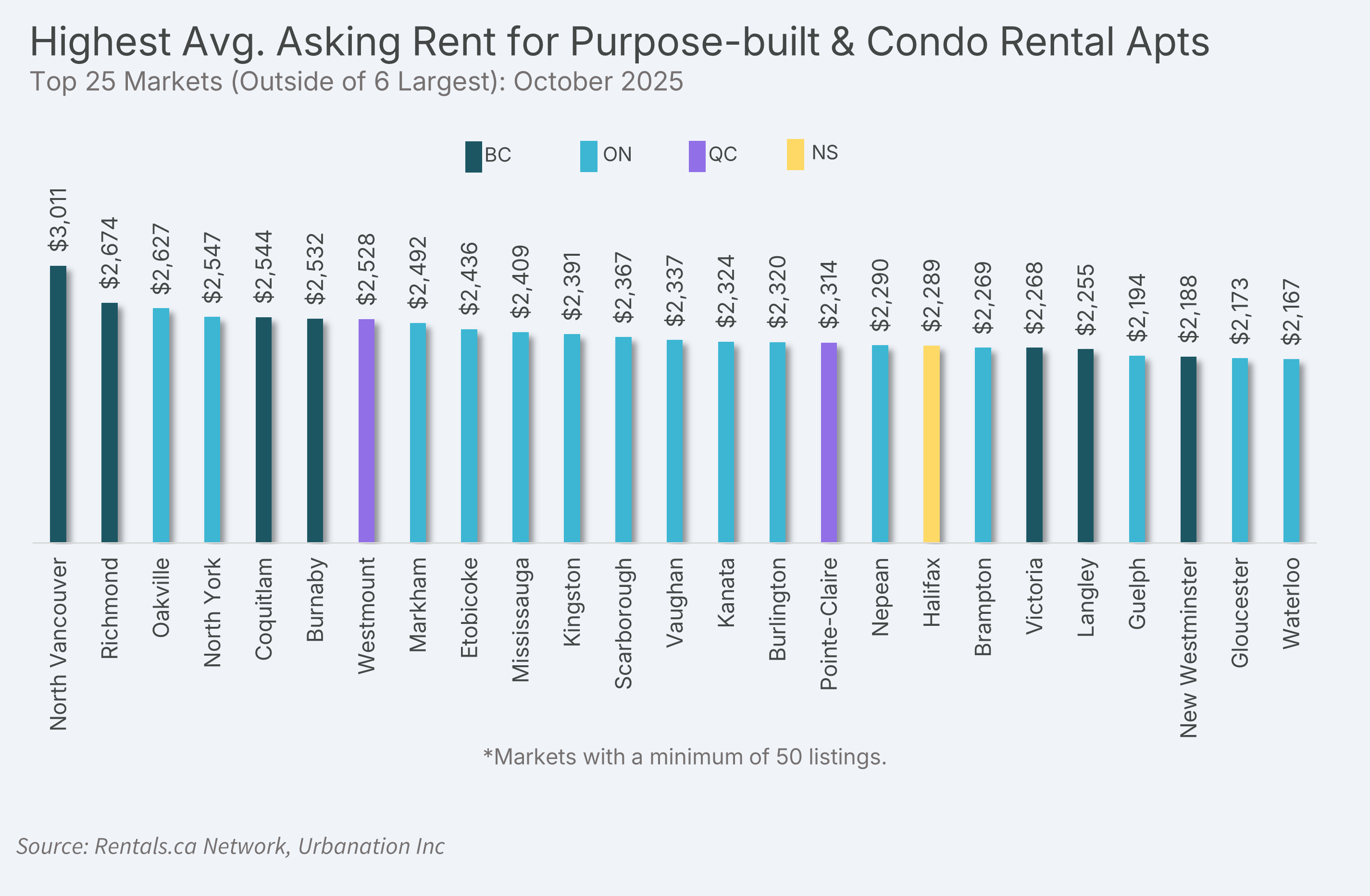
North Vancouver maintained its position as Canada’s most expensive city for rentals with an average apartment rent of $3,011 in October. Outside of Vancouver and Toronto, the remaining top five highest-priced cities for apartment rents included Richmond ($2,674), Oakville ($2,627), North York ($2,547), and Coquitlam ($2,544). Overall, B.C and Ontario represented 22 of the 25 most expensive cities for apartment rents in Canada.
Quebec City and Winnipeg Most Affordable in Central Canada
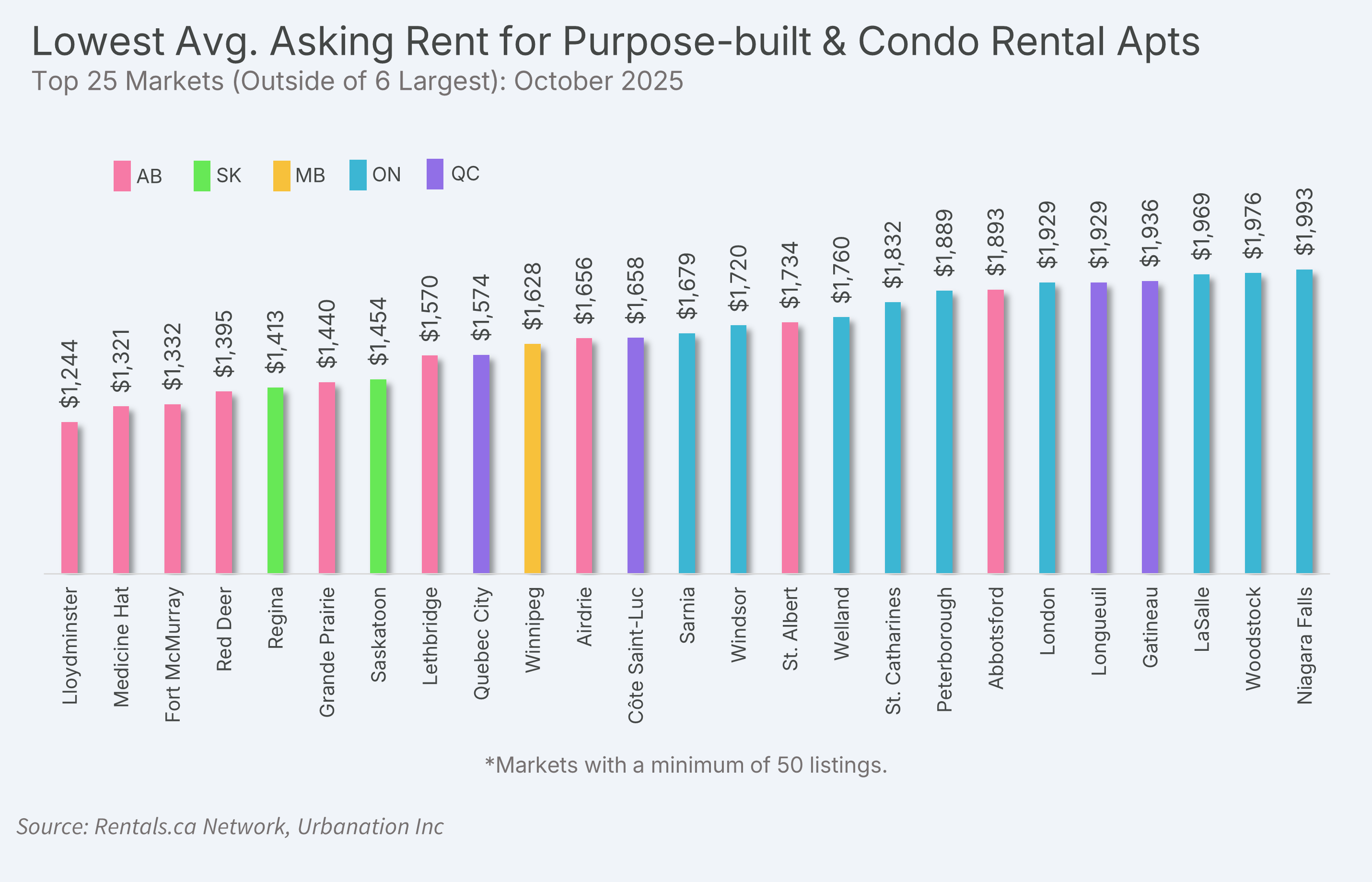
Nine of the 25 least expensive cities for apartment rents in Canada were located in Alberta, including six in the top 10 and four in the top five: Lloydminster ($1,244), Medicine Hat ($1,321), Fort McMurray ($1,332) and Red Deer ($1,395). Outside of Alberta, the most affordable cities for apartment rents were in Saskatchewan — Regina ($1,413) and Saskatoon ($1,454). In Central Canada, the most affordable cities for apartment rents included Quebec City ($1,574), Winnipeg ($1,628), Cote Saint-Luc ($1,658), Sarnia ($1,679), and Windsor ($1,720).
Less than 10 Cities See Rents Rise More than 3%
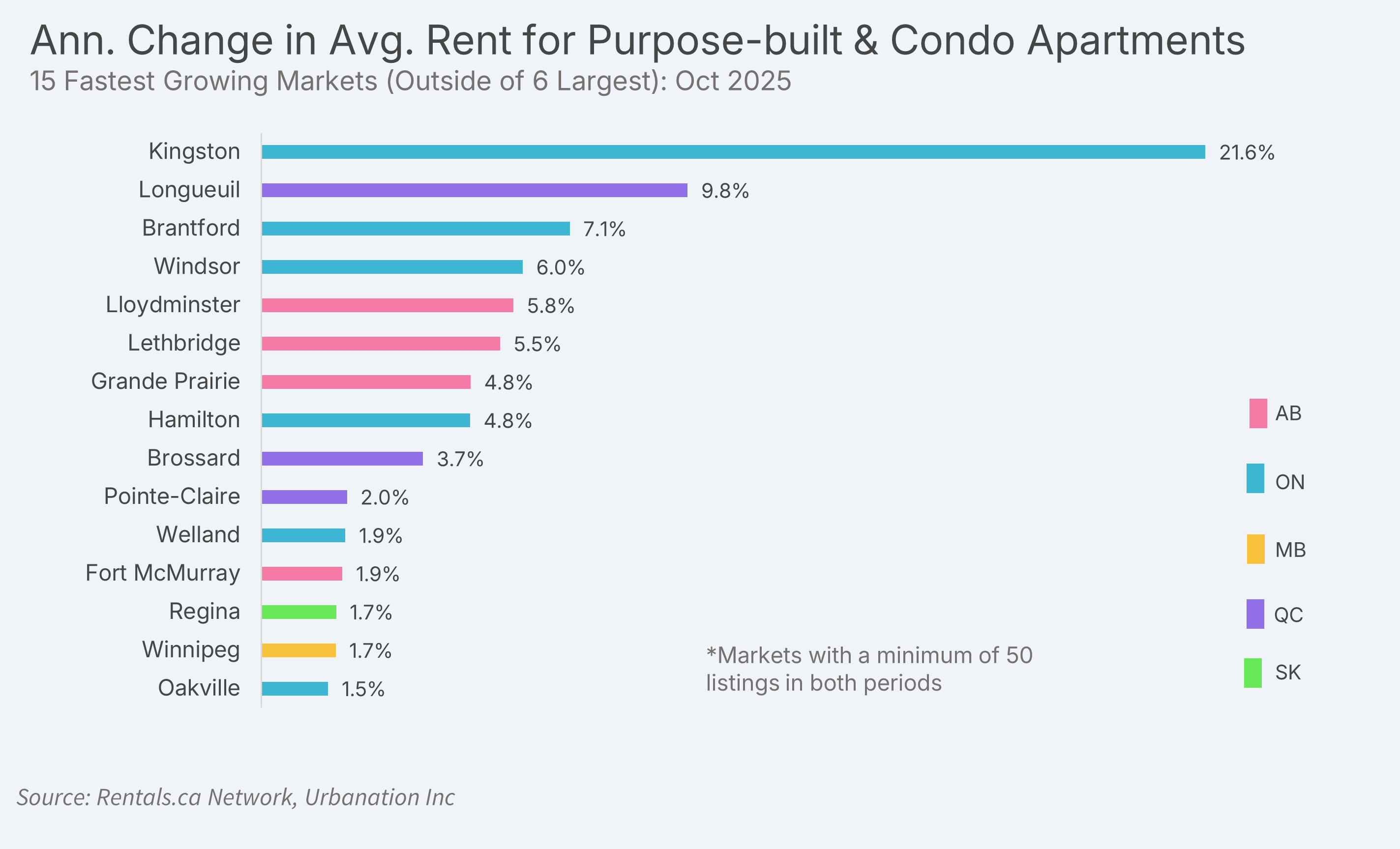
For the third straight month, apartment rents grew fastest in Kingston with annual growth of 21.6%, reaching an average of $2,391. Longueil in Quebec had the second fastest rising rents for apartments (+9.8% to $1,929), followed by the Ontario cities of Brantford (+7.1% to $2,028) and Windsor (+6.0% to $1,720). Only nine cities in Canada posted annual rent growth for apartments above 3%.
B.C. and Ontario Cities See Largest Rent Declines
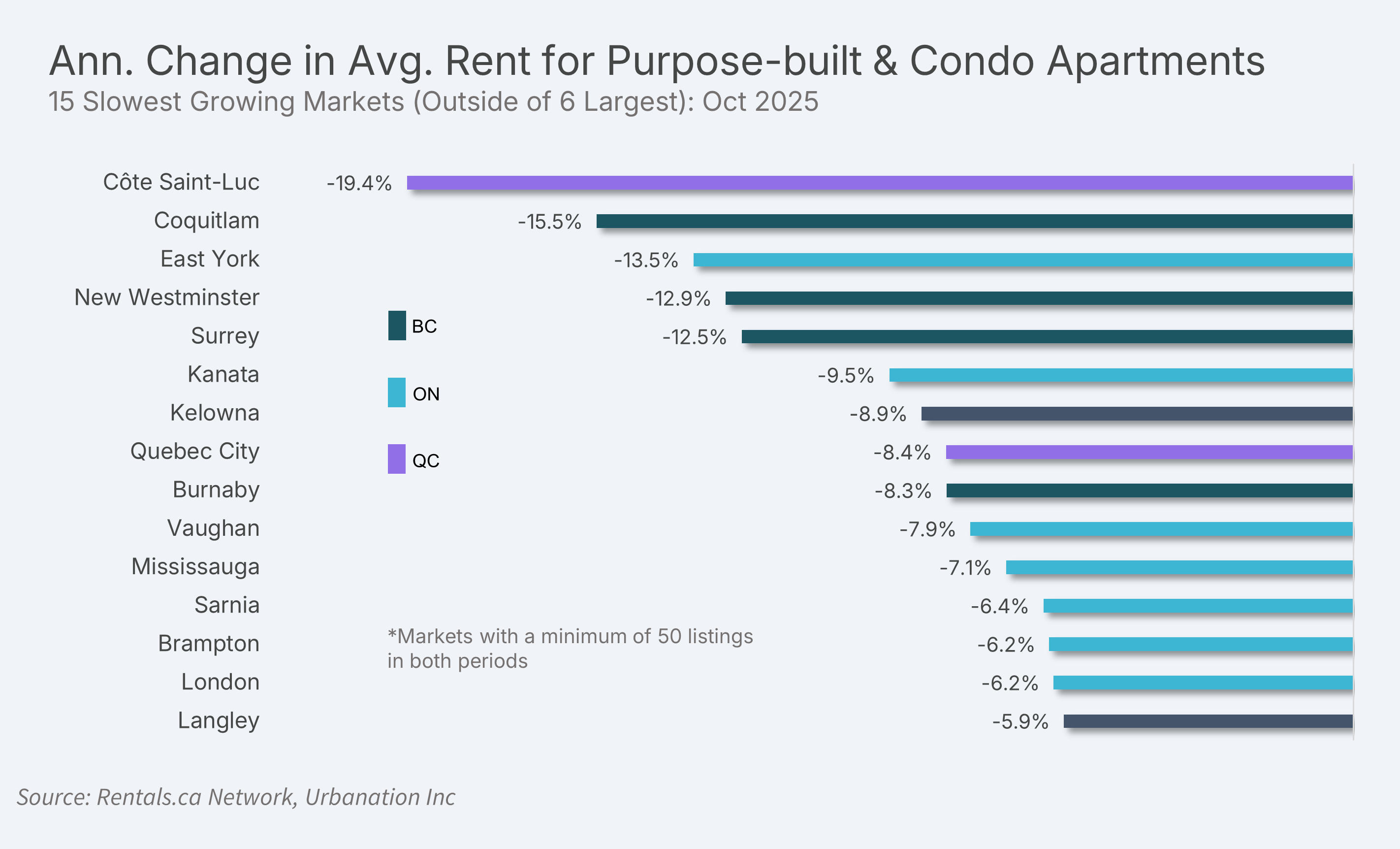
Apartment rents in Cote Saint-Luc in Quebec dropped 19.4% from a year ago, largely driven by a compositional shift in listings towards lower-priced properties. Otherwise, the largest annual decreases in apartment rents were found in B.C. and Ontario, led by Coquitlam (-15.5%), East York (-13.5%), New Westminster (-12.9%), and Surrey (-12.5%).
Shared Accommodation Rents Fall to 28-Month Low
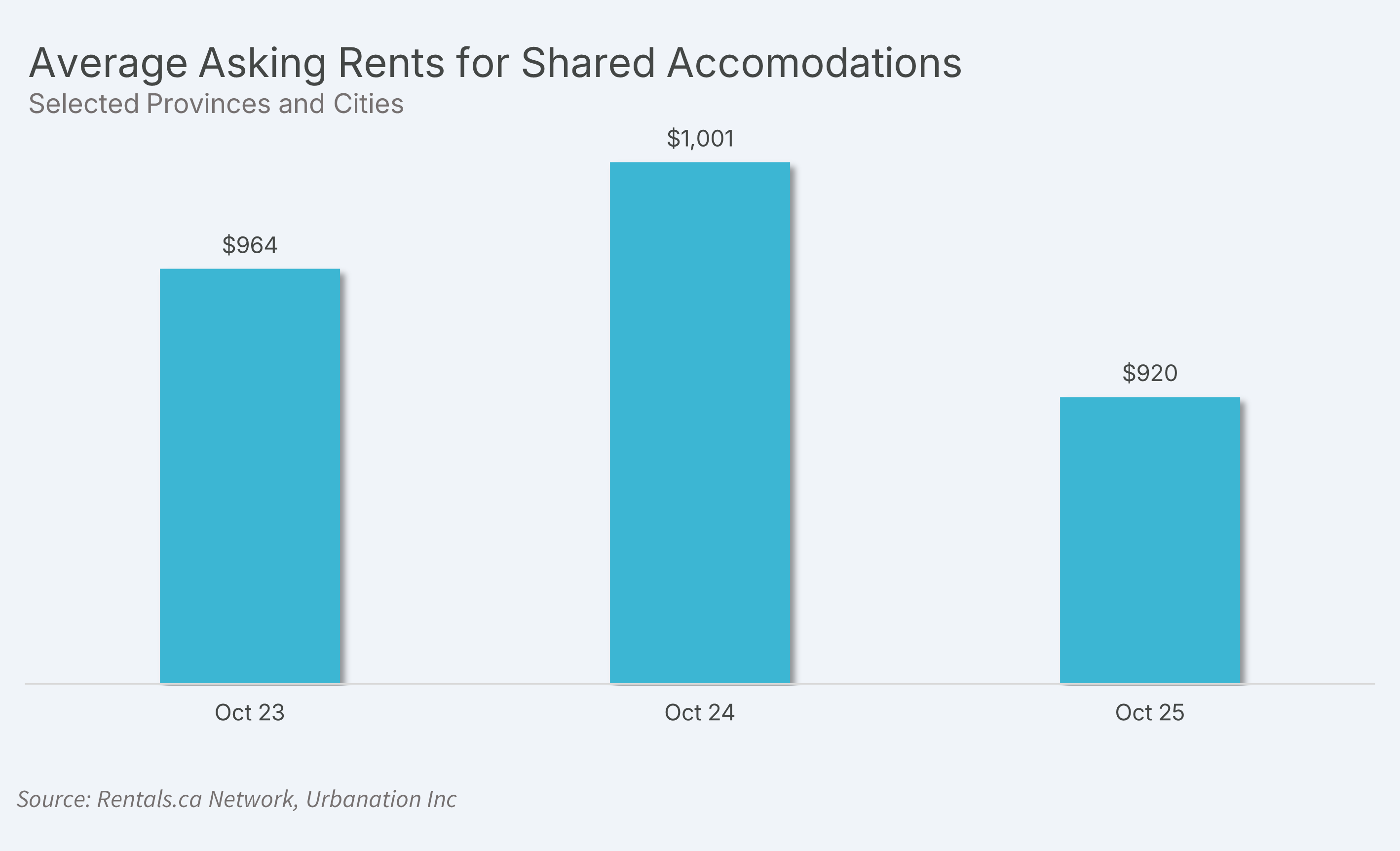
Asking rents for shared accommodations in B.C., Alberta, Ontario, and Quebec fell to a 28-month low of $920 in October, decreasing 8.1% from a year ago. Shared accommodation rents have decreased on an annual basis for 11 consecutive months.
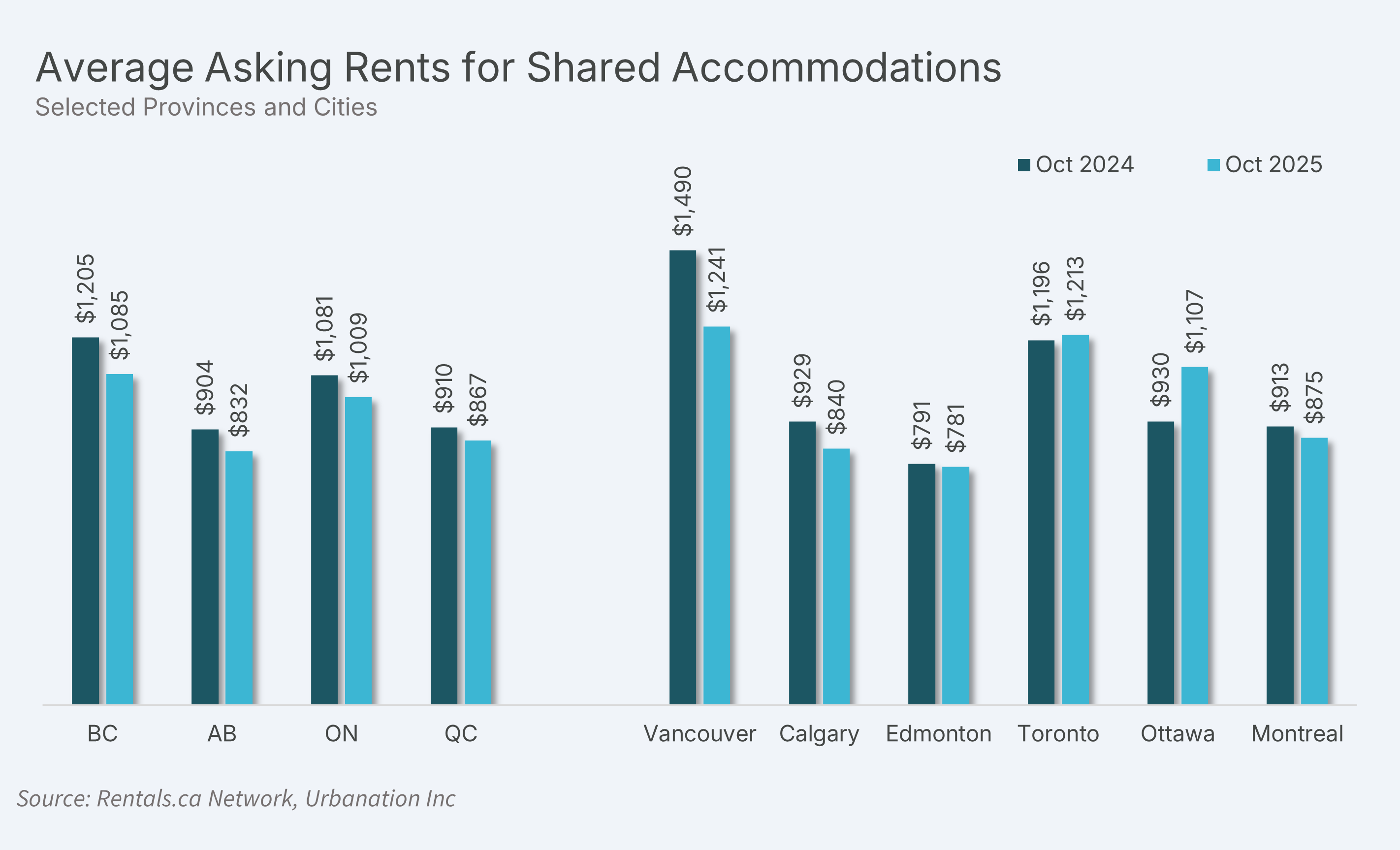
Annual rent decreases for shared accommodations were largest in B.C. (-10.0% to $1,085) and Alberta (-7.9% to $832). Rents in Ontario declined 6.6% annually to $1,009, while in Quebec, rents decreased 4.7% to $867.
Vancouver led all cities with a 16.7% annual drop in shared accommodation rents to an average of $1,241. Calgary followed with a 9.5% year-over-year decline to an average of $840. In Toronto, shared accommodation rents edged up 1.4% from last year to an average of $1,213. Ottawa led growth in shared accommodation rents with a 19.1% annual jump to an average of $1,107, owing to a number of new co-living properties coming to market.

Rentals.ca is Canada’s premier online marketplace for renters and landlords, providing a comprehensive suite of tools and resources tailored to simplify the rental process. With an extensive selection of listings across the country, Rentals.ca offers user-friendly search functionality that helps renters find their perfect home efficiently. For landlords, Rentals.ca delivers effective advertising solutions to maximize visibility and fill vacancies faster. Committed to innovation and excellence, Rentals.ca aims to empower users with up-to-date market insights and expert guidance, making renting easier and more accessible for everyone.