
Asking rents for all residential property types in Canada averaged $2,193 in February, increasing 10.5% year-over-year — the fastest rate of annual growth since September 2023. Rents decreased marginally by 0.1% month-over-month.
National Overview

Rent Inflation Accelerates to 5-Month High
Compared to two years ago in February 2022, just before the start of interest rate hikes by the Bank of Canada, average asking rents in Canada have grown by 21% or $384 per month.


Purpose-built Rents Rise Jump 14%
Asking rents for purpose-built rental apartments were lowest by property type at an average of $2,110 in February, although increasing the most over the past year with annual growth of 14.4%. Condominium rental apartments had average asking rents of $2,372, increasing 5.0% year-over-year, while apartments in houses averaged asking rents of $2,347, rising 5.3% annually.

Studio Rents Rise Fastest in February
Asking rents for purpose-built and condominium apartments averaged $2,146 in February, increasing 12.5% from a year earlier. As renters shifted toward more affordable housing options in February, rents grew fastest for the smallest unit types.
Studio apartments posted the strongest annual rent growth in February with a 14.8% increase, followed by 13.4% annual growth for one-bedroom apartments, 11.7% growth for two-bedroom apartments, and 9.9% growth for three-bedroom apartments.


Provincial Overview

Rents in B.C. and Ontario Increased by 1%
Ontario and British Columbia posted the slowest growth in asking rents for purpose-built and condo apartments at the provincial level in February, with annual increases of just 1.0% and 1.3%, respectively. In B.C., asking rents for two-bedroom apartments declined 0.6% annually to $2,766, while one-bedroom rents increased 6.3% annually to $2,207. Ontario asking rents for one-bedroom apartments increased 2.0% from a year ago to an average of $2,221 and two-bedroom apartment rents increased 1.1% annually to $2,690.
Alberta maintained its lead as the province with the fastest growing rents, with total average asking rents for apartments up 20.0% annually in February. One-bedroom apartment asking rents in Alberta grew 20.4% to an average of $1,531, while two-bedroom apartment asking rents increased 18.8% annually to $1,886.
Saskatchewan remained the most affordable province for rents in February, despite posting the second-fastest annual increase of 15.8%. One-bedroom apartment rents in Saskatchewan rose 17.8% from a year ago to $1,187, while two-bedroom apartment rents grew 15.6% to $1,352.


Municipal Overview

Rents Decline in Vancouver and Toronto
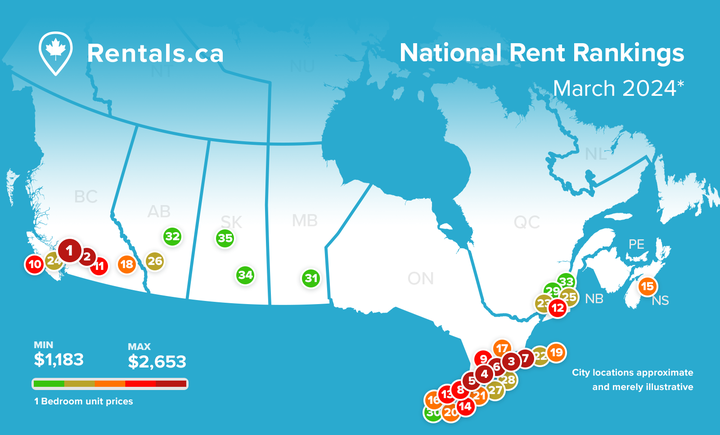
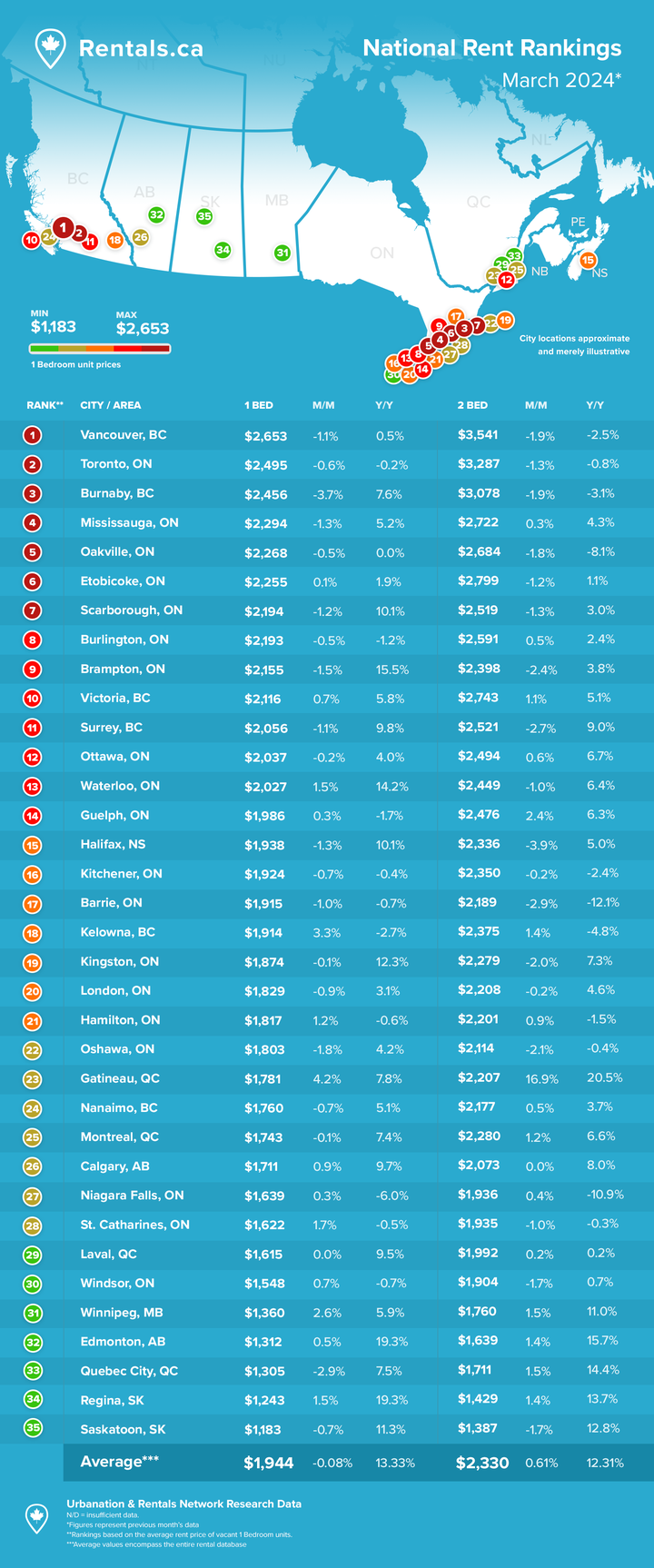
Canada’s largest and most expensive cities saw asking rents decline compared to a year ago. The average asking rent for purpose-built and condo apartments decreased by 3.3% annually in Vancouver and 1.3% annually in Toronto to $3,017 and $2,803, respectively.
For the second straight month, Edmonton was the leader for rent increases among Canada’s largest cities, posting annual growth of 17.3% to reach an average of $1,489 for purpose-built and condo apartments. Calgary remained in second place with asking rents for apartments up 10.6% annually to $2,059, a slower increase compared to the 12.8% annual growth rate in January. In Montreal, annual rent growth for apartments accelerated from a 9.5% annual pace in January to a 10.1% annual pace in February, raising asking rents to an average of $2,034 for purpose-built and condo apartments.


Quebec Leads Rent Growth Among Small-to-Mid Sized Cities
Four out of the top five most expensive small-to-medium sized markets for purpose-built and condo apartment rents remained in B.C during February, led by North Vancouver, ($3,180), Burnaby ($2,880), Coquitlam ($2,797), and Richmond ($2,774). Richmond Hill, Ontario maintained its fifth position with an average asking rent of $2,708 for purpose-built and condo apartments, while Langley, B.C. moved into the sixth spot with an average asking rent of $2,697. The remainder of the top 10 most expensive small-to-medium sized markets were all located in the GTA.
Among the top 25 small-to-mid-sized markets for annual rent growth in February, seven were located in Quebec, six were located in Alberta, five were located in B.C, three were in Ontario, and two were in Saskatchewan. The lone Manitoba city was Winnipeg, with annual growth of 9.1%, while Halifax led Nova Scotia with annual growth of 8.6%. The fastest rising city for rents in Quebec was Pointe-Claire (+27.9%), while Lloydminster led rent growth in Alberta (+25.7%) and Langley saw the fastest rising rents in B.C. (+20.3%). Regina was the fifth fastest growing city for rents in Canada with an annual growth of 17.1%, and Waterloo represented the city with the fastest rising rents in Ontario with annual growth of 9.2%.


The number of Roommate Listings Surged 72%
The number of listings for shared accommodations tracked in four provinces in Canada surged 72% in February compared to a year ago. Average asking rents for shared accommodations increased 12% annually to $1,010, led by 13% annual growth in B.C. to an average of $1,186 and 12% annual growth in Alberta to an average of $873. Average roommate rents increased 9% year-over-year in Ontario to $1,099 and by 5% in Quebec to $920.
Vancouver continued to have the highest average asking rents for shared accommodations at $1,406, followed by Toronto at an average of $1,280. Ottawa ranked third among Canada’s largest cities with average asking rents for roommate rentals at $973, with slightly lower asking rents of $945 in Montreal. In Calgary and Edmonton, asking rents for shared accommodations averaged $899 and $793, respectively.


Rentals.ca Data
The data used in this analysis is based on monthly listings from the Rentals.ca Network of Internet Listings Services (ILS). This data differs from the numbers collected and published by the Canada Mortgage Housing Corporation (CMHC).
The Rentals.ca Network of ILS’s data covers both the primary and secondary rental markets and includes basement apartments, rental apartments, condominium apartments, townhouses, semi-detached houses, and single-detached houses. CMHC’s primary rental data only includes purpose-built rental apartments and rental townhouses. CMHC also collects data on secondary market rentals, but this is reported separately.
CMHC’s rental rates are based on the entire universe of purpose-built rental units (rental stock), regardless of rental tenure. CMHC rental rates are reflective of what the average household spends on rental housing and not the current market rents for vacant units. The data used in this report is based on the asking rates of available (vacant) units only and reflect on-going trends in the market. This covers a smaller sample size but is more representative of the actual market rent a prospective tenant would encounter. The Rentals.ca Network of ILS’s data typically provides much higher rental rates compared to CMHC, as vacant units typically reset to market rates when not subject to rent control.
The average and median rental rates in this report can also skew higher than CMHC’s data for the following reasons: the inclusion of larger more expensive unit types such as single-family homes, townhouse units, and large luxury condominium units; the presence of duplicate or multiple listings at the same property and the survivorship bias where more expensive or over-priced units take longer to lease and remain in the sample longer.
Properties listed for greater than $5,000 per month, and less than $500 per month are removed from the sample. Similarly, short-term rentals, single-room rentals, and furnished suites are removed from the sample when identifiable.
Urbanation is a real estate research firm providing market research.
Urbanation provides in-depth market analysis and consulting services to the apartment industry since 1981. Urbanation uses a multi-disciplinary approach that combines empirical research techniques, industry relationships forged over the past four decades, and first-hand observations and site visitations. Urbanation offers subscription services and custom market feasibility studies covering the new construction condominium and purpose-built rental apartment markets in Ontario.