

From 2020 to 2023, the population of international students in Canada nearly doubled, leading to high demand and a very tight market for student rentals. However, with new caps and restrictions on study permits being implemented gradually since January of 2024, the market is shifting, with conditions becoming more favourable for renters. To see what the impact has been, Rentals.ca analyzed data for properties located near Canada’s post-secondary institutions, which revealed a changing landscape for student renters.
Falling International Enrolment
The Canadian government has been implementing a variety of new restrictions on study permits over the past two years. In January of 2024, the amount of proven financial support required for international students was more than doubled. Stricter requirements for post-graduation work permits followed in September 2024, and shortly afterward, the government announced a cap on the number of study permits to be issued altogether in 2025.
In the first seven months of 2025, the number of study permits issued to students seeking to enter Canada to study decreased by 39% compared to the same period in 2024. Permits have also skewed more towards renewals and extensions, with new arrivals of international students in Canada falling by 69%.
Lead Volumes Reveal Falling Demand
To see the impact on demand, Rentals.ca examined data for the number of unique individuals responding to rental ads, which is defined as lead volume. In the areas near post-secondary campuses, there have been significant changes since 2023, when the international student population peaked. The rental market across Canada as a whole has seen reduced demand, with lead volume in the first seven months of 2025 falling by 28% from the same period in 2023; but student areas have seen an even larger drop, with lead volume falling by 39%.

This impact is even more pronounced among Ontario colleges with very high international enrolment. In the area around Conestoga College in Kitchener, where international students made up over 90% of enrolment in 2023, lead volume in the first seven months of 2025 fell by 67% compared to the same period in 2023.
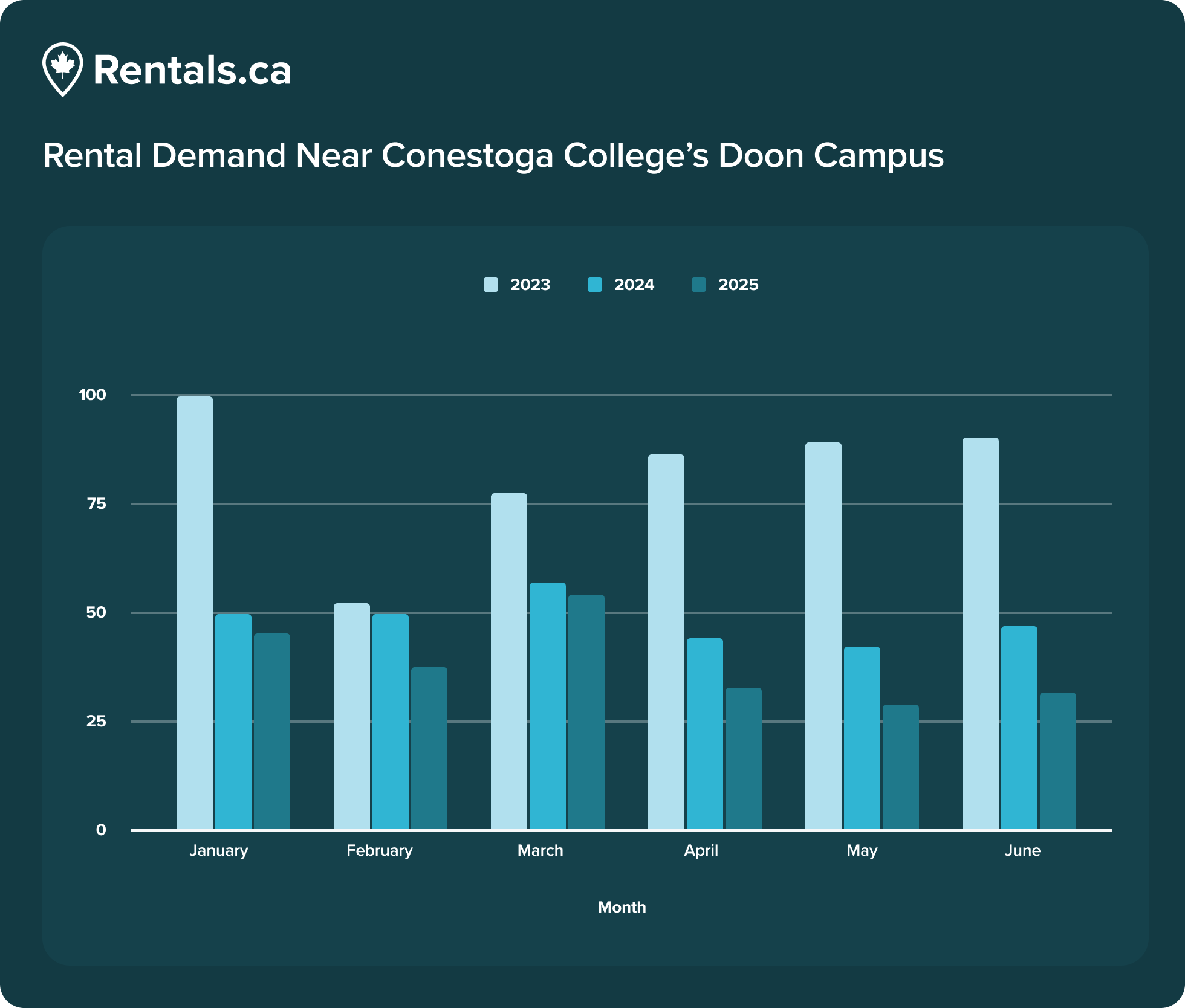
As a result, current students as well as international students entering Canada under the new caps are often seeing reduced competition and more choice in rental properties close to campus.
Reduced Demand is Impacting Prices
In addition to lead volume, rental prices are also impacted by the reduction of study permits being issued. Ontario and BC are the most impacted by the new study permit caps because they have the highest number of international students per capita. While for the most part, cities across Canada have been experiencing small decreases in rent costs month over month for the last year, the shrinking international student population is leading to reduced demand and therefore steeper declines in rents in university towns than the provincial averages, particularly in Ontario and BC.
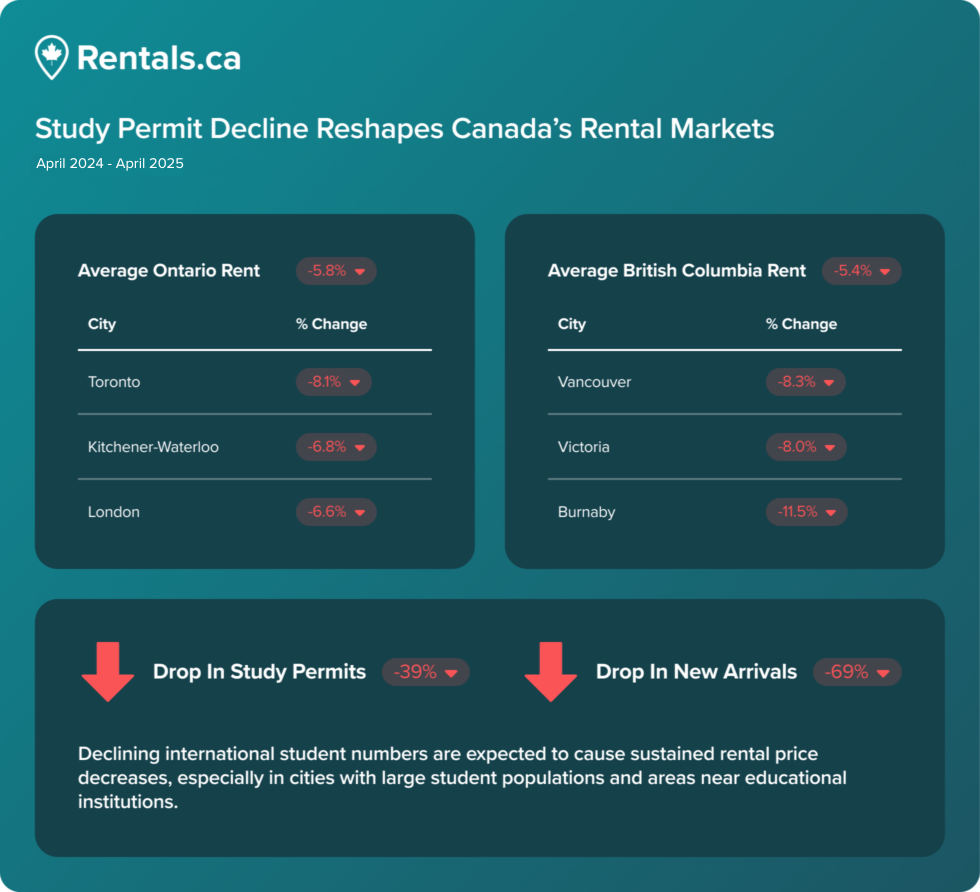
With demand plummeting in these markets, and international student populations expected to continue falling into 2026, these trends suggest that rental prices will continue to drop in cities with large post-secondary student populations, particularly in the neighbourhoods surrounding these institutions.
Student Neighbourhoods: The Local Impact
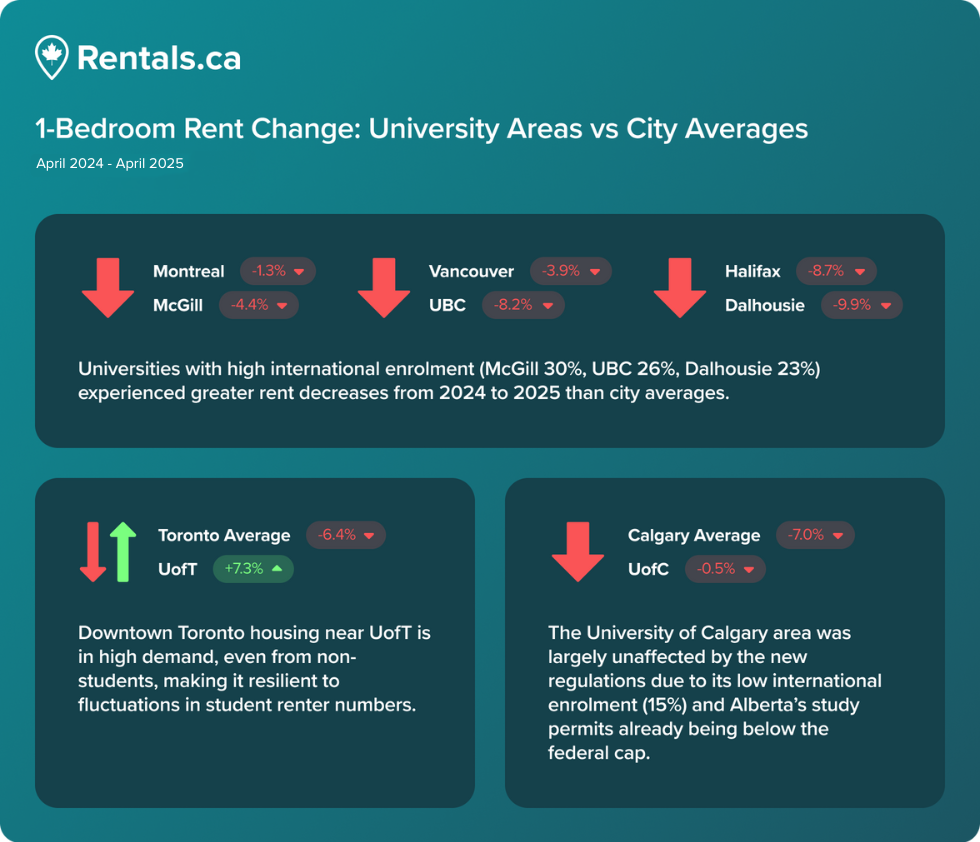
To further see what effects permit caps are having at a local level, Rentals.ca examined data from listings in a 1.5 km radius from the main campus of post-secondary institutions across Canada. While results varied from school to school, in general, rental housing surrounding post-secondary institutions with a high proportion of international enrolment, like McGill (30%), UBC (26%), and Dalhousie (23%), saw larger rent decreases from 2024 to 2025 than the city-wide averages.
However, there are some notable exceptions. For example, the area surrounding the University of Toronto saw nearby rents rise rather than fall. With a central and densely populated location in downtown Toronto, housing around U of T sees a considerable amount of demand from non-student renters, and is therefore better insulated against the impacts of reduced student renter populations.
The areas surrounding the University of Calgary were also mostly unaffected by the new rules, as the proportion of international enrolment is relatively low (15%), and the number of study permits issued in Alberta was already below the new cap imposed by the federal government. As a result, rents near the university remained relatively flat, even as rents across the rest of the city declined.
Conclusion
International student inflows are decreasing, leading to reduced demand in the areas around post-secondary campuses with high international enrolment, particularly in Ontario and BC. Projections indicate that the downward trend in the international student population will continue into 2026. The reduced intake of international students has led to falling demand and lower rents in many student areas, resulting in greater choice for student rentals, and in many cases, more affordable options. Despite the overall trend, there is still local variation in how markets have responded. Prices have remained relatively robust in cities like Toronto, where the student area is highly integrated with the surrounding neighbourhoods; or Calgary, where international students make up a relatively low proportion of total enrolment. Understanding your local market is crucial for making informed decisions.

Rentals.ca is Canada’s premier online marketplace for renters and landlords, providing a comprehensive suite of tools and resources tailored to simplify the rental process. With an extensive selection of listings across the country, Rentals.ca offers user-friendly search functionality that helps renters find their perfect home efficiently. For landlords, Rentals.ca delivers effective advertising solutions to maximize visibility and fill vacancies faster. Committed to innovation and excellence, Rentals.ca aims to empower users with up-to-date market insights and expert guidance, making renting easier and more accessible for everyone.