

The Greater Toronto Area is Canada’s largest and busiest hub for car commuters, with commuters in the GTA facing the longest average commute time in the country. Due to the high cost of living in the city core, many people choose to live in the surrounding areas, and commute into the city for work and recreation. But is commuting really the more affordable option?
Car owners know that the cost of driving extends far beyond the price of gas. According to a report by Ratehub, the average cost of car ownership in Canada adds up to a total of $1,370 per month, when accounting for car payments, fuel, insurance, maintenance, parking, and registration. In contrast, the price of an annual TTC pass is only $143 per month, a savings of over $1,200.
Cities are also increasingly turning towards less car-centric planning. Toronto, along with many other cities in North America, has eliminated parking minimums for new construction. At the same time, younger generations are reducing their reliance on personal vehicles as a primary mode of transportation. So what would the all-in cost of transportation and rent look like for a walkable neighbourhood in Toronto versus commuting in from the suburbs?
By combining neighbourhood-level average rents from Rentals.ca with data from Walk Score, we can see the overall cost of living downtown for those willing to go car-free.
Commuter Cities and Vehicle Ownership
When the full cost of commuting by car is taken into account, Toronto’s walkable neighbourhoods compare favourably with the cost of renting and commuting, with only West Queen West being more expensive on average than a typical car commuter option. The average cost of renting in seven popular commuter cities, plus the $1,370 monthly cost of car ownership, is summarized in the table below.
| City | 1 Bedroom | 2 Bedroom | 3 Bedroom |
| Mississauga | $3,277 | $3,703 | $4,283 |
| Oakville | $3,390 | $3,875 | $4,465 |
| Hamilton | $2,962 | $3,292 | $3,874 |
| Vaughan | $3,370 | $3,723 | $4,481 |
| Brampton | $3,100 | $3,415 | $3,928 |
| Markham | $3,200 | $3,528 | $4,332 |
| Milton | $3,187 | $3,301 | $4,116 |
Walkable Neighbourhoods and Transit
The cost of rent and an annual TTC pass for Toronto’s most walkable neighbourhoods is summarized in the table below.
| Neighbourhood | Walk Score | 1 Bedroom | 2 Bedroom | 3 Bedroom |
| Bay Street Corridor | 99 | $2,744 | $3,385 | $4,094 |
| Kensington Market | 99 | $2,283 | $3,060 | $4,092 |
| West Queen West | 99 | $3,308 | $3,833 | $4,128 |
| Annex | 98 | $2,496 | $3,301 | $3,174 |
| Danforth | 98 | $1,670 | $2,493 | $2,934 |
| Cabbagetown | 97 | $2,107 | $2,974 | $3,799 |
| Trinity-Bellwoods | 91 | $2,450 | $3,188 | $3,855 |
| Mount Pleasant West | 91 | $2,216 | $3,080 | $3,990 |
With the exception of West Queen West, where average rents sit substantially higher than the city average, the combined cost of renting in a downtown walkable neighbourhood and using transit is less than the cost of renting in a commuter city and owning a vehicle.
Cost Breakdown
The chart below shows the average rent for all unit types, plus the cost of either driving or transit, depending on the location.
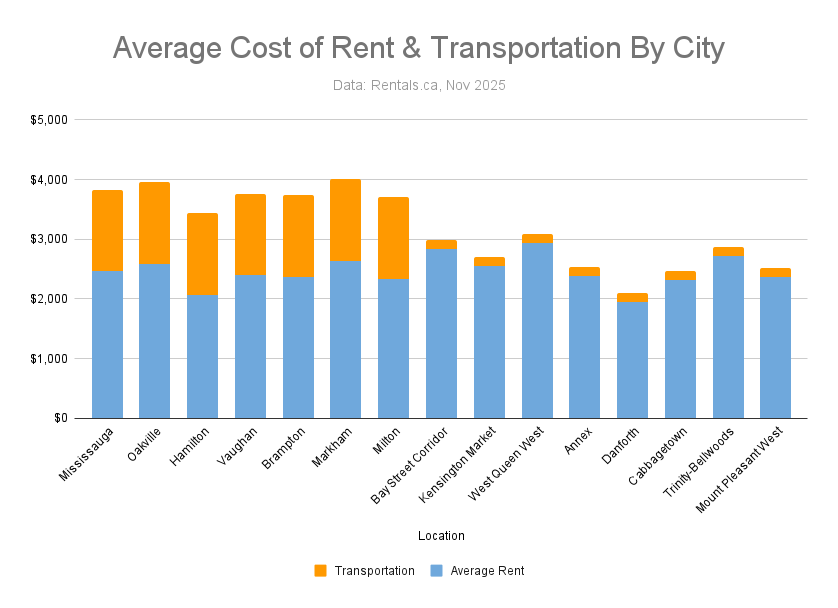
While commuter cities generally have slightly lower rent prices than downtown neighbourhoods, when the cost of vehicle ownership is included, the cost of living downtown is generally lower, if you’re willing to rely on transit for your transportation needs.
Conclusion
For renters who have the option of living downtown and going car-free, it can actually be the more affordable option, when all the costs of car ownership are taken into account. According to Statistics Canada, those who commuted by foot or by bicycle also had a significantly shorter commute than those who commuted by car.
While the trade-off may not be for everyone, if you’re looking for the convenience and pace of the downtown lifestyle, or the time savings and health benefits of an active commute, it may be worth examining what the real costs and benefits could be. To see what’s available in your favourite neighbourhood, check out thousands of Toronto listings available now at Rentals.ca.

Rentals.ca is Canada’s premier online marketplace for renters and landlords, providing a comprehensive suite of tools and resources tailored to simplify the rental process. With an extensive selection of listings across the country, Rentals.ca offers user-friendly search functionality that helps renters find their perfect home efficiently. For landlords, Rentals.ca delivers effective advertising solutions to maximize visibility and fill vacancies faster. Committed to innovation and excellence, Rentals.ca aims to empower users with up-to-date market insights and expert guidance, making renting easier and more accessible for everyone.