
Executive Summary
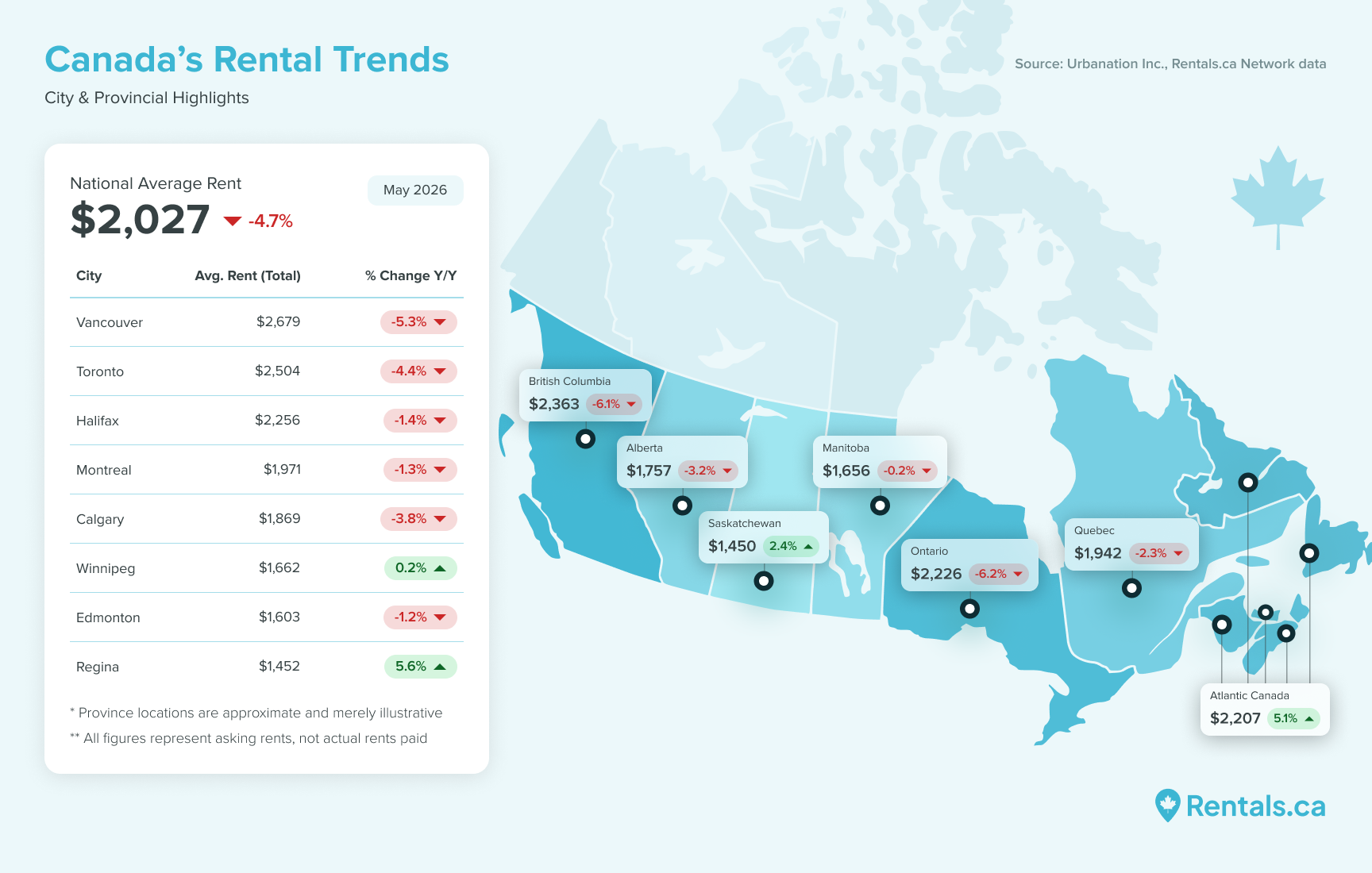
- Average asking rent in Canada declined 4.7% year-over-year in April, falling by $100 to $2,027, marking the 19th consecutive month of year-over-year declines.
- On a monthly basis, rents rose by 0.9% compared to March, marking the beginning of increasing seasonal demand during the spring and summer.
- Since reaching a low of $1,662 in April 2021 during COVID-19, average rents have risen 21.9%.
- Secondary markets adjacent to Canada’s largest cities experienced some of the steepest declines in apartment rents over the past year, including double-digit drops in Richmond (-13.1%), Markham (-12.0%), Oakville (-11.1%), Coquitlam (-11.1%) and Burnaby (-10.2%).
- Purpose-built rents remained the most stable over the past year, declining 3.7% to an average of $2,027, while asking rents for condo units fell by 5.6% to $2,087. However, incentives such as free rent periods have become common at purpose-built rental projects, resulting in lower effective rents for tenants.
- Average rents for all unit types continued to fall across the most populous provinces, down 5.9% in B.C., 5.2% in Ontario, 3.4% in Alberta, and 1.9% in Quebec. However, increases were seen in Nova Scotia (+3.3%), Saskatchewan (+2.2%) and Manitoba (+1.3%).
- Average rent per square foot declined slightly to $2.54, compared to $2.56 in April 2025, and down from $2.68 in April 2024. The average unit size for available listings decreased to 827 square feet, down from 845 square feet in April 2025 and 865 square feet in April 2024.
National Overview
Asking Rents in Canada Decline for 19th Consecutive Month
Average asking rents for all property types in Canada fell 4.7% annually to $2,027 in April, marking the 19th consecutive year-over-year decline, but up 0.9% from the three-year low of $2,008 set in March.
Over the past two years, rents have fallen by 7.4% from April 2024, but were 1.2% higher than three years ago in April 2023. Compared to the COVID-era low in April 2021, average rents have risen 21.9%.
Rent Per Square Foot Shows Slight Decline
Average asking rent per square foot declined 0.8% year-over-year to $2.54, falling 5.2% from April 2024, when asking rents averaged $2.68 per square foot. Compared to two years ago, the average size of an available rental unit shrank by 4.4%, from 865 square feet to 827 square feet.
Purpose-Built Rents Most Resilient Among Unit Types
On an annual basis, asking rents for condos continued to decrease, falling 5.6% year-over-year, to an average of $2,087. Other secondary market units, such as houses and townhomes, saw the steepest decline, falling 7.8% annually to an average of $1,998.. Purpose-built rentals continued to experience the smallest rent declines, down 3.7% from last year and rising 1.1% month-over-month to an average of $2,027.
Units with four or more bedrooms (primarily houses and townhomes) saw the largest annual decline in rents, falling 5.3% to an average of $2,888. Among the remaining unit sizes, one-bedroom rents decreased the most compared to a year ago, down 4.3% to an average of $1,778.Three-bedroom rents continued to see the smallest decline of all unit sizes, down 2.9% annually to an average of $2,490.
Studio Condo Rents Continue to Fall Fastest, while Three-Bedroom Rents See Smallest Decrease
In the condo market, studio rents fell by 7.9% to $1,640, the largest decrease among unit types but a moderation from the double-digit annual declines seen in recent months. For purpose-built apartments, one-bedroom units saw the largest decline, falling 4.4% year-over-year to $1,810.
Three-bedroom rents for purpose-built rental units were down only 1.1% over the past year to an average of $2,726, with three-bedroom condo rents decreasing 2.9% to $2,732.
Provincial Overview
B.C. Leads Apartment Rent Declines, Alberta and Ontario Follow
Nationwide, the average asking rent for purpose-built and condominium apartments was $2,033 in April, a 3.9% decrease from the same time last year but up 1.1% from March
On a provincial basis, annual apartment rent increases were seen in Nova Scotia (+3.3%, $2,299), Saskatchewan (+2.2%, $1,383) and Manitoba (+1.3%, $1,640). Saskatchewan has also seen the largest rent increase over the past three years, with a 25.9% total gain since April 2023. The largest apartment rent decreases in the past year were seen in B.C. (-5.9%, $2,336), Ontario (-5.2%, $2,216), and New Brunswick (-3.9%, $1,472).
Only two provinces have seen rent declines over the past three years: Ontario (-8.5%) and B.C. (-5.4%).
While three-bedroom apartment rents held steady in Ontario (-0.2%, $3,034) and Manitoba (+0.2%, $1,922), significant declines were seen in B.C. (-6.3%, $3,233) and Alberta (-4.0%, $2,054), while a significant increase was seen in Nova Scotia (+5.0%, $2,902). Across all unit types and provinces, rents fell fastest for one-bedroom units in Ontario (-6.6% to $1,973).
Municipal Overview
Rents Decline in All of Canada’s Six Largest Markets
Average apartment rents fell across all six of Canada’s largest markets, with the largest overall decline in Vancouver (-5.3%, $2,679) and the smallest decline in Edmonton (-1.2%, $1,603).
Among the six largest markets, Vancouver apartment rents fell most significantly for studio units, down 8.0% annually to $2,068. Among all six markets, Vancouver also saw the largest decline in one-bedrooms (-7.0%, $2,358) and three-bedrooms (-7.7%, $3,876), while Ottawa saw the largest decrease in two-bedrooms (-4.0%, $2,472).
On a monthly basis, Toronto rents increased across all unit types except for studios, which remained flat at $1,769.
Vancouver was the only major market to show a monthly decline in total average rents, falling 1.3% to $2,679. Rents in Vancouver have fallen on a year-over-year basis for 29 consecutive months, with the average rent now 4% lower than four years ago in April of 2022. Rents in Toronto have fallen for 27 months, but remain 7% higher than four years ago.
Overall, the range of rents across the top six markets continued to narrow, with the difference in average rent between Edmonton ($1,498) and Vancouver ($2,660) now $1,162, compared to a peak difference of $1,957 in July of 2023.
Three-Bedroom Apartment Rents Increase in Toronto and Montreal
While asking rents for apartments fell for almost all unit types in the six largest markets in April, three-bedroom units increased on an annual basis in Montreal (+0.8% to $2,804) and Toronto (+2.3% to $3,558). Montreal was the only top-six market to see increased rents for one-bedroom units (+3.4%, $1,793) and two-bedroom units (+3.0%, $2,341).
North Vancouver Remains Most Expensive Rental Market in Canada
Despite a year-over-year decline of 5.0%, North Vancouver apartment rents ($2,974) remained the most expensive in the country. Other B.C. markets with the highest-priced apartment rents (excluding the six largest markets) were Richmond ($2,566), Burnaby ($2,469) and Coquitlam ($2,409). Kanata ($2,364) was the most expensive Ontario market outside the GTHA.
Halifax ($2,247) was the most expensive market in Atlantic Canada, ranking slightly more affordable than Victoria ($2,251) and Markham ($2,277) at a national level. Among the most affordable large cities (top 25 most populous) in the country were Regina ($1,402), Saskatoon ($1,441) and Quebec City ($1,483).
The most affordable rental markets in Canada were concentrated in Alberta, led by Fort McMurray ($1,264), Lloydminster ($1,264), Medicine Hat ($1,397) and Red Deer ($1,421).
Large Declines Persist in Suburban Centres
Double-digit declines in asking rents for apartments continued to be concentrated in suburban areas adjacent to the top six markets. Brossard (-14.4%) saw the largest decline in the country, with significant rent declines also seen in Richmond (-13.1%), Côte Saint-Luc (-12.0%), Markham (-12.0%), Oakville (-11.1%), Coquitlam (-11.1%), Longueil (-10.9%), and Burnaby (-10.2%).
The largest annual rent increase was once again seen in Kingston (+13.3%), owing mostly to a higher concentration of listings in newer and more expensive properties, with a double-digit increase in asking rents also seen in Stratford (+10.7%).
Shared Accommodation Rents Drop below $900
The average asking rent for shared accommodations in B.C., Alberta, Ontario and Quebec was $899 in April, down 4.7% from April 2025 ($943) and a 9.7% drop from April 2024 ($996). Shared accommodation rents fell the most on an annual basis in B.C. (-11.3% to $1,012) and Ontario (-5.6% to $984), with smaller declines seen in Alberta (-4.7% to $803) and Quebec (-2.1% to $831).
Among the six largest markets, the largest decline in rents for shared accommodations was seen in Vancouver (-17.1% to $1,111), falling below Toronto (-4.7% to $1,130). Declines were also seen in Calgary (-6.0% to $803) and Montreal (-0.4% to $859). Average asking rents increased in Ottawa (+2.0% to $1,048), as well as Edmonton (+1.7% to $780).
Rentals.ca Data
The data used in this analysis is based on monthly listings from the Rentals.ca Network of Internet Listings Services (ILS). This data differs from the numbers collected and published by the Canada Mortgage Housing Corporation (CMHC).
The Rentals.ca Network of ILS’s data covers both the primary and secondary rental markets and includes basement apartments, rental apartments, condominium apartments, townhouses, semi-detached houses, and single-detached houses. CMHC’s primary rental data only includes purpose-built rental apartments and rental townhouses. CMHC also collects data on secondary market rentals, but this is reported separately.
CMHC’s rental rates are based on the entire universe of purpose-built rental units (rental stock), regardless of rental tenure. CMHC rental rates are reflective of what the average household spends on rental housing and not the current market rents for vacant units. The data used in this report is based on the asking rates of available (vacant) units only and reflect on-going trends in the market. This covers a smaller sample size but is more representative of the actual market rent a prospective tenant would encounter. The Rentals.ca Network of ILS’s data typically provides much higher rental rates compared to CMHC, as vacant units typically reset to market rates when not subject to rent control.
The average and median rental rates in this report can also skew higher than CMHC’s data for the following reasons: the inclusion of larger more expensive unit types such as single-family homes, townhouse units, and large luxury condominium units; the presence of duplicate or multiple listings at the same property and the survivorship bias where more expensive or over-priced units take longer to lease and remain in the sample longer.
Properties listed for greater than $5,000 per month, and less than $500 per month are removed from the sample. Similarly, short-term rentals, single-room rentals, and furnished suites are removed from the sample when identifiable.