
Author: Rentals.ca & Urbanation
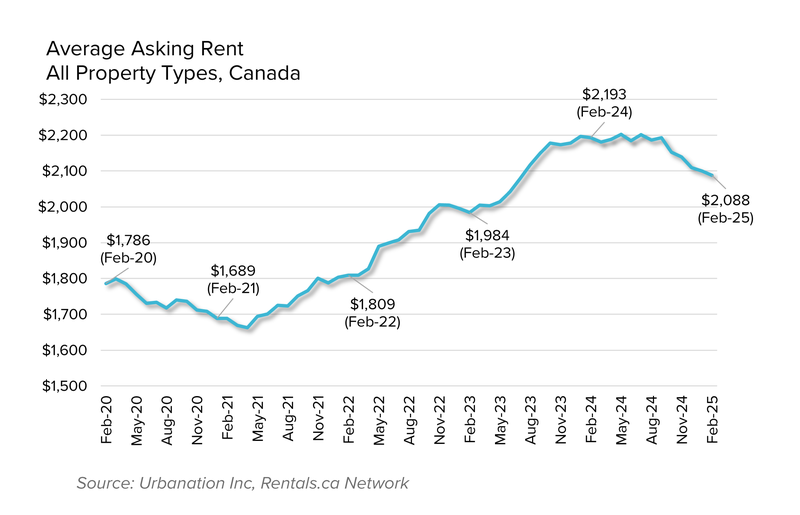
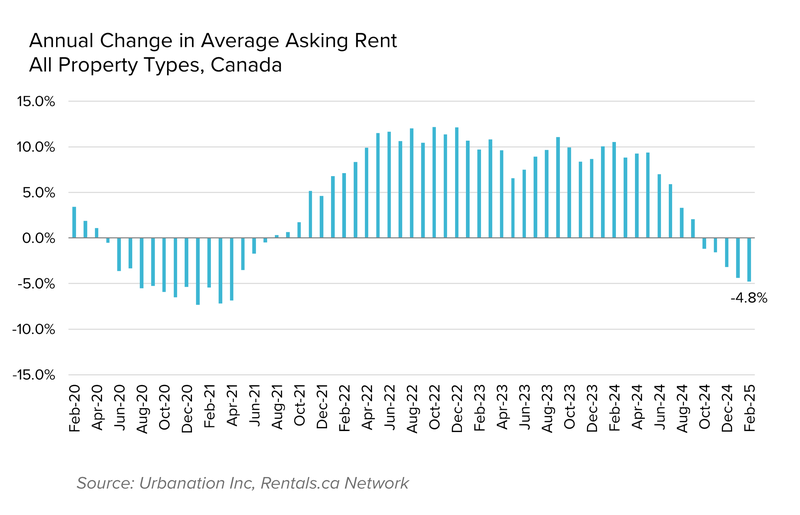
Average asking rents in Canada declined compared to a year ago for the fifth consecutive month in February, falling 4.8% to $2,088 — the lowest level since July 2023.
National Overview
Asking Rents in Canada Drop 5% in February
The year-over-year decrease in February was the steepest since April 2021 during the COVID-19 pandemic, representing a dramatic trend reversal from a year earlier in February 2024 when asking rents increased 10.5% annually.
Despite the recent decline, average asking rents remained 5.2% higher than two years earlier in February 2023 and 16.9% higher than the pre-COVID level five years ago in February 2020.
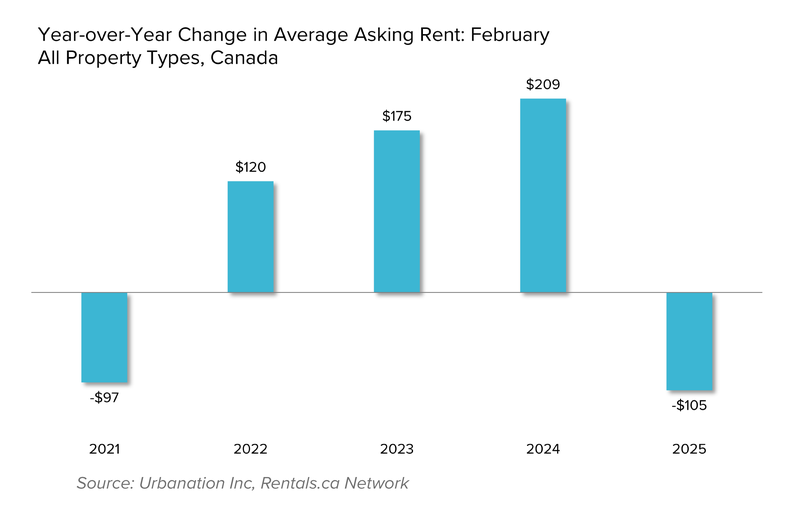
Since February 2024, average asking rents in Canada have fallen $105 per month, a larger annual decline than the one experienced during the pandemic from February 2020 to February 2021. In comparison, from February 2023 to February 2024, rents in Canada increased by $209 a month. Overall, average asking rents in Canada are still $302 per month higher than five years ago.
Condo Rents Fall to Lowest Level in Over Two Years
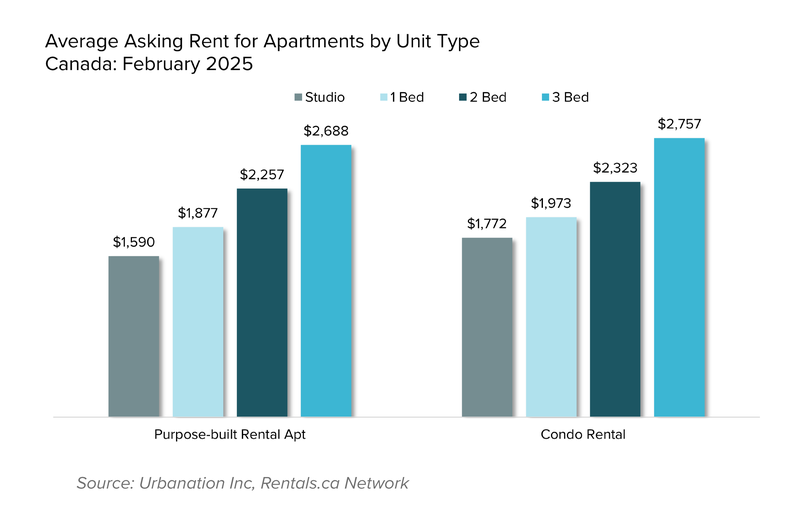
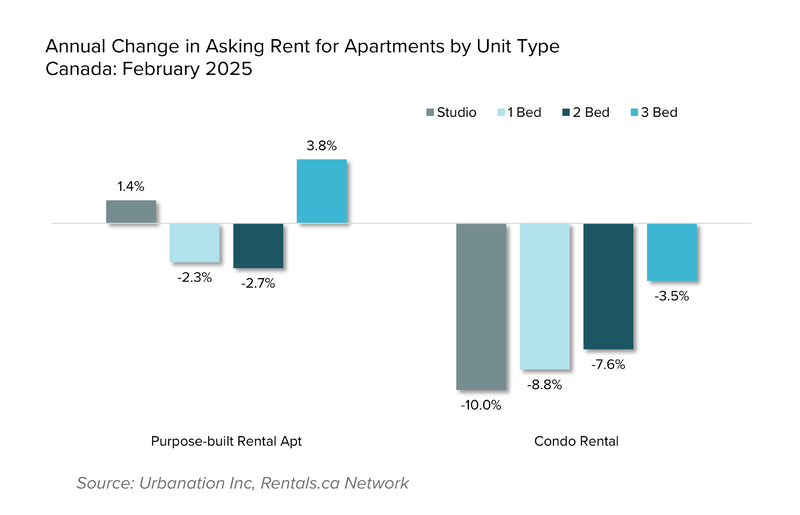
Average asking rents for condo apartment rents decreased 7.6% annually to a 26-month low of $2,192 in February, declining for the sixth consecutive month. The smallest condos experienced the largest rent decreases, with a 10.0% year-over-year drop in studio rents to $1,772 and an 8.8% annual decrease in one-bedroom rents to $1,973. Two-bedroom condo rents were down 7.6% from a year ago to $2,323, while three-bedroom condo rents experienced a milder 3.5% annual decrease to an average of $2,757.
Purpose-built apartment asking rents declined by 1.9% compared to a year ago to an average of $2,070, with annual rent decreases focused on one-bedroom units (-2.3% to $1,877) and two-bedroom units (-2.7% to $2,257). Meanwhile, purpose-built rents increased over the past year for the most affordable units in the market represented by studios (+1.4% to $1,590) as well as three-bedroom units (+3.8% to $2,688), which continue to show strong demand and low supply.
Provincial Overview
Ontario Represents the Majority of Rent Decline in Canada
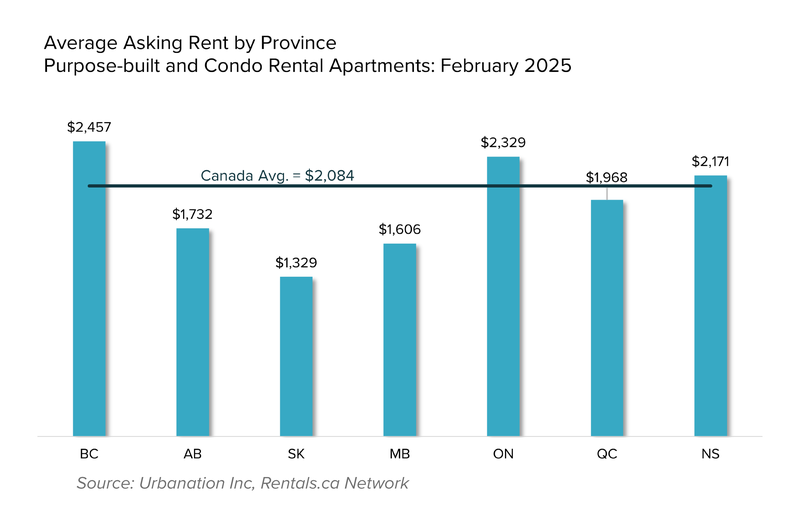
Overall, combined apartment rents for purpose-built and condo rentals decreased 2.9% annually in February to an average of $2,084.
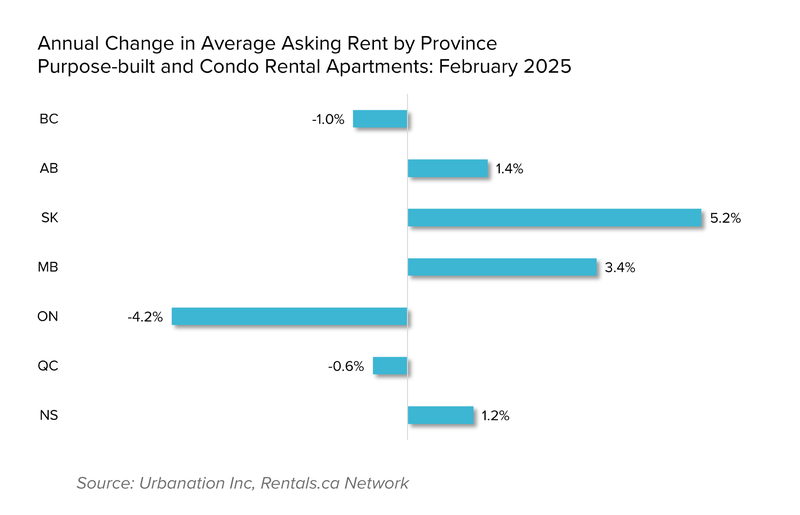
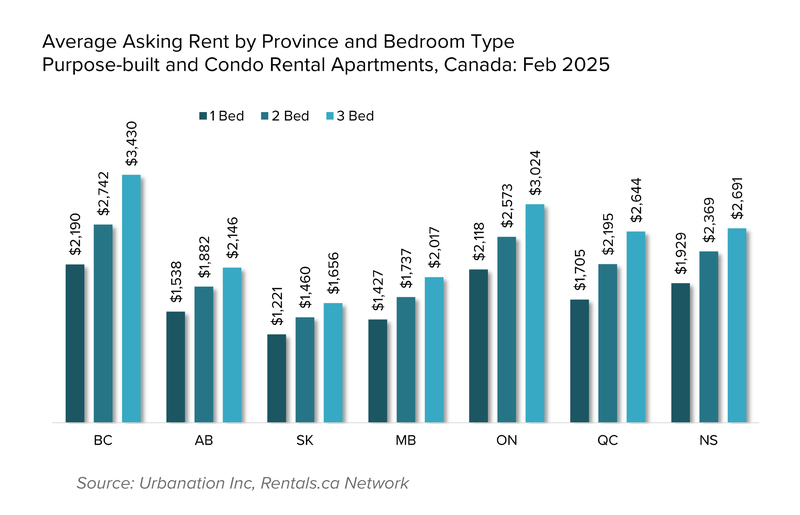
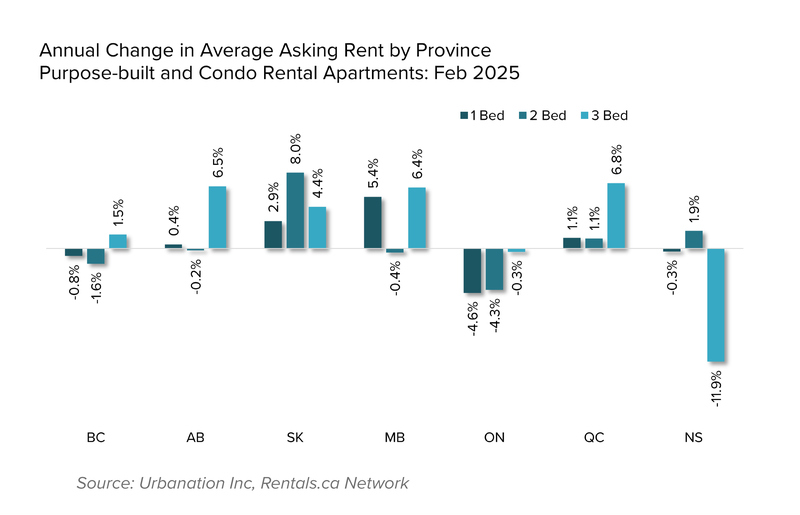
Annual rent declines for apartments were focused in Ontario (-4.2% to $2,329), B.C. (-1.0% to $2,457), and Quebec (-0.6% to $2,329). Marginal annual rent increases for apartments were recorded in Alberta (+1.4% + $1,732) and Nova Scotia (+1.2% to $2,171), with rent growth strongest in the most affordable provinces of Saskatchewan (+5.2% to $1,329) and Manitoba (+3.4% to $1,606).
Across most provinces, three-bedroom apartment rents performed best over the past year. Ontario three-bedroom apartment rents decreased only 0.3% annually to $3,024, while all other unit types in Ontario saw rents fall by over 4%. In B.C., three-bedroom apartment rents increased 1.5% annually to $3,430. Quebec had the strongest annual growth in three-bedroom apartment rents (+6.8% to $2,644), followed by Alberta (+6.5% to $2,146) and Manitoba to (+6.4% to $2,017).
Municipal Overview
Calgary Leads Rent Declines in Major Markets
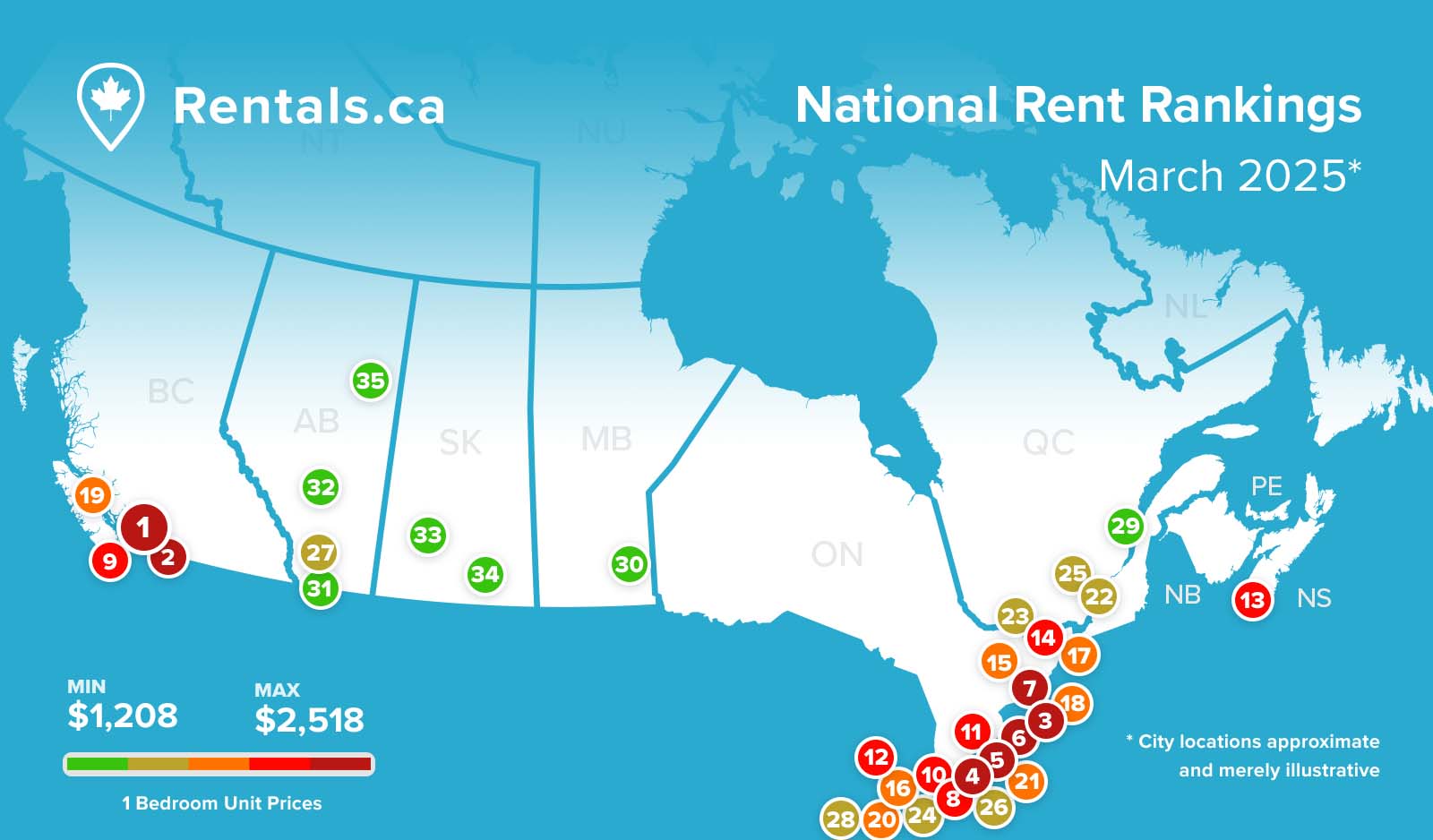
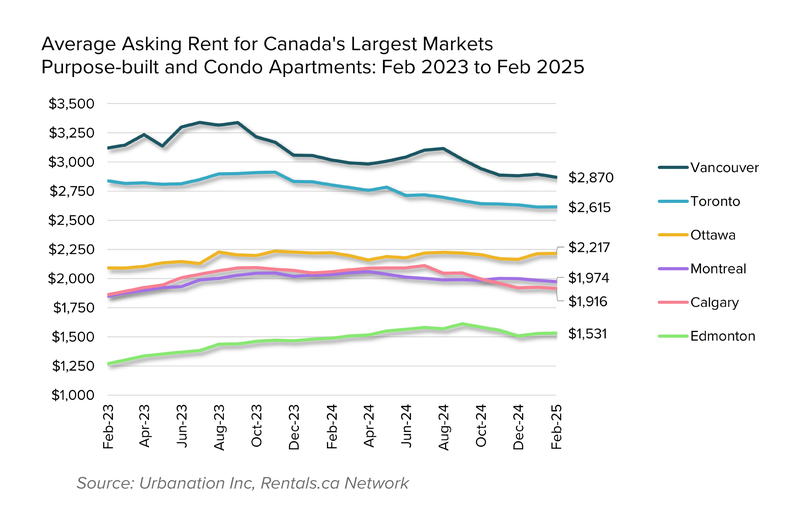
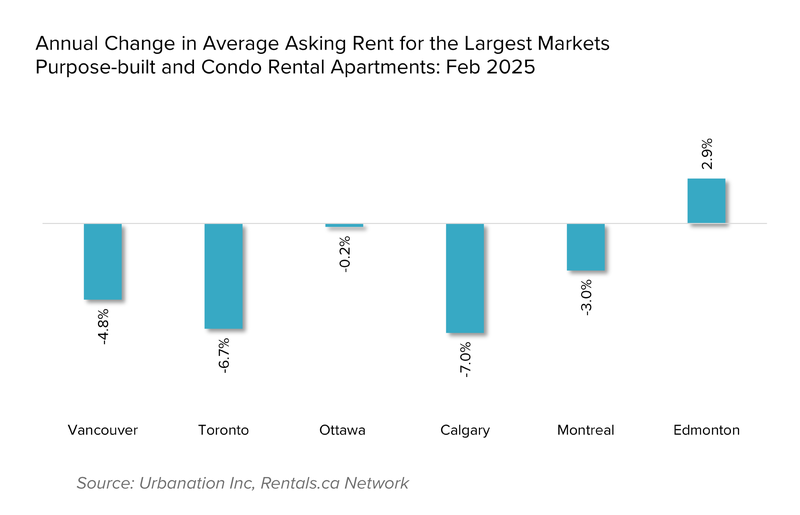
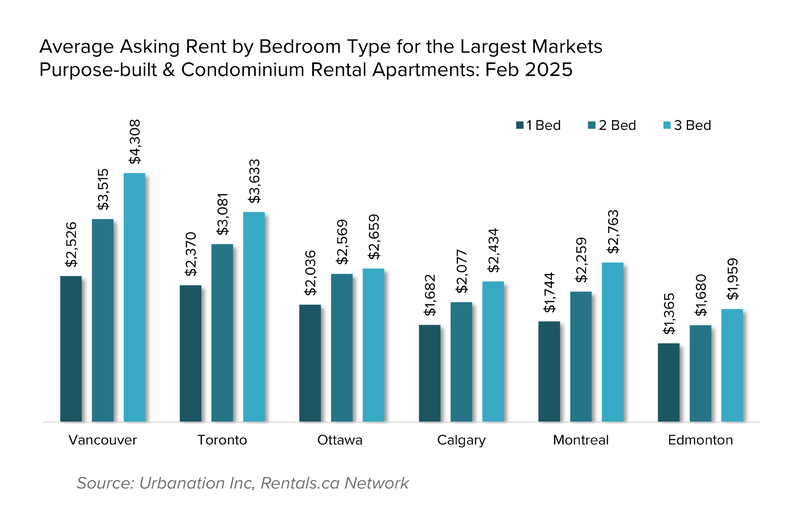
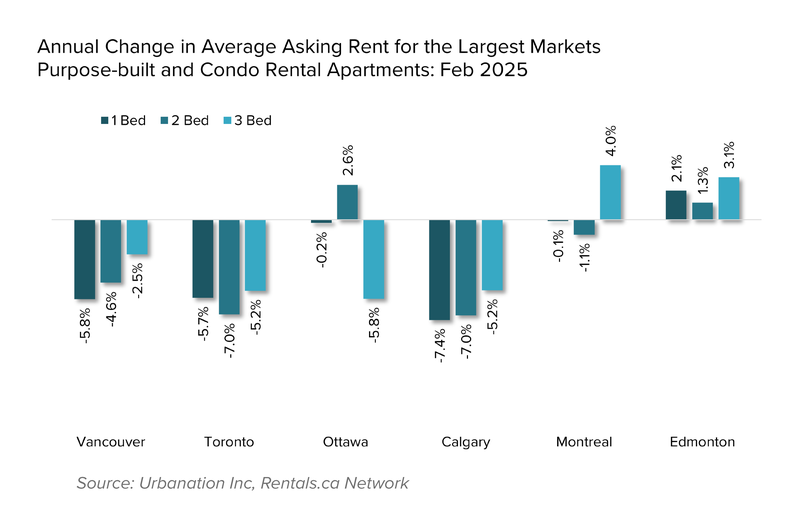
Apartment rents in Toronto were unchanged month-over-month at an average of $2,615 in February, remaining at a 2.5 year low and declining 6.7% year-over-year— the 13th consecutive month of annual rent declines. Vancouver asking rents for apartments declined 4.8% from a year ago to $2,870, which was the lowest level since April 2022 — a nearly three-year low. Calgary reported the biggest annual decrease in apartment rents amongst Canada’s largest markets with a 7.0% decline to an average of $1,916. Milder annual rent declines for apartments were reported in Montreal (-3.0% to $1,974) and Ottawa (-0.2% to $2,217), while Edmonton rents continued to rise on an annual basis in February (+2.9% to $1,531).
In Toronto, Vancouver, and Calgary, apartment rents declined over the past year across all units types, with the smallest decreases reported for three-bedroom apartments. In Toronto, the largest annual rent decline was reported for two-bedroom apartments (-7.0% to $3,081), while in Vancouver rents fell the most for one-bedroom apartments (-5.8% to $2,526). Studio and one-bedroom rents in Calgary saw the largest annual drops of 9.6% to $1,395 and 7.4% to $1,682, respectively.
Apartment rents grew on an annual basis for two-bedroom apartments in Ottawa (+2.6% to $2,569) and three-bedroom apartments in Montreal (+4.0% to $2,763). Rents grew across all unit types in Edmonton over the past year, led by a 9.1% increase in studios to $1,109 and a 3.1% increase in three-bedrooms to $1,959.
Ontario Includes Mix of Most Expensive and Affordable Rental Markets
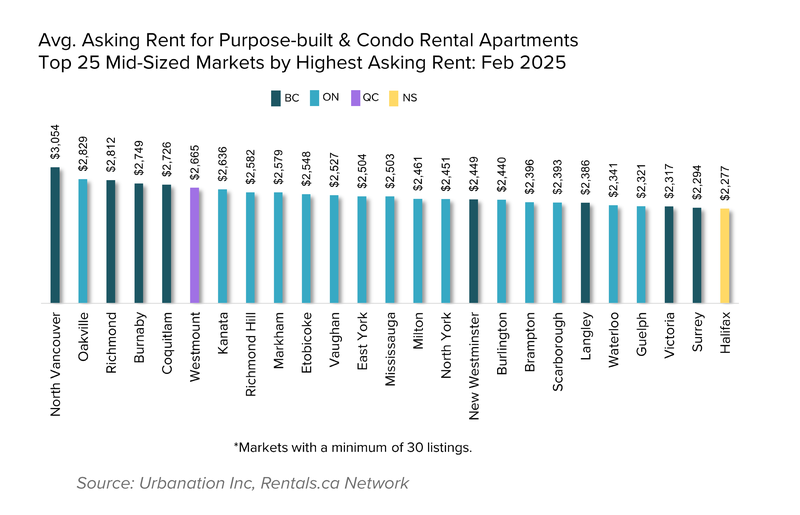
Four out of the top five most expensive small- and mid-sized markets for average apartment rents in Canada were located in B.C., including North Vancouver ($3,054), Richmond ($2,812), Burnaby ($2,749), and Coquitlam ($2,749). The second most expensive market in Canada was Oakville (ON) with an average apartment asking rent of $2,829. In total, 14 of the 25 most expensive small- and mid-sized markets were located in Ontario, including five in the top 10. Outside of the Greater Toronto Area, the most expensive Ontario market was Kanata, ranked seventh with an average apartment asking rent of $2,636. Westmount, an enclave of Montreal (QC), was the sixth most expensive market with an average rent of $2,665.
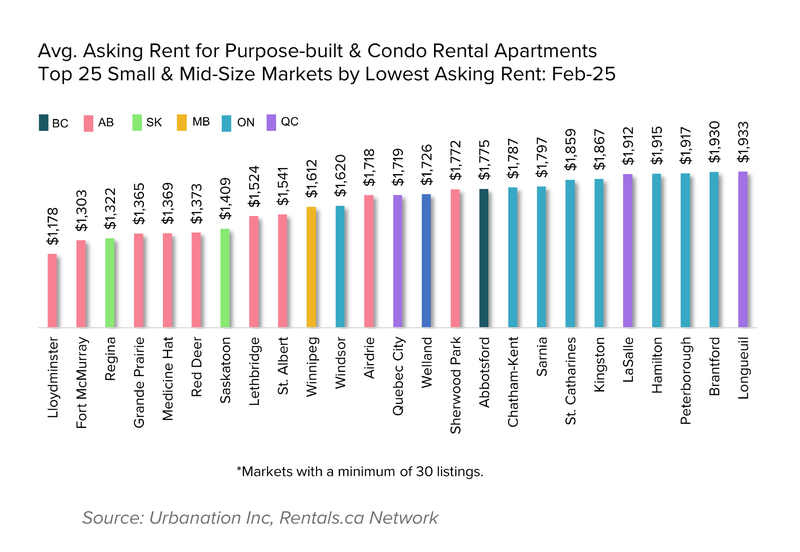
While dominating the list of most expensive markets, Ontario also represented 10 of the 25 most affordable markets in Canada for small- and mid-sized cities. Markets with the lowest average apartment asking rents in Ontario included Windsor ($1,620), Welland ($1,726), Chatham-Kent ($1,787), Sarnia ($1,797), and St. Catharines ($1,859). Seven of the top 10 most affordable markets in Canada were located in Alberta, led by Lloydminster and Fort McMurray with average apartment asking rents of $1,178 and $1,303, respectively. Outside of Alberta, the most affordable markets in Canada were Regina ($1,322), Saskatoon ($1,409), and Winnipeg ($1,612).
Quebec City Becomes the Fastest Rising Market for Rents in Canada
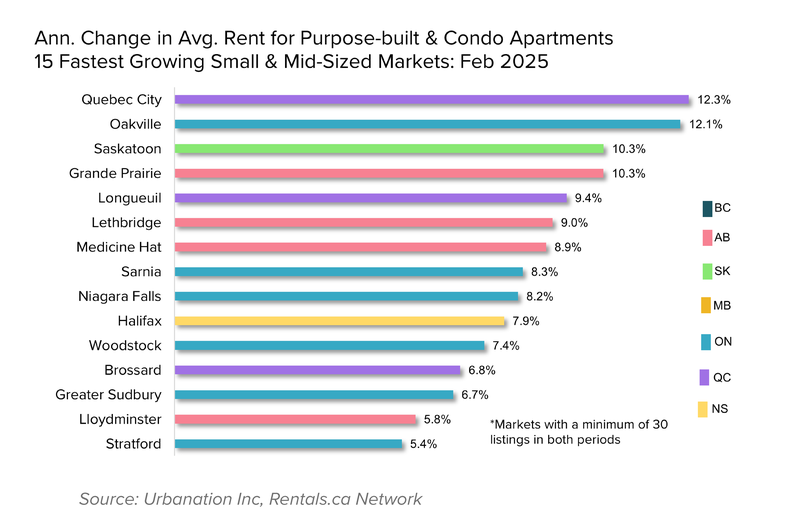
The fastest rising market in Canada for apartment rents in February was Quebec City with annual growth of 12.3%. This was followed by a 12.1% annual increase in Oakville. Other Ontario-based markets ranked amongst the fastest rising for apartment rents in February included Sarnia (+8.3%), Niagara Falls (+8.2%), Woodstock (+7.4%), Greater Sudbury (+6.7%), and Stratford (+5.4%). Within the top five, Saskatoon (SK) and Grande Prairie (AB) both recorded annual rent growth of 10.3%, and Longeuil (QC) saw rents rise 9.4% from a year earlier.
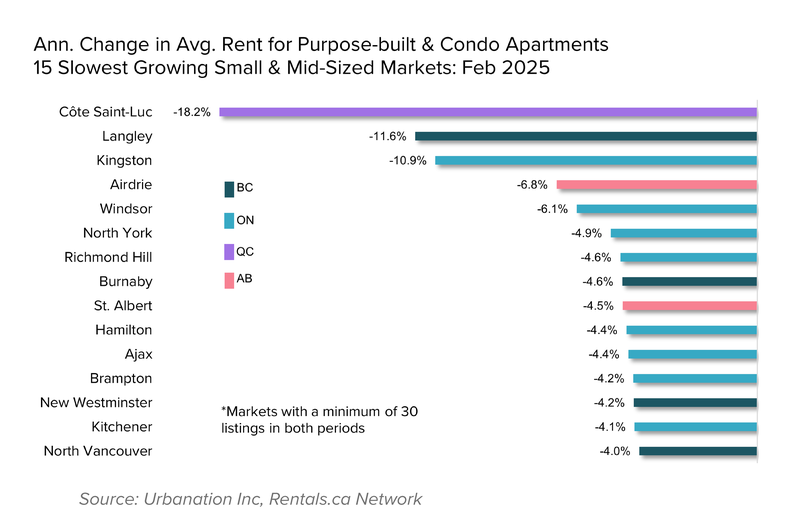
Cote Saint-Luc (QC) saw the steepest annual decline in average asking rents for apartments (-18.2%), although this was mainly due to a compositional shift away from high-priced rentals in the market last year. Most cities with the largest annual rent declines were located in Ontario, led by Kingston (-10.9%), Windsor (-6.1%), and North York (-4.9%). Langley saw the largest rent decline in B.C. with an 11.6% annual decrease. In Alberta, rents fell the most among small- and mid-sized cities in Airdrie (-6.8%) and St. Albert (-4.5%).
Shared Accommodation Rents Drop 8% in Toronto and Montreal
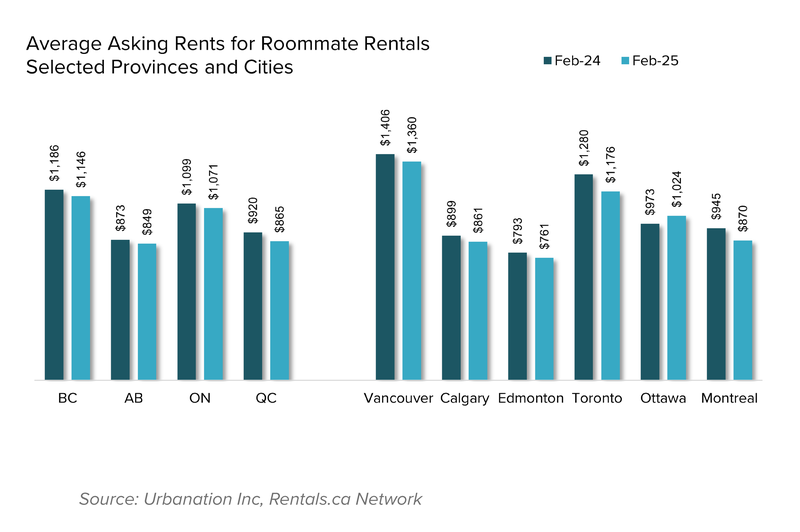
The number of shared accommodation rental listings slowed in February, decreasing 29% from the record high in January and edging down 0.6% from a year ago. At an average of $964, shared accommodation rents were 4.6% lower than last year.
Shared accommodation rents decreased over the past year across each of the four provinces tracked for this form of rental. Larger urban centres such as Toronto, Vancouver, Calgary, Edmonton and Montreal all saw annual rent declines for shared accommodations in February, with the largest annual drops experienced in Toronto (-8.2% to $1,176) and Montreal (-8.0% to $870).
You can check out the previous rent reports here.

Rentals.ca is Canada’s premier online marketplace for renters and landlords, providing a comprehensive suite of tools and resources tailored to simplify the rental process. With an extensive selection of listings across the country, Rentals.ca offers user-friendly search functionality that helps renters find their perfect home efficiently. For landlords, Rentals.ca delivers effective advertising solutions to maximize visibility and fill vacancies faster. Committed to innovation and excellence, Rentals.ca aims to empower users with up-to-date market insights and expert guidance, making renting easier and more accessible for everyone.