
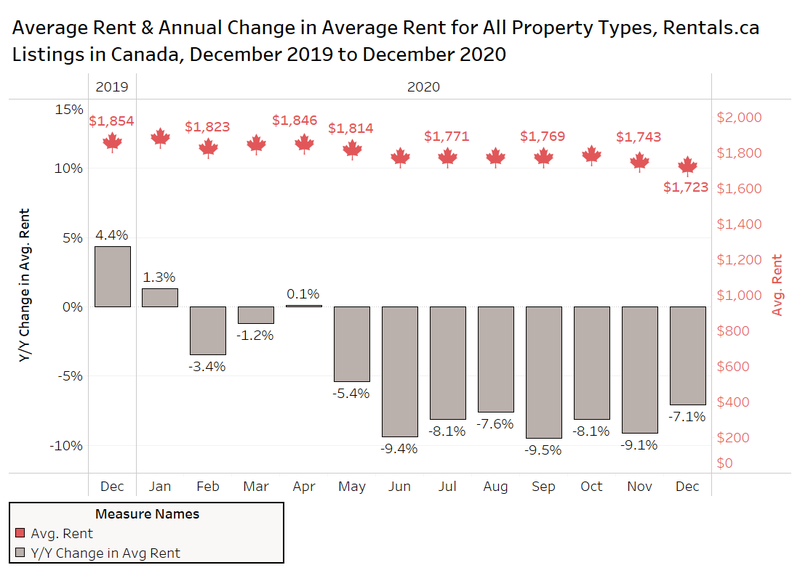
The average rent for all Canadian properties listed on Rentals.ca in December was $1,723 per month, down 7.1% annually and 1.1% from November 2020. The Canadian rental market weakness continued in the final month of the year, but the 7.1% year-over-year drop was the lowest rate of decline since May.
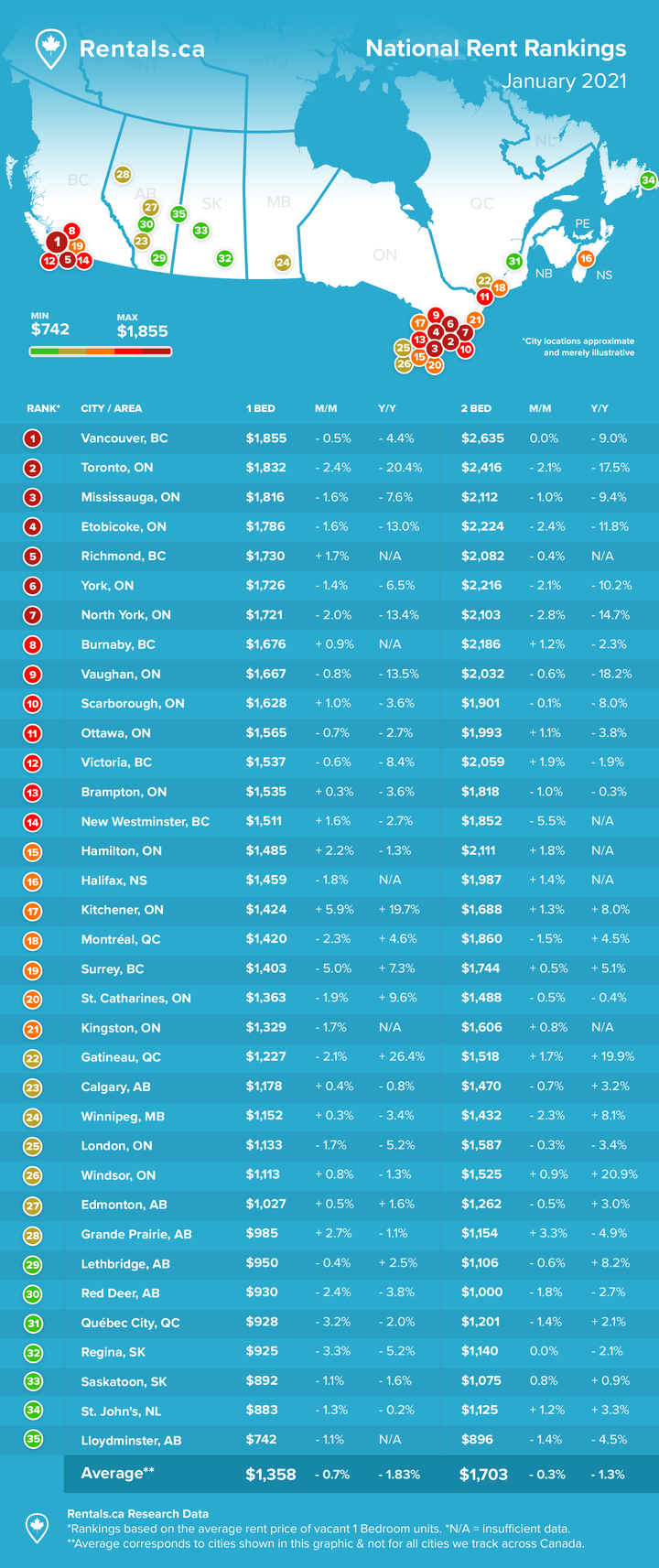
Rentals.ca January 2021 Rent Report
Rentals.ca January 2021 Rent Report
1. National Overview
The chart below shows the average monthly asking rent for single-family housing, townhouses, rental apartments, condominium apartments, and basement apartments cumulatively from December 2019 to December 2020 (red), with the annual change in average rent represented by the grey bars.
At the end of 2019, the average rent was $1,854 for all property types (Dec 2019), which was up 4.4% annually. A tenant looking for a rental property in December 2020 was looking at a savings of approximately $130 on average from a year earlier.
 National Rental Rates by Quarter
The chart below shows the average rent for all property types in Canada by quarter via Rentals.ca listings over the past two years (top panel). Also shown is the average rent per square foot by quarter (bottom panel). Not all listings make their unit size available, and those that do tend to skew toward newer properties, thus making the figure higher than it normally would be.
The average rent was $1,750 per month on average in Canada in Q4-2020, a decline of 8% annually. Overall in 2020, the average rent was approximately $1,794 per month, down 5.7% from the previous year.
The average rent per square foot (psf) was $2.30 in the fourth quarter of 2020, nearly identical to the $2.31 psf from Q4-2019. The big difference is the average unit size, which has declined from 933 (square feet) to 847 sf from the fourth quarter of last year to Q4-2020.
 Rental Rates by Property Type
The chart below looks at the average monthly rent, average rent per square foot and median rent for single-family properties (single-detached and semi-detached houses), condominium apartments, and rental apartments in Canada via Rentals.ca listings in the fourth quarter of 2018, 2019 and 2020.
The average single-family home was offered at $2,547 per month in December 2018, rising 2.2% to just over $2,600 in December 2019. The average rent declined 9.3% in 2020 to $2,361, despite the fact that the average rent per square foot was virtually unchanged.
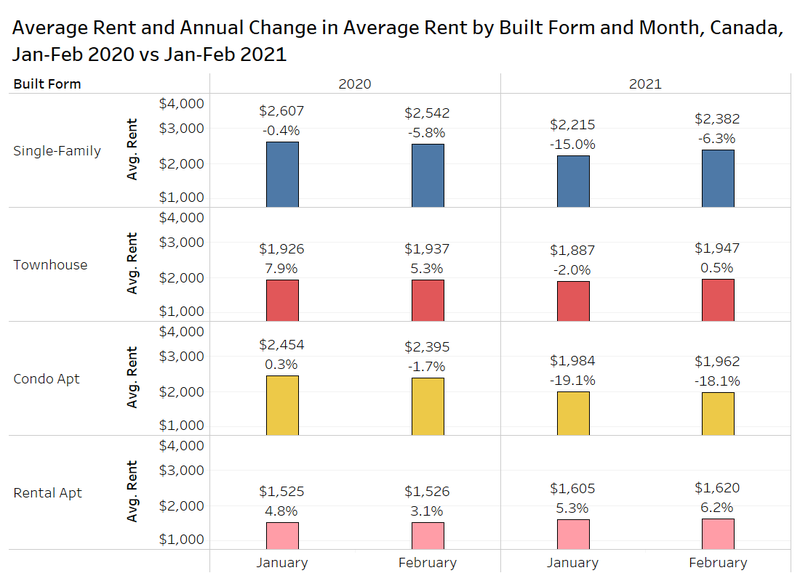 Condominium apartments experienced a significant drop in average rents in 2020, falling 18.5% annually to $2,009 per month from $2,465 per month in December 2019. The average rent per square foot declined by 16.1% annually in December 2020 to $2.77 psf. Rent per square foot had declined slightly in December 2019 as well, falling to $3.30 psf from $3.41 psf on average in December 2018.
Rental apartments bucked the trend in 2020, rising by 8.4% year over year to $1,603 in December 2020. However, it is important to reiterate here that this report looks at asking rents only, not the actual lease rates. Some landlords are negotiating discounts, and for more expensive properties, they are offering one or two months free rent or other incentives like gift cards. Secondly, there were a number of new apartment completions in 2020, and increased vacancies in new properties over the past couple of years (the new units are slower to absorb and sitting on the market for several months), contributing to the rise in the average listing rental rate.
Rent versus Unit Size for Condo & Rental Apartments by Bedroom Type
The chart below plots all of the condominium apartment and rental apartment listings on Rentals.ca that are one bedroom, two bedroom, or three bedrooms (where unit sizes were available). The vertical axis shows the rent (outliers excluded), while the horizontal axis shows the unit size using fourth-quarter data from 2018, 2019 and 2020. The year of the listings is represented by the colour.
Three linear trendlines are also drawn that represent the individual years. For both one-bedroom and two-bedroom units, the 2020 trendline (purple) is below both the 2018 and 2019 trendlines. For three-bedroom units, the trendline is higher than in previous years, which suggests that in the “work-from-home” era, additional space was in demand, driving up rental rates.
 If we insert a unit size into the equation of the trendlines, a 600-square-foot one-bedroom apartment would have been worth about $1,795 per month in rent in Canada in the fourth quarter of 2018, $1,720 per month in Q4-2019, and $1,610 per month in Q4-2020, a 6.4% annual decline.
An 800-square-foot two-bedroom apartment would have been worth about $1,880 per month in Q4-2018, $1,920 per month in Q4-2019, and $1,855 per month in Q4-2020, a 3.4% annual decrease in 2020.
Before presenting the data on three-bedroom suites, it should be noted that there are fewer new three-bedroom condo suites, so this data is more reflective of older rental apartments, and thus lower rent levels. A 1,000-square-foot three-bedroom unit was worth about $1,750 per month in Q4-2018, $1,830 per month in Q4-2019, and $1,980 per month in Q4-2020. The average rent in the fourth quarter of 2020 was up 8.2% annually.
2. Provincial Rental Rates
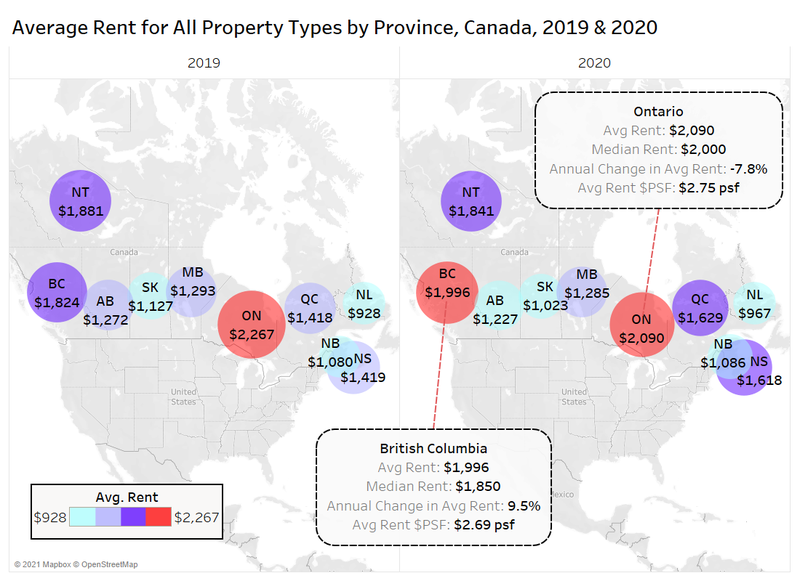
The chart below looks at the average rent for all property types by province in 2019 and 2020.
The average rent in British Columbia was up 9.5% annually in 2020 to $1,996 per month, while Ontario’s rent declined by 7.8% annually to $2,090 per month.
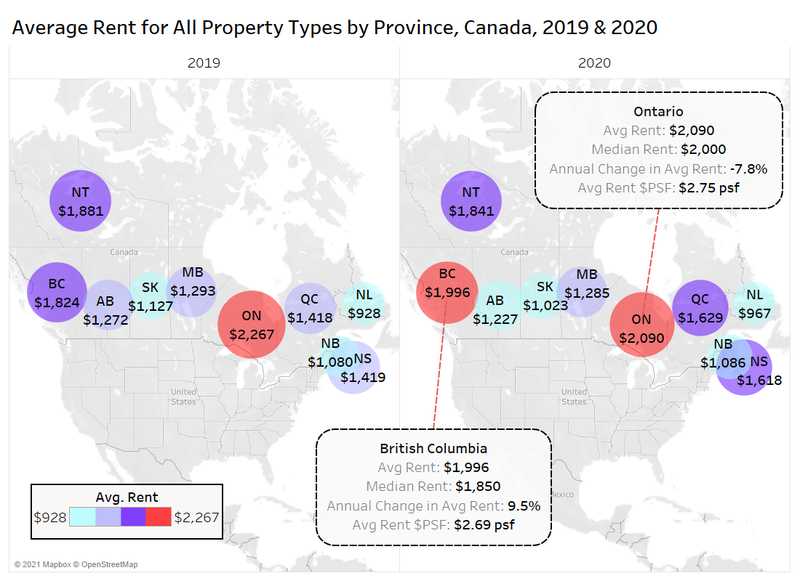 Quebec also experienced a significant increase in average rent in 2020, rising by almost 15% annually to just under $1,630 per month. What is even more impressive is that Quebec’s rent increased this much with an 11% decline in the average unit size. Keep in mind that the Rentals.ca data represents a sample of listings in the overall market that can shift every month based on the composition of the listings from large single-family homes to tiny basement apartments.
Average Rent by Property Type in British Columbia, Alberta, Ontario and Quebec
The chart below looks at the average rent in 2019 and 2020 for all property types in British Columbia, Alberta, Ontario and Quebec based on listings data from Rentals.ca.
In each of the four provinces, the average rent for single-family homes has declined. Alberta experienced the biggest drop at 10% with Quebec experiencing the lowest drop at 1%.
Condo apartment rents also declined in all four provinces, with Ontario and Quebec both experiencing declines of 9.3% annually, but Alberta has the lowest percentage fall (-3%).
 The largest sample of listings on Rentals.ca is rental apartments, and thus the most reliable measure of market conditions. However, the results are not consistent with the findings for single-family and condo apartments in BC, Ontario and Quebec. In Alberta, the average lease rate for rental apartments declined 4.4% annually from $1,223 per month in 2019 to $1,169 per month in 2020.
In BC, the average rent increased by 13% annually, rising from $1,609 per month to $1,820 per month. In Quebec, the average rent increased by 20% annually, rising from $1,321 per month to $1,586 per month. Again, it must be reiterated that these are listing rents, and as the pandemic wore on, there was less demand for expensive centrally located apartments, and therefore more listings in those markets. In BC in 2019, rental apartment listings in Vancouver accounted for 24% of the listings, in 2020, that share rose to 42%. In Quebec, listings for rental apartments in Montreal made up 62% of the total, rising to 79% in 2020.
Despite the “urban exodus” theory that has been discussed in previous National Rent Reports, the same phenomenon hasn’t occurred in Ontario, with the former City of Toronto accounting for 36% of rental apartment listings in 2019 and 32% in 2020. There has not been a substantial increase in rental apartment supply in the former City of Toronto.
3. Municipal Rental Rates
Annual Change in Rent for Top Municipalities in Canada for Condo and Rental Apartments
The chart below looks at the annual change in average rent for condominium and rental apartments in December 2020 for select municipalities in Canada (and former municipalities prior to amalgamation in Toronto).
Three markets experienced significant rent growth in December 2020 compared to December 2019, including Gatineau at 21.8%, Kitchener at 16.8% and Hamilton at 15.1%.
Six major markets experienced double-digit rent deflation year over year, from Ottawa at -10% to Toronto at -19.4%.
Looking at municipalities in the Greater Toronto Area, the average rent is fairly close in many areas at around $2,000 per month — see Mississauga, York, North York, Etobicoke, Oakville, Toronto. The locational advantage of downtown has shrunk, but hasn’t been completely eliminated due to the differences in unit sizes (will be explored further at the end of this report).
 Annual Change in Average Rent by Municipality for All Property Types in Southwestern Ontario
The chart below looks at the annual change in average rent by municipality in southwestern Ontario in 2020 (this is data for all of 2020, not just December). The data is inclusive of all property types for the most active areas on Rentals.ca.
Hamilton experienced the highest growth at 24% annually, followed by Kitchener at 17% and London at 16%. Markham, North York and Mississauga all dropped by 7% annually, with Toronto down 9%.
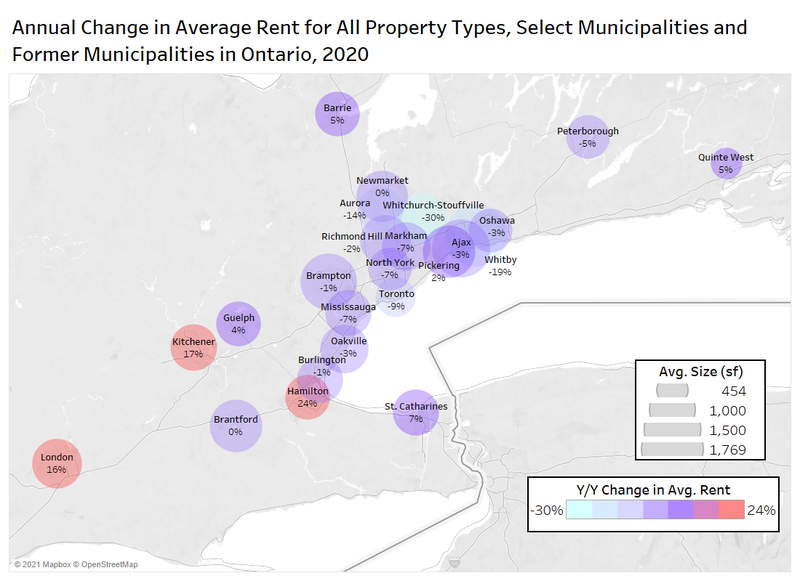 Several smaller municipalities experienced growth in excess of inflation in 2020 despite the pandemic, including Guelph at 4%, Barrie and Quinte West at 5%, and St. Catharines at 7%.
GTA Condo Rental Market Per Square Foot
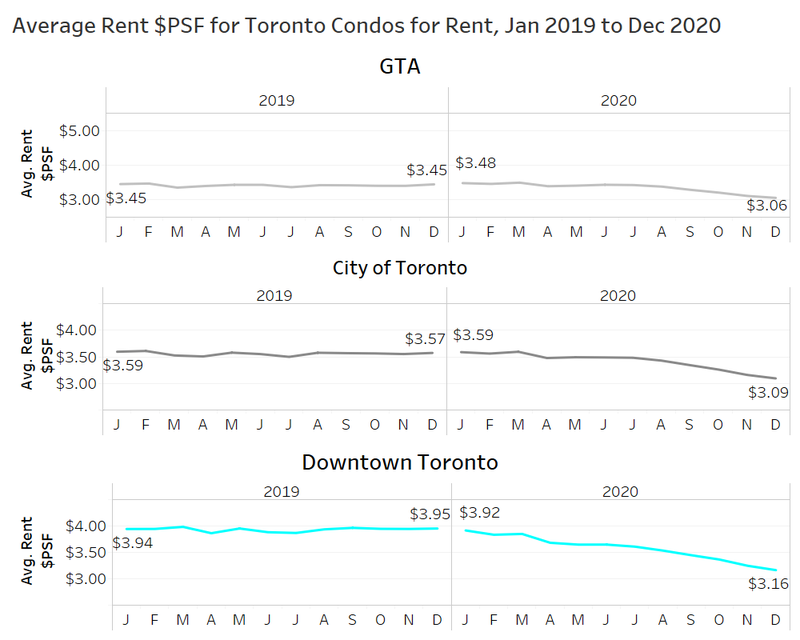
In 2019, the average rental rate per square foot for condominium apartments for rent in the GTA was flat at $3.45 psf. The same stagnant rent level was experienced in the city of Toronto at about $3.58 psf, and downtown Toronto at $3.95 psf.
However, condo investors are being hit hard during the pandemic, with GTA average rents per foot down 11.3% annually, the amalgamated City of Toronto has seen rents decline by 13.4% annually, and downtown Toronto has seen average rents decline by 20% annually.
The downtown or central Toronto rent premium has nearly evaporated.
 Rental Rates for 600-square-foot Condos in the GTA
Is it really that much cheaper to rent a unit outside of the downtown core than elsewhere in the GTA? Looking at units on an apples-to-apples basis can help answer that question.
The chart below looks at condominium apartments for rent in the GTA that are rounded to 600 sf (550 sf to 649 sf) in December 2019 and December 2020 for projects completed over the past 10 years. The downtown comparable is Massey Tower at 197 Yonge Street, which had 600-square-foot units for lease at about $2,250 per month in December 2019. Those 600-square-foot units were offered at $2,426 per month on average by February 2020, but have slowly declined during the pandemic, hitting $1,956 in December 2020, a decline of 20.4% from their February peak (note that this data is not controlling for the actual floor plan, the floor the unit is on, or any upgrades made to the suite).
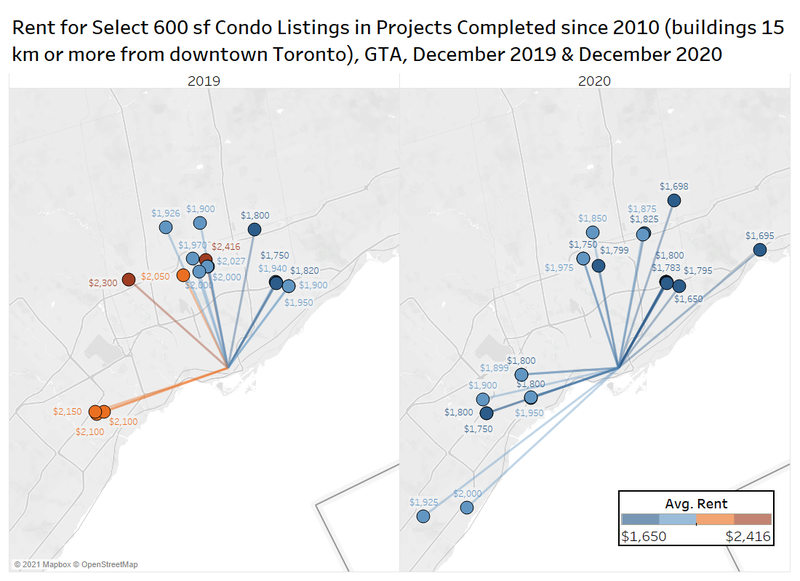 In December 2019, The Avenue on 7 project in Vaughan, had a 600-square-foot unit offered at $2,300 per month, higher than the Massey Tower average rent. Minto Wintergarden, a straight shot up Yonge Street to Vaughan has a 600-square-foot unit for $2,461 per month. If you headed to the Scarborough City Centre, 600-square-foot units were available from $1,750 per month to $1,940 per month, a discount to Massey Tower of as much as 20%. In the Mississauga City Centre area, 600-square-foot units were available for around $2,100 to $2,150 per month, a 5% discount from Massey Tower. Note that many (if not most) of the small units in Massey Tower do not come with a parking space.
In December 2020, rents in the Scarborough City Centre have declined to a range of $1,650 to $1,800, with the discount to Massey Tower now as much as 15%. The Mississauga City Centre has 600-square-foot units at about $1,850 on average, the same 5% discount to Massey Tower.
In December 2020, there were a few examples even farther from downtown. In Pickering, a 600-square-foot unit was listed at $1,695 per month, a 13% discount from Massey Tower. A 600-square-foot unit was offered at a suburban condo project in north Oakville at $1,925 per month, just 1% less than Massey Tower at Yonge Street and Queen Street in downtown Toronto.
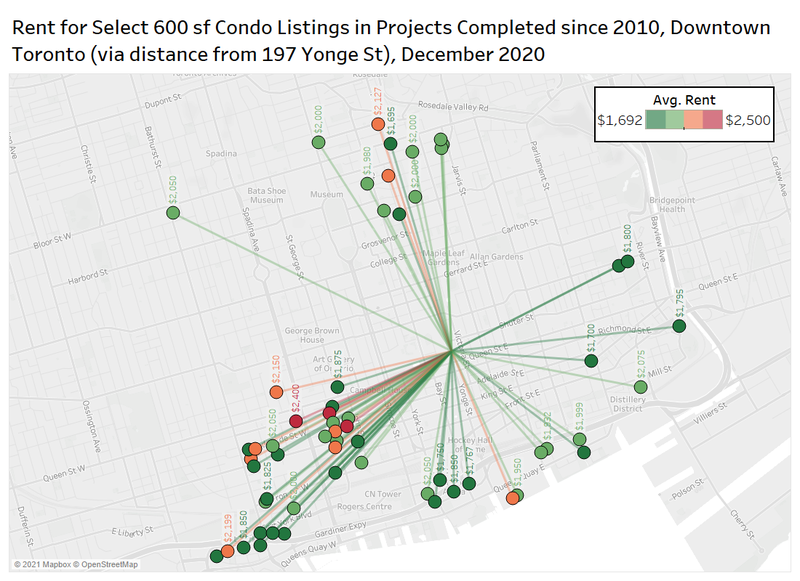
The next figure looks at rents for 600-square-foot condos in downtown Toronto in December, linked to Massey Tower at 197 Yonge Street.
There is a unit at One Bloor at Yonge Street for $1,695 per month, the same as Pickering. There are suites for $2,000 a month at Yorkville Plaza at 155 Yorkville Avenue and Casa 3 at 50 Charles Street East, the same rent level as a unit in Oakville’s Kerr Village. It is $200 cheaper to rent a unit in River City 3 in Toronto’s West Don Lands community at 170 Bayview Avenue, than a unit in the Thornhill City Centre.
4. Conclusion
Needless to say, the Rentals.ca and Bullpen Research & Consulting rent forecasts from December 2019 were not very accurate. The COVID-19 pandemic threw a monkey wrench into the rental market in Canada.
The biggest factors that resulted from the pandemic were job loss for workers lower in the pay spectrum, and a major decline in immigration. Most lower-income workers rent, and many (if not most) immigrants, international students, and temporary workers rent when they first arrive in Canada. These factors pulled significant demand from the market.
To help stimulate the economy, interest rates were lowered, which incentivized many renters with stable employment to buy their first home. Many tenants and buyers purchased property outside of the major centres, or simply moved in with a parent/relative, or into the family cottage. All of these factors significantly reduced demand in the most expensive markets in the country as well.
On the supply side, the lack of tourism has reduced the usage of short-term rentals, and further legislation against these suites has also reduced their usage. These properties have made their way to the long-term rental market, boosting rental supply. Secondly, Canada is building more units than it has in decades, including a higher share of rental apartments than in the past 25 years, which has added more supply.
Landlords have been forced to offer big incentives to entice tenants to their properties; these incentives are not captured in the data here. The true impact of the pandemic can’t be fully understood without netting out those incentives, which are not always made available to the public.
The eviction ban and difficulty in collecting full payment from tenants may result in fewer investors buying rental properties, and fewer developers building rental properties. However, the impact of those decisions might not be felt for many years.
The vaccines rollout appears to be occurring at a slow pace, and the second wave of COVID-19 is showing no signs of slowing either, so our expectation is that rental rates will continue to decline over the next three to four months, perhaps longer.
One positive for landlords is the resale housing market remains strong, which will entice some landlords to sell their properties and reduce rental supply. There will be some price-rent arbitrage that will occur.
Please keep checking this link every month for an updated report on the state of the rental market in Canada.
Rentals.ca Data
The data used in this analysis is based on monthly listings from Rentals.ca. The data is much different than the more familiar numbers collected and published by Canada Mortgage Housing Corporation (CMHC).
Rentals.ca data includes basement apartments, rental apartments, condominium apartments, townhouses, semi-detached houses and single-detached houses, where CMHC’s primary rental data only includes rental apartments and rental townhouses. CMHC collects some data on the secondary market, but it is reported separately.
The CMHC rental rates are based on the entire universe of purpose-built rental units in Canada (the stock), while Rentals.ca data is primarily based on the asking rents of vacated units only (the flow) — this is a smaller sample size, but more representative of the actual market rent a prospective tenant encounters. The Rentals.ca data set typically produces much higher rental rates in comparison to CMHC, as vacated units are not subject to rent control.
The average and median rental rates via Rentals.ca can also skew higher than CMHC’s data for several reasons: The inclusion of larger and more expensive unit types like singles, row units and condos; the survivorship bias (overpriced units remain in the sample longer); and the multiple listings of the same property at different rent levels every month.
It should also be noted that properties listed for above $5,000 a month and below $500 a month are eliminated from the sample of units analyzed. Also, short-term leases, single-room rentals, and furnished rental units are eliminated from the sample where identifiable.

Rentals.ca is Canada’s premier online marketplace for renters and landlords, providing a comprehensive suite of tools and resources tailored to simplify the rental process. With an extensive selection of listings across the country, Rentals.ca offers user-friendly search functionality that helps renters find their perfect home efficiently. For landlords, Rentals.ca delivers effective advertising solutions to maximize visibility and fill vacancies faster. Committed to innovation and excellence, Rentals.ca aims to empower users with up-to-date market insights and expert guidance, making renting easier and more accessible for everyone.