

It’s no secret that Canada is in the midst of a housing crisis. Renters face heightened competition due to increased population growth, rising interest rates, and a shortage of new housing developments, leading to intense market competition for a diminishing pool of affordable rentals. However, since the summer of 2023, asking rents in some of Canada’s largest markets like Toronto and Vancouver have been steadily declining. Simultaneously, the number of unique renters to submit a lead online dropped by approximately 26% nationally. This prompted us to delve deeper into the data, as more research would be required to understand the overarching trends across Canada.
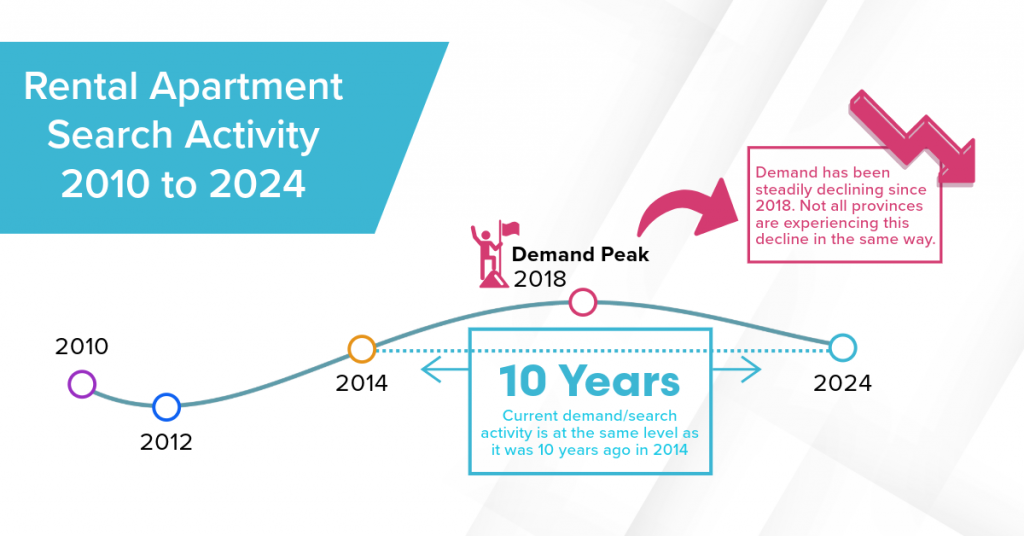
By blending Google trends data with our internal tracking metrics, we can better understand the long-term shifts in demand, the peaks, the troughs and where the Canadian rental landscape is likely headed.
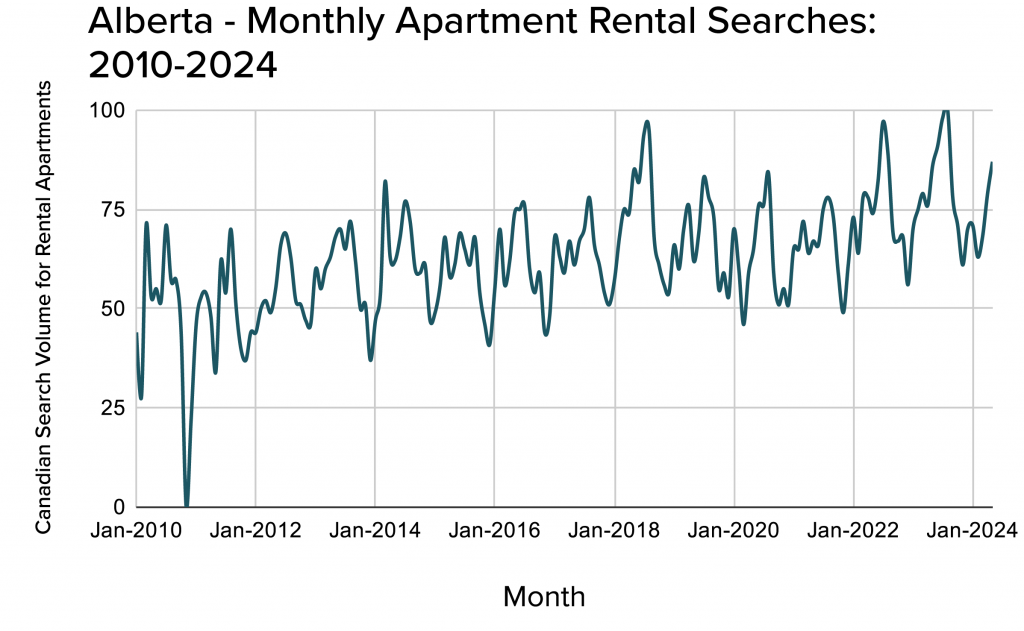
In the early 2000s, demand was relatively flat, with demand increasing gradually starting in 2013. Peak rental demand in Canada reached its apex in July 2018 at nearly triple the activity seen in 2013. However, this surge was not evenly distributed across the provinces. Alberta, in particular, showcased a unique trajectory, experiencing distinct peaks in 2018, 2022, and 2023.
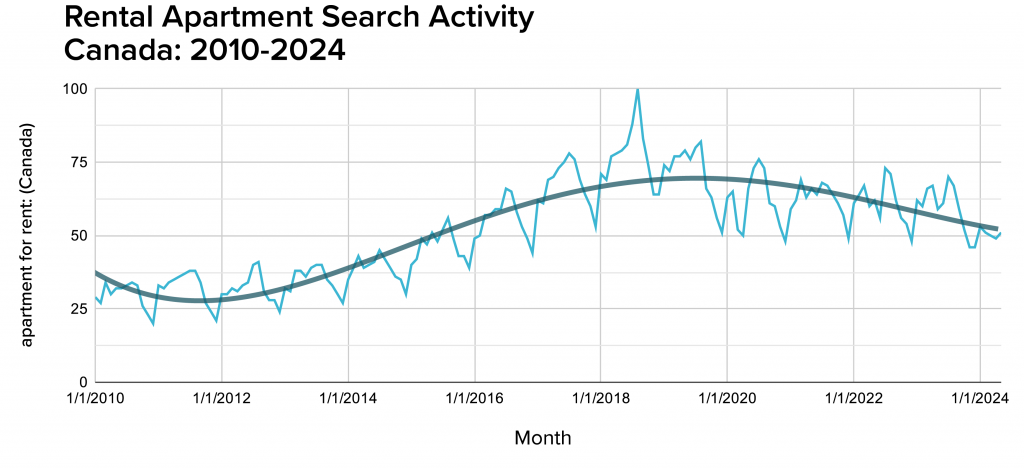
Google Trends data over the past year in Canada shows a decline of approximately 10% year over year May 2023 to May 2024). Our internal data shows an even more dramatic decline in unique renters of over 26% over the same period. Month-over-month, unique renters were down -2.6% in May 2024, which is a stark contrast to the 13% increase in April 2024 compared to March 2024 . When looking over a 2-year time period, we can see unique renters are down over 37% in May 2024 compared to May 2022.

Unique renters are down by 26% year over year, while leads are down by 20% . This means the average leads submitted per renter are up by 7.3% compared to the same time last year, as renters are submitting more leads out of necessity as they try to find the ideal property offering the right combination of features, at the right price.
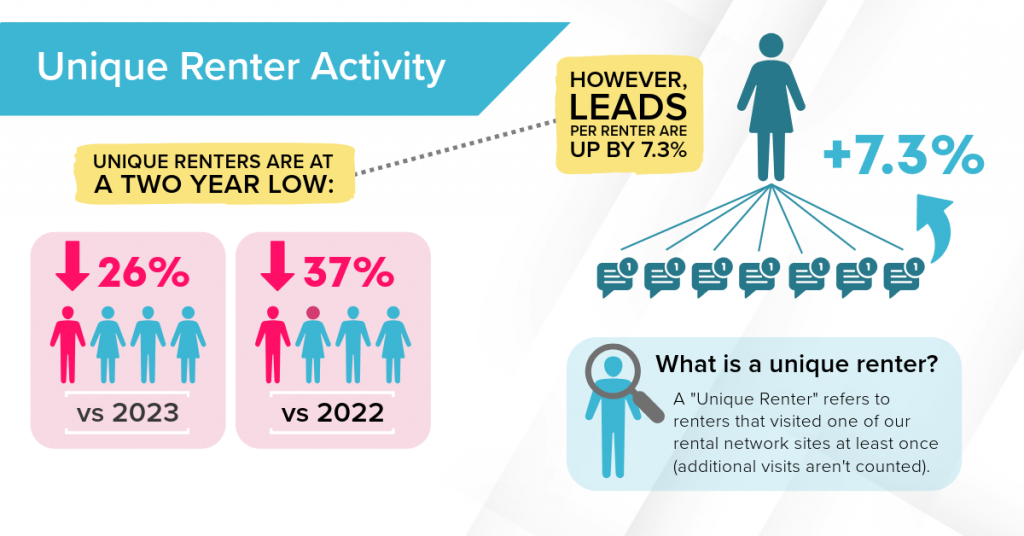
When we look at month-over-month data, however, both unique renters and leads are trending down, suggesting that over a shorter period, demand is slowly declining with unique renters down by 2.6%, and leads down by almost 4.4% month over month. With fewer unique renters remaining in the market, those who stay are more selective and are gradually submitting fewer leads.
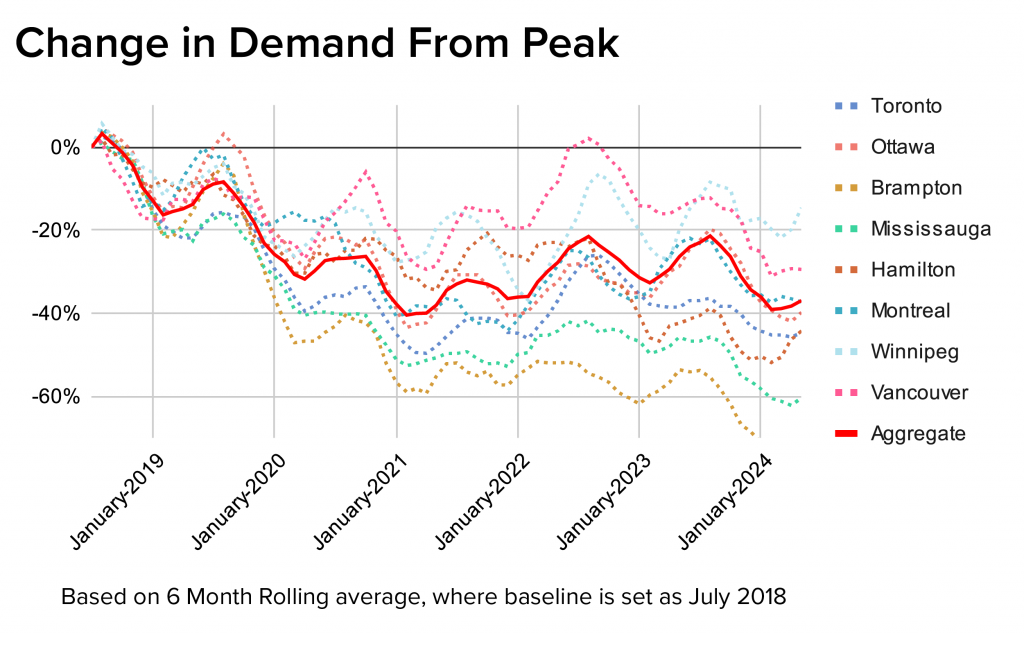
In 2024, Canada is seeing demand levels comparable to those in 2015, as overall demand has steadily declined since peaking in 2018.
Provincial Activity & Trends
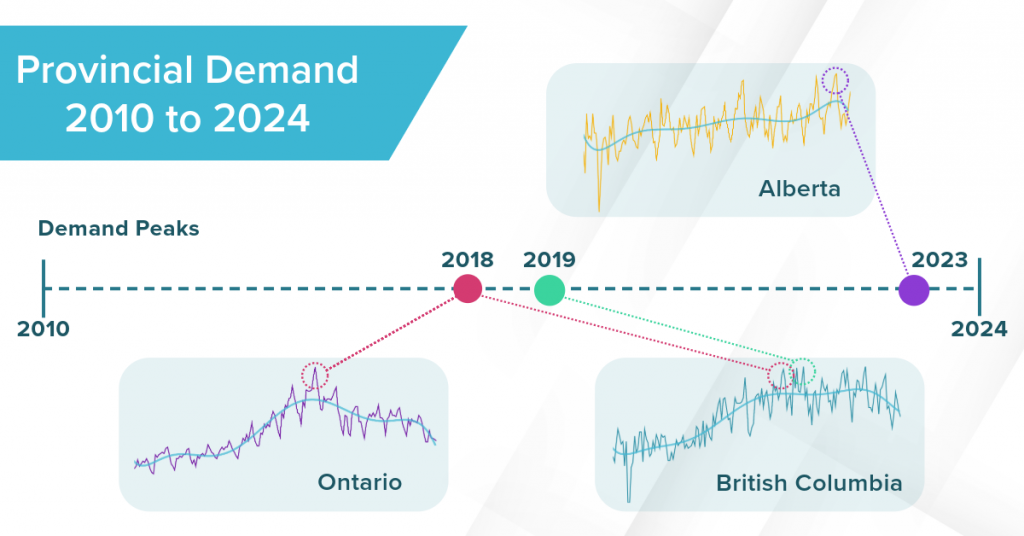
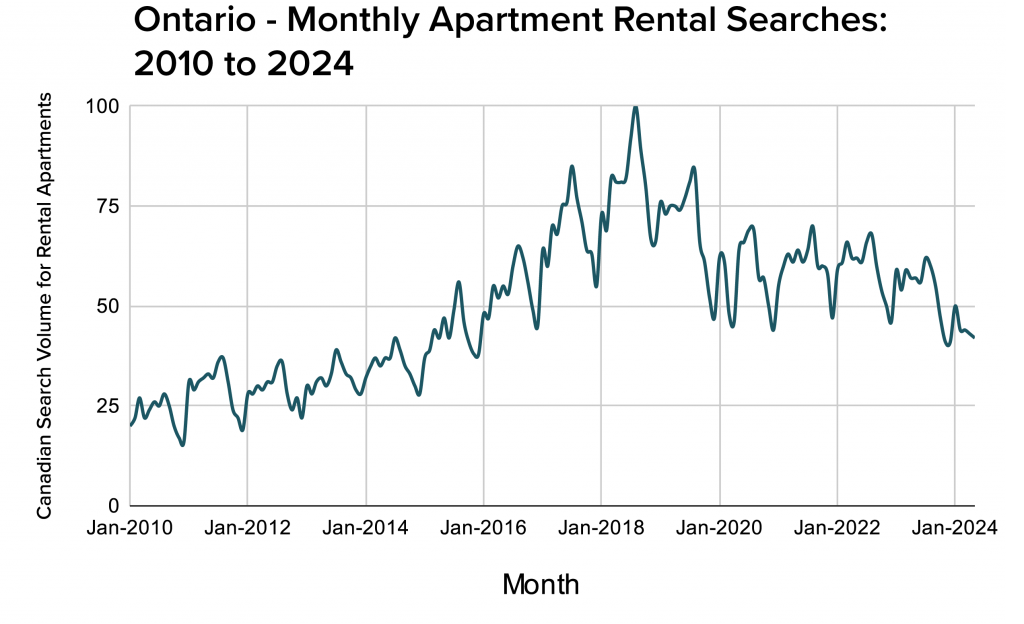
Ontario experienced its peak rental activity in September 2018, aligning with peak national demand. Moreover, Ontario showcases a distinctive pattern in rental searches among all provinces, characterized by a gradual increase from 2010 to 2015, followed by an acceleration between 2015 and 2018, and a consistent decline thereafter.
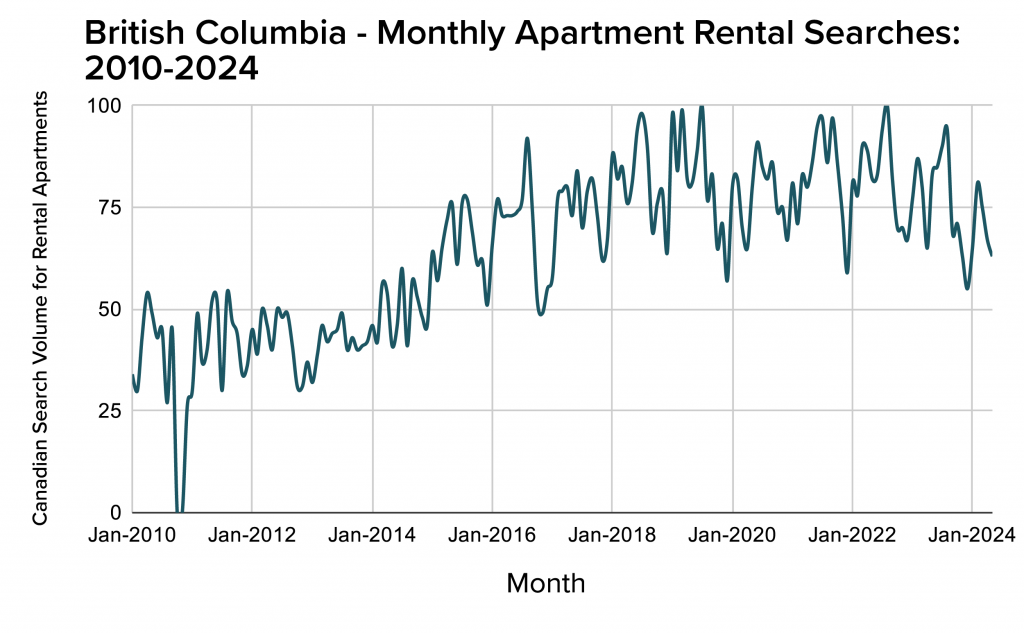
British Columbia shares a similar pattern to that of Ontario, with peak online rental activity and demand in July 2019 and July 2018. As of right now, British Columbia’s rental search activity has declined by over 30% to the demand levels we were seeing in 2015.
The uniqueness in Alberta can be attributed to the large number of Canadians moving to the province for well-paying jobs, but also the increase in the number of Canadians in search of more affordable housing. Markets with a lower relative cost of living have maintained stronger demand fundamentals and, as such, have sustained a more robust demand trajectory post-COVID. These markets can continue attracting an influx of new renters, which sustains strong rental demand. This strong demand has driven down the supply of available units, and as a result, continues to drive market rents up as more people compete for a finite supply of available units.
International Demand
Beyond Canada’s borders, international rental demand tells a compelling story of its own. International interest in Canadian rentals continued to grow through the mid-2000s, though that trend did not last, and began a steady decline.
Despite pockets of growth in select markets, international demand was trending downwards, even in the face of increasing Canadian immigration, we saw global demand decline.
Two of the largest single source countries of international traffic for Canadian rentals are the US, which is Canada’s most proximate neighbour, and India, which is the most common country of birth for foreign-born Canadians.
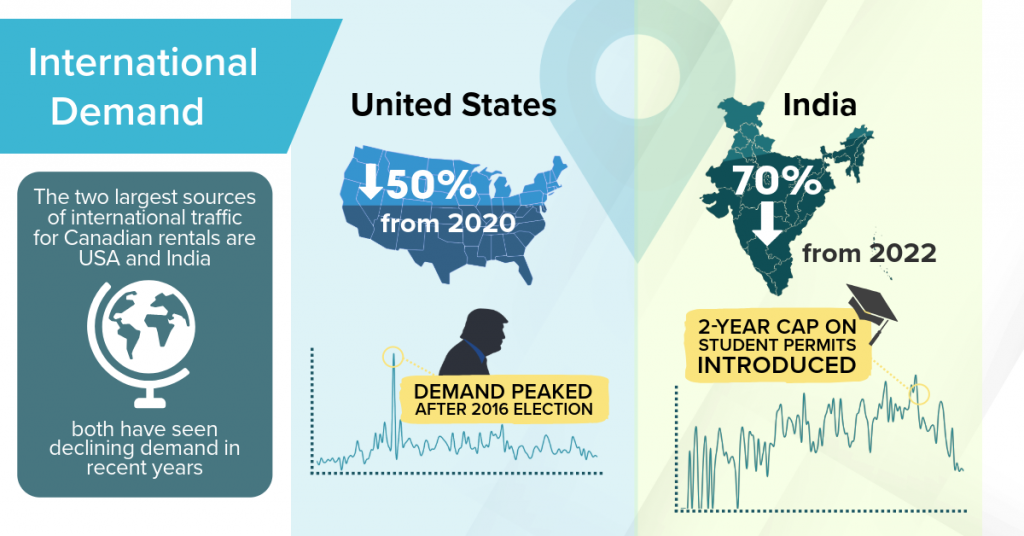
US demand peaked in November 2016 coinciding with Trump winning the 2016 presidential election. In November of 2016, US demand more than doubled, with levels quickly subsiding by the start of the new year.
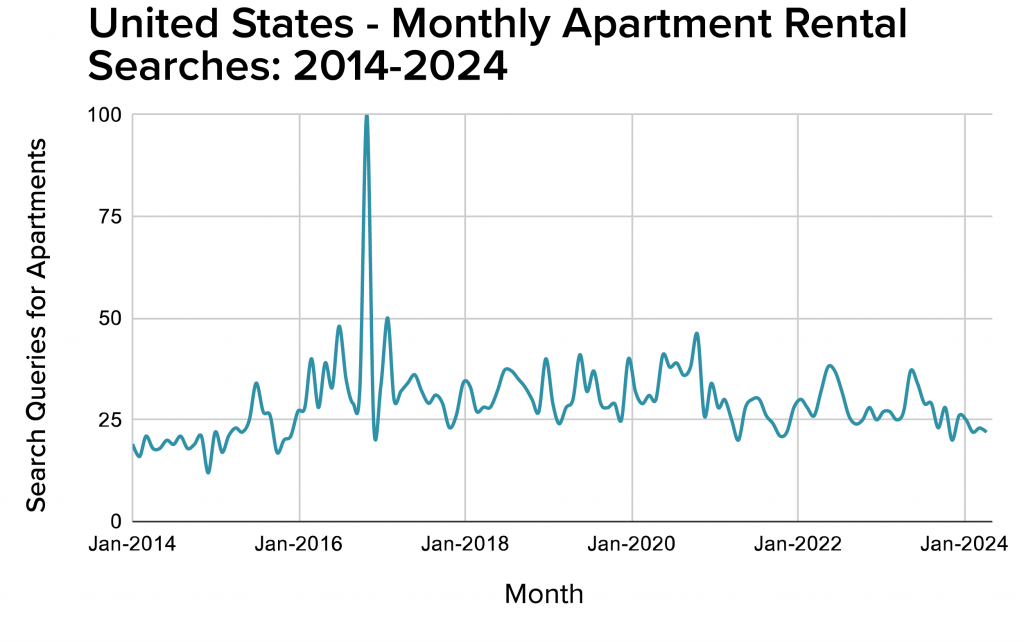
Since 2016, overall demand has returned to previous levels, albeit with a slight increase leading up to 2020, followed by a downward trend 2021 onwards. Currently, US demand is on par with 2014, down by 50% from just four years ago in 2020.
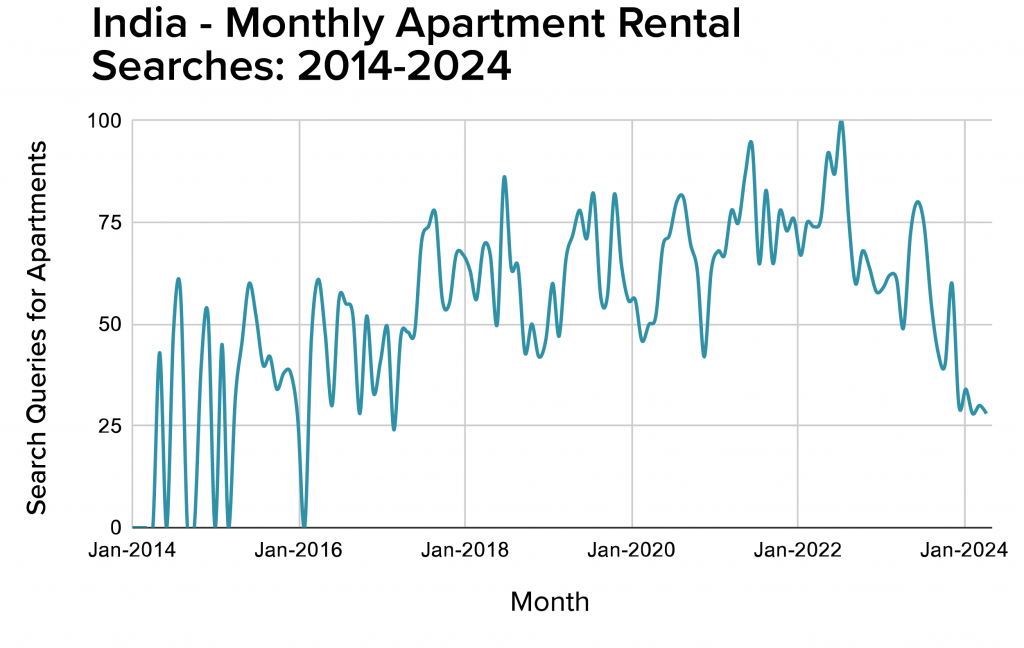
Rental interest from India significantly increased in early 2014, maintaining strong momentum until 2018 when it stabilized somewhat. The peak of this activity occurred in August 2022 and July 2021. However, since then, rental demand from India has declined by 70%, reverting to levels similar to the initial growth period before 2018. With the recently announced 2-year cap on student permits in January of 2024, we do expect internal interest in Canada to remain somewhat mild as the government looks to improve levels of housing supply.
Conclusions
After the 1970s decline of rental construction, Canadian rental demand remained relatively dormant for almost 40 years, before beginning to show signs of regained momentum in the mid-2000s. Moving through the late 2000s and early teens, interest in the rental market continued to pick up steam, peaking in July 2018. That peak coincided with growing rents, and tightening vacancy rates. Since then, we saw the pandemic usher in a momentary decline of rentals in primary markets, followed post-pandemic by a regained demand for rentals across the country, and a subsequent decline in rental activity once the pandemic era unmet demand was reabsorbed.
This latest decline, which has been ongoing since 2022, has shown itself through reduced turnover, increased vacancy rates in new construction, and greater interprovincial migration pushing households to search for affordability elsewhere. While demand dropped in 2023, the supply of rentals was down even more which resulted in an imbalance of supply and demand fundamentals and allowed for the rental market as a whole to remain a “sellers market”. 2024 has seen a further complication with supply rebounding thanks in part to new condominiums entering the market while demand continues its downward spiral leaving property owners in a tighter position relative to last year.
Rental searches nationally are down 8% year over year and down 11% when compared to 2022. While not all provinces are affected equally, this nonetheless impacts housing providers. British Columbia and Ontario, which represent the highest rent markets in Canada, have experienced the highest rates of decline. Even provinces that offer greater affordability are not immune. The increase in migration between provinces nationwide has exported affordability issues around the country, rendering these markets more susceptible to similar issues as those seen in BC and Ontario. This includes concerns regarding security, price fatigue, and consequently, a decreased willingness to relocate.
In conclusion, Canada’s housing market has undergone significant shifts in recent years, with rental demand experiencing peaks and valleys influenced by various factors such as population growth, economic conditions, and government policies. As Canada grapples with these challenges, policymakers and stakeholders must work together to address the root causes of the housing crisis and ensure sustainable solutions for the future. Rentals.ca will continue to monitor and report on rental demand trends across Canada.

Rentals.ca is Canada’s premier online marketplace for renters and landlords, providing a comprehensive suite of tools and resources tailored to simplify the rental process. With an extensive selection of listings across the country, Rentals.ca offers user-friendly search functionality that helps renters find their perfect home efficiently. For landlords, Rentals.ca delivers effective advertising solutions to maximize visibility and fill vacancies faster. Committed to innovation and excellence, Rentals.ca aims to empower users with up-to-date market insights and expert guidance, making renting easier and more accessible for everyone.